

Menu
Shopping Cart
Close

Pop Up Banner Sizes and Dimensions: Choosing the Right Fit

Two banners can carry the same message, yet one pulls crowds while the other disappears into the background. The difference is rarely the logo; it is almost always the size, proportions and placement in the space.

Choosing the correct pop up banner size affects how far your message can be read, how easily people navigate your stand and how quickly your team can set up. When pop up banner dimensions are matched to venue height limits, traffic flow and viewing distance, even modest graphics can outperform bigger, badly sized displays.

Many teams order on autopilot, picking the cheapest template or a familiar width without checking sightlines, ceiling heights or transport constraints. That often leads to cropped logos, unreadable bullet points and awkward cases that will not fit in smaller cars. A little planning around banner dimensions typically saves reprints and maximises return on every event booking.

This guide compares common sizes for pop up stand banners and pop up roller banners, showing how each format behaves in real venues. You will see how height, width and aspect ratio influence visibility, portability and cost, so you can brief designers accurately and order print once, not twice.

1
pop up banner size

Standard Pop Up Banner Size Options Explained

Standard Pop Up Banner Size Options Explained

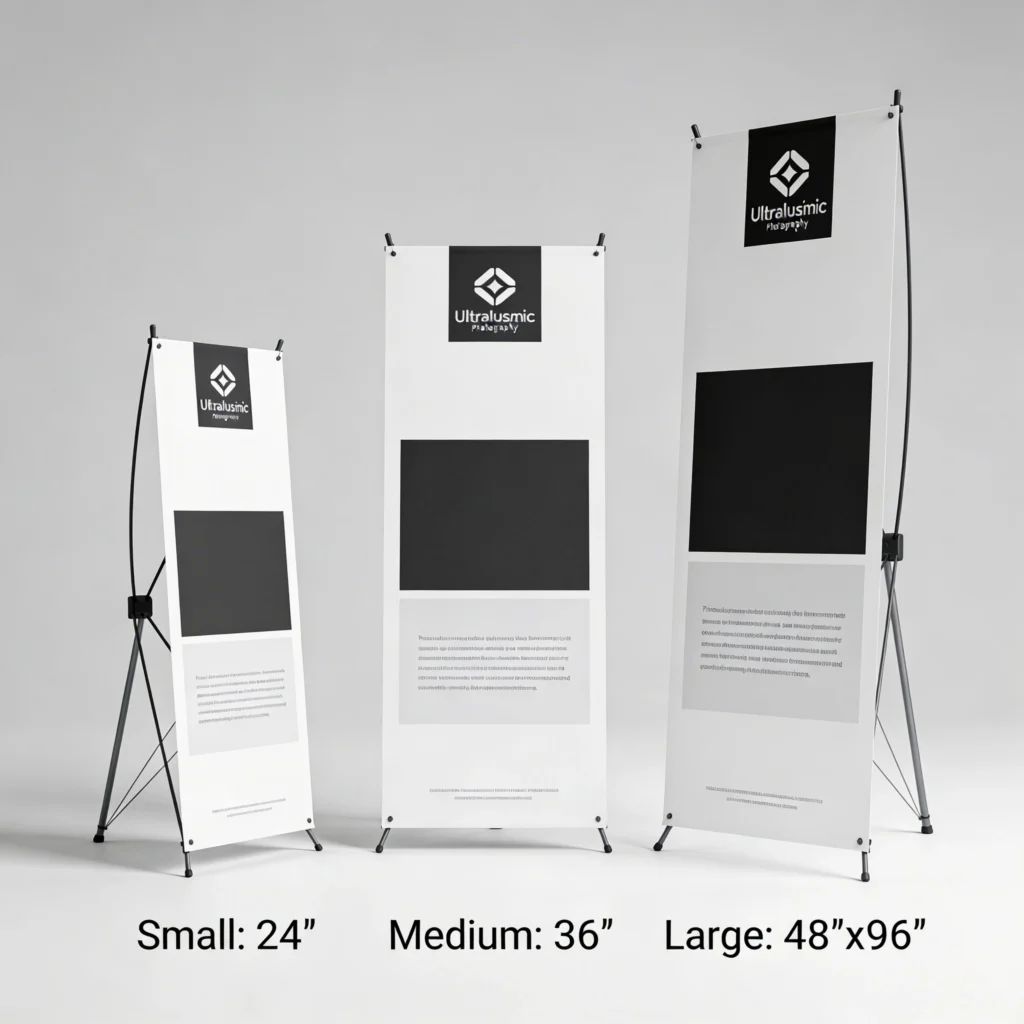
Standard pop up banner sizes usually fall into small, medium and large formats, each with typical width and height ratios. Seeing these options side by side makes it easier to judge how much content they can comfortably hold, and which dimensions are most practical for your transport, storage and event schedule.

Most printers in the UK and Europe offer a similar core range of pop up banner size options, even if product names differ. Understanding these typical widths and heights lets you compare quotes accurately instead of guessing from marketing labels like “premium” or “wide”. Dimensions also determine how much copy you can include before layouts feel cramped or visually unbalanced.

Common Roller and Cassette Banner Dimensions

Entry-level pop up roller banners usually start around 800mm wide by 2000mm high, giving a tall, narrow format that suits single-column layouts. Mid-range systems commonly step up to 850mm or 1000mm widths with heights between 2000mm and 2150mm, which allows bolder headlines and side imagery. Extra-wide options can reach 1200mm or 1500mm, creating near-backdrop coverage for compact stands.

Curved, Fabric and Modular Pop Up Stand Banner Sizes

Pop up stand banners using magnetic frames or tensioned fabric often work in panel modules, such as three or four panels each 730mm wide by 2225mm high. A three-by-three curved system might span roughly 2700mm, while a four-by-three reaches around 3070mm. Fabric walls can stretch to 6000mm widths, but still pack into wheeled cases shorter than 1m for easier vehicle loading.

2
pop up banner dimensions

How Pop Up Banner Dimensions Affect Visibility and Readability

Visibility is not only about making banners taller; the relationship between viewing distance, letter height and banner proportions controls how quickly people grasp your message. A well-chosen pop up banner size ensures that key text remains legible from typical aisle distances, usually 2–6 metres at trade shows and 1–3 metres in smaller retail or reception spaces.

How Pop Up Banner Dimensions Affect Visibility and Readability

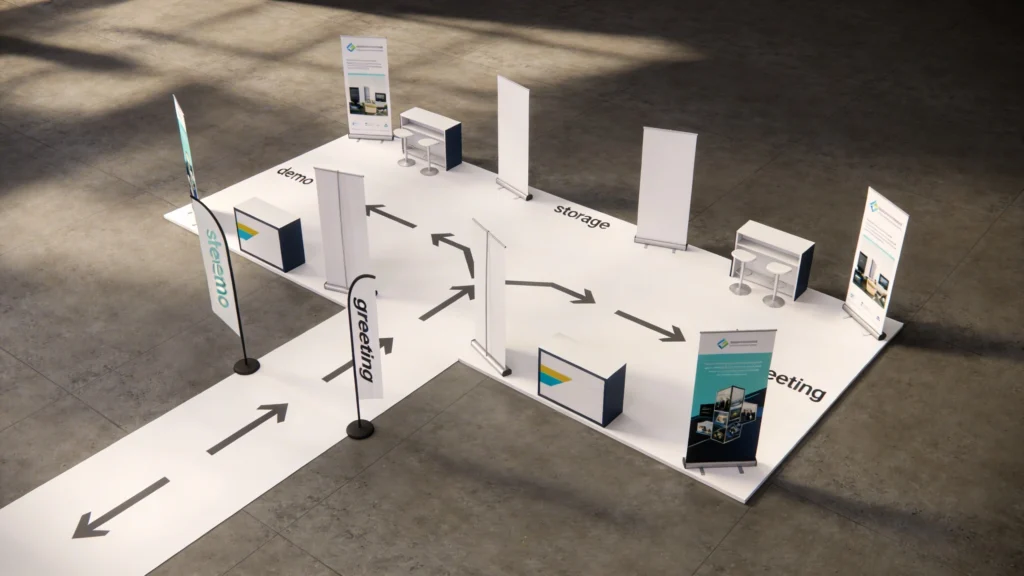
Thinking about traffic flow before choosing dimensions helps you position banners where they guide visitors rather than block them. A simple floor plan can reveal where tall banners create strong sightlines from aisles, and where shorter or narrower units are safer near corners, entrances and high-traffic walkways.

Reading Distance, Letter Height and Aspect Ratio

Designers often use a rough rule that each 25mm of letter height is readable from 2–3 metres away, assuming high contrast and simple fonts. On a 2000mm-high banner, that means a 120mm headline can be read from around 10–12 metres, while 40mm body copy suits 3–4 metres. Taller banners give more vertical room to separate hierarchy, reducing visual clutter around key selling points.

For fast-moving traffic, prioritise a single headline readable at double your expected viewing distance; supporting details can remain smaller for closer inspection once people stop.

Balancing Width, Content Density and Eye Movement

Width influences how far the eye must travel to scan information, which is crucial in busy aisles where visitors glance for only two or three seconds. A narrow 800mm pop up roller banner forces vertical stacking, so bullet lists should stay short to avoid dense text blocks. Wider 1000–1200mm formats support side-by-side messaging and images, helping separate offers, logos and calls-to-action more clearly.

3

Comparing Small vs Large Pop Up Banner Size for Different Spaces

Compact banners and extra-wide systems each solve different spatial problems; neither is automatically better. The right pop up banner size depends on stand footprint, ceiling height and whether you compete directly with neighbouring exhibitors. Comparing small, mid-size and large options side-by-side reveals where extra surface area genuinely adds value rather than simply increasing print costs.

Comparing Small vs Large Pop Up Banner Size for Different Spaces

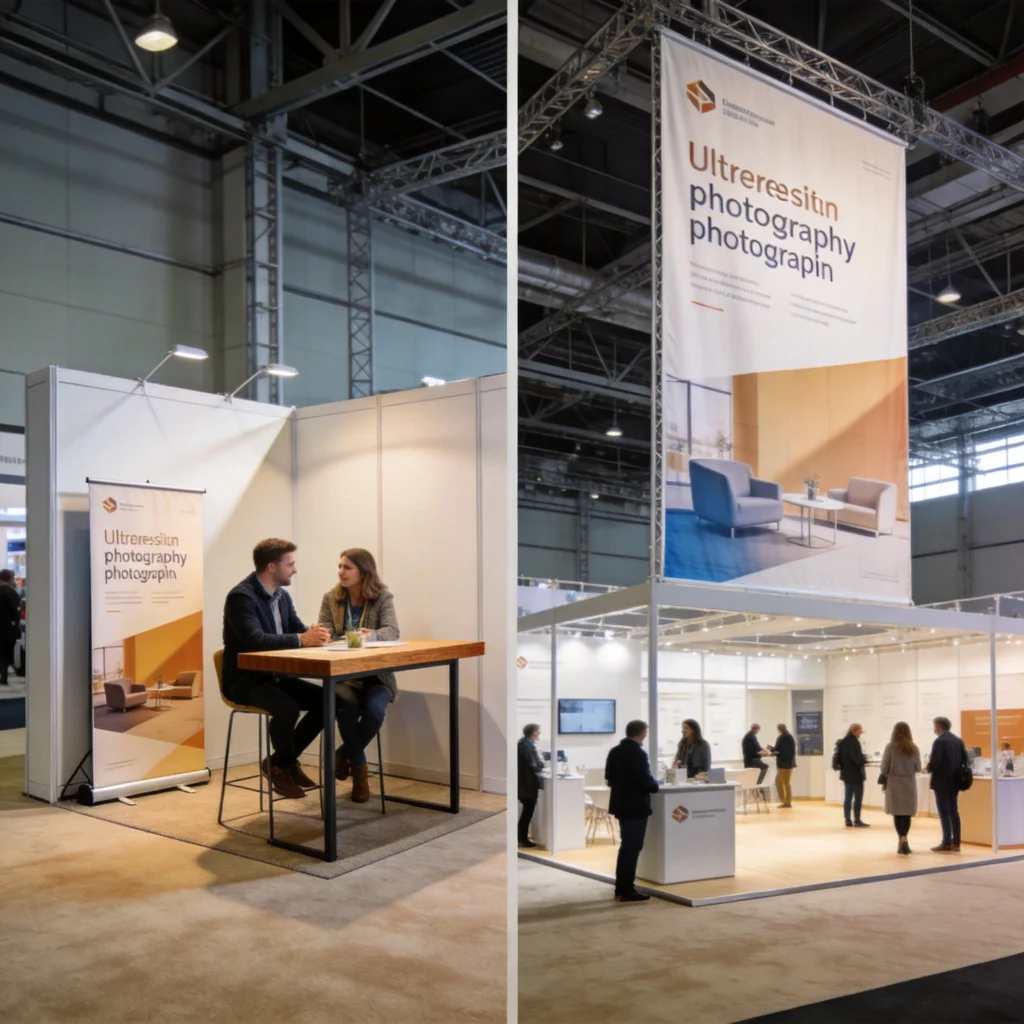
Small banners suit tight spaces where visitors stand close, such as shell schemes or small networking events. Larger formats work better in open halls where you need to catch attention from a distance. Matching banner footprint to stand size prevents clutter, reduces trip hazards and keeps your layout feeling intentional.

Size Comparison by Use Case

The table below contrasts typical small, mid-size and large pop up stand banner formats, focusing on footprint, visual impact and practical deployment. Dimensions are representative of common UK products, such as 800mm economy roller banners, 1000mm premium units and 3m-wide curved pop up stands. Use these as a baseline when reviewing supplier datasheets and checking venue technical manuals.

Banner Category Typical Dimensions (W×H) Recommended Stand Size Viewing Distance Range Typical Use
Compact Roller 800mm × 2000mm 1m–2m wide shell scheme 1–3 metres Reception areas, small retail promos, side-of-desk branding
Mid-Size Roller 1000mm × 2150mm 2m–3m wide trade stand 2–5 metres Core exhibition messaging, conference foyer displays
Extra-Wide Roller 1500mm × 2150mm 3m–4m open stand 3–6 metres Hero backdrop, product launch visuals, photo backdrops
Curved Pop Up 2700mm × 2225mm 3m shell scheme 3–7 metres Full backwall branding, multi-product storytelling
Fabric Wall 3000mm × 2300mm 3m–6m island stand 4–8 metres Immersive graphics, high-level brand presence

Smaller banners shine where floor space is sold by the square metre and every extra footprint reduces demo room. Larger backdrops suit island or corner positions where you are visible from several aisles and need consistent branding from multiple angles. Selecting two mid-size units instead of one oversized wall can also create flexible layouts for varying stand widths across your event calendar.

4

Matching Pop Up Banner Size to Event Types and Traffic Flow

Different event environments impose distinct constraints on pop up banner dimensions, from strict height limits at conference centres to wind exposure at outdoor shows. Mapping your calendar by venue type helps you choose a core set of banners that can be reused across multiple bookings, rather than commissioning one-off sizes for each individual event.

Matching Pop Up Banner Size to Event Types and Traffic Flow

Visibility and readability depend less on graphic flair and more on scale and distance. Larger banners allow for bigger headlines and fewer, clearer points that can be read from across a corridor. Poorly sized displays often cram in text that disappears once visitors are more than a few steps away.

Event Scenarios and Recommended Sizes

The table below links typical event types with practical banner formats, taking into account traffic direction, dwell time and ceiling height. While individual venues vary, these guidelines reflect common layouts at UK exhibition centres, hotel conference suites and retail concourses. Adjust widths and quantities according to your stand size and whether you share space with partners.

Event Type Suggested Banner Size Traffic Pattern Height Constraints Placement Strategy
Trade Exhibition 1000mm roller + 3m pop up wall Two-way aisle flow Typically 2.4m–4m Backwall branding plus side banner angled towards main aisle
Hotel Conference 800mm × 2000mm roller Linear corridor flow Often 2.3m–2.5m Place near registration desk and session entrances
Retail Promotion 850mm × 2000mm roller Multi-directional shoppers Low signage clutter Position beside demo table, avoid blocking product shelves
Outdoor Event 1000mm outdoor-rated banner Irregular footpaths Open sky Anchor near tent entrance, angle slightly into prevailing approach
Careers Fair 1000mm × 2150mm roller Dense aisle clusters 2.4m–3m Use one banner front-facing, another side-on to cross aisles

Outdoor events demand heavier bases or ground stakes, which can slightly reduce visible graphic height once hardware is assembled. Conferences typically favour slimmer pop up stand banners that do not obstruct fire exits or buffet lines. For multi-aisle exhibitions, consider one tall hero piece plus a shorter banner highlighting offers at eye level where queues naturally form.

5

Designing Artwork to the Correct Pop Up Banner Dimensions

Once you have chosen a pop up banner size, artwork must be built precisely to the printer’s template to avoid clipped logos or misaligned cassette edges. Every system has defined live area, safe zone and bleed requirements, often varying by 3–5mm between models. Ignoring these technical margins can cause expensive reprints if crucial text falls outside visible panels.

Designing Artwork to the Correct Pop Up Banner Dimensions

Safe Area, Bleed and Resolution Guidelines

Most roller banners require 3mm bleed on all sides and an additional 100mm at the bottom for cassette wind-on, which disappears inside the base. Designers should keep key text at least 50mm from top and side edges on a 2000mm-high layout to allow for trimming tolerances. Artwork should be supplied at 150–200dpi at full size, balancing file weight and print sharpness.

  • Request the exact template PDF or Illustrator file from your printer before starting any layout work.
  • Set document size to full visible area plus bleed, not just the nominal width and height listed online.
  • Keep body text above 30–35pt on 800mm banners, increasing to 40–45pt for wider 1000mm systems.
  • Place logos within the top third, centred or aligned, avoiding cassette join lines or pole shadows.

Aligning Multiple Pop Up Stand Banners

When using two or more pop up stand banners side-by-side, treat them as a single panoramic canvas. Align horizon lines, background colours and key imagery so visual breaks occur only in low-detail areas. Leave at least 20–30mm of shared background overlap between designs to disguise minor spacing differences when stands are positioned slightly apart on uneven floors.

6

Portability, Storage and Transport Considerations by Pop Up Banner Size

Portability, Storage and Transport Considerations by Pop Up Banner Size

Portability often becomes the decisive factor when marketing teams travel by train or share small pool cars. Larger pop up banner dimensions increase weight and case length, which affects whether one person can carry the unit safely and how many fit alongside luggage. Planning around real transport scenarios prevents last-minute compromises, such as leaving key graphics behind.

Weight, Case Size and Handling

An economy 800mm pop up roller banner typically weighs 3–4kg and packs into a soft or semi-rigid case around 850mm long. Premium 1000mm units can reach 6–8kg with heavier cassettes, while 3m-wide pop up stand systems often exceed 18–20kg including frame and lights. Airline cabin baggage limits rarely accommodate full-size banners, so checked luggage or courier shipping is usually required.

  • Measure your car boot opening; some 1.2m cases fit diagonally only, limiting passenger and equipment space.
  • For rail travel, choose banners under 6kg with shoulder straps, leaving one hand free for laptops.
  • Store banners upright in dry rooms; moisture can warp graphics and promote adhesive failure over months.
  • Label cases clearly by size and message so staff select appropriate graphics quickly before early departures.

Storage Footprint and Multi-Venue Use

Each additional large pop up stand banner consumes around 0.1–0.15m² of floor space in storerooms once cases are stacked. Smaller 800mm units can be nested on shelving, allowing ten or more banners in a single 1m-wide bay. Designing a modular set of two compact and one mid-size banner often covers most venues while keeping storage costs and manual handling risks manageable.

7

Cost Implications of Different Pop Up Banner Size Options

Print budgets rarely stretch indefinitely, so understanding how pop up banner size affects unit price helps prioritise investment. Costs rise with hardware quality, graphic area and finishing complexity, but not always linearly. Sometimes upgrading from a narrow economy unit to a mid-size premium banner adds only 20–30% cost while significantly boosting impact and durability across multiple event seasons.

Cost Implications of Different Pop Up Banner Size Options

Typical Price Ranges by Size

UK online printers often advertise 800mm economy roller banners from around £35–£45 including printed graphics, while 1000mm premium versions can range between £80 and £120. Curved 3×3 pop up stand kits with case and lights typically fall between £450 and £650. Fabric walls and higher-end modular systems may reach £900–£1,500 depending on width, hardware brand and replacement graphic policies.

  • Compare cost per square metre of visible area to judge value, not just headline banner prices.
  • Ask whether replacement graphics alone can be ordered later, reducing future refresh costs significantly.
  • Balance one large backdrop with two smaller pop up roller banners to create varied layouts cost-effectively.
  • Allocate 10–15% of overall event budget to signage, ensuring banners match stand fees and travel spend.

Maximising Lifetime Value

Design evergreen core messaging that survives at least 18–24 months of events, avoiding dated offers or specific show names on main banners. Use clip-on panels, A4 holders or digital screens for time-sensitive promotions instead of reprinting large graphics. Tracking leads or sales per banner size over several events reveals which formats consistently earn their keep and deserve future upgrades.

Cart