Extra Sale 10% off

Menu
Shopping Cart
Close

Roller Banner Stands: Comparison of UK Display Options

Your printed graphic can be flawless, but if the roller mechanism jams or the base tilts, visitors remember the failure, not the message. Choosing robust roller banner stands is therefore as critical as colour accuracy or design. Hardware decisions directly influence reliability, perceived professionalism and how confidently staff use displays under pressure.

Roller banner stands act as both frame and protection for your printed panel, so weaknesses quickly show during transport or repeated use. In the UK market, prices range from about £25 for basic models to over £200 for premium cassette systems. Understanding how construction, mechanism design and width options differ helps you invest where it truly affects longevity.

Many buyers focus on artwork size and turnaround time, then simply tick the cheapest hardware option. That approach often leads to curled edges, leaning poles or cassette failures after only three or four events. Analysing stand type, weight, foot design and pole configuration before ordering prevents emergency replacements and wasted print costs later.

Beyond basic function, hardware choices also shape brand perception at exhibitions or in retail. A slim, stable base with clean anodised aluminium finish subtly signals quality, whereas dented, rattling housings look budget, even with premium graphics. Comparing standard and wide roller banner options side by side clarifies where higher specification stands justify the extra initial spend.

1
roller banner stands

Types of Roller Banner Stands Available in the UK

Types of Roller Banner Stands Available in the UK

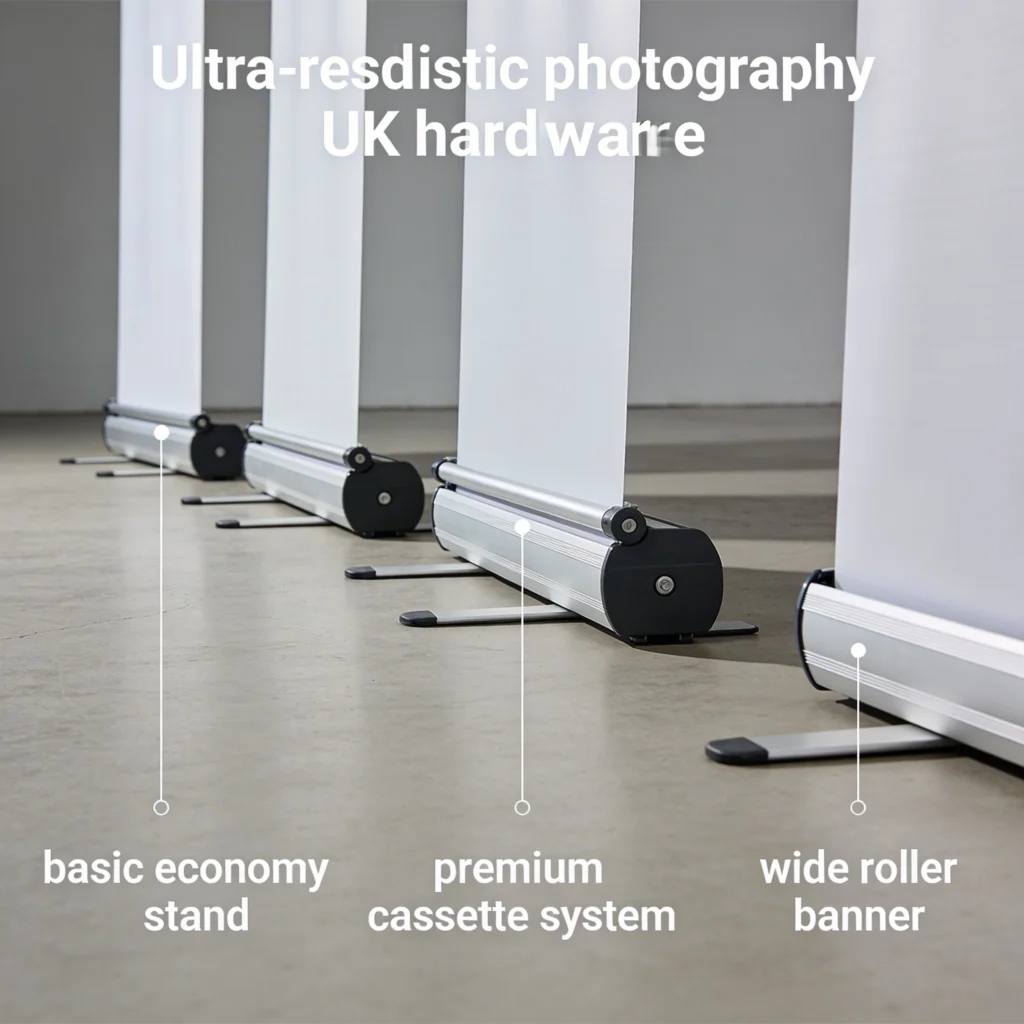
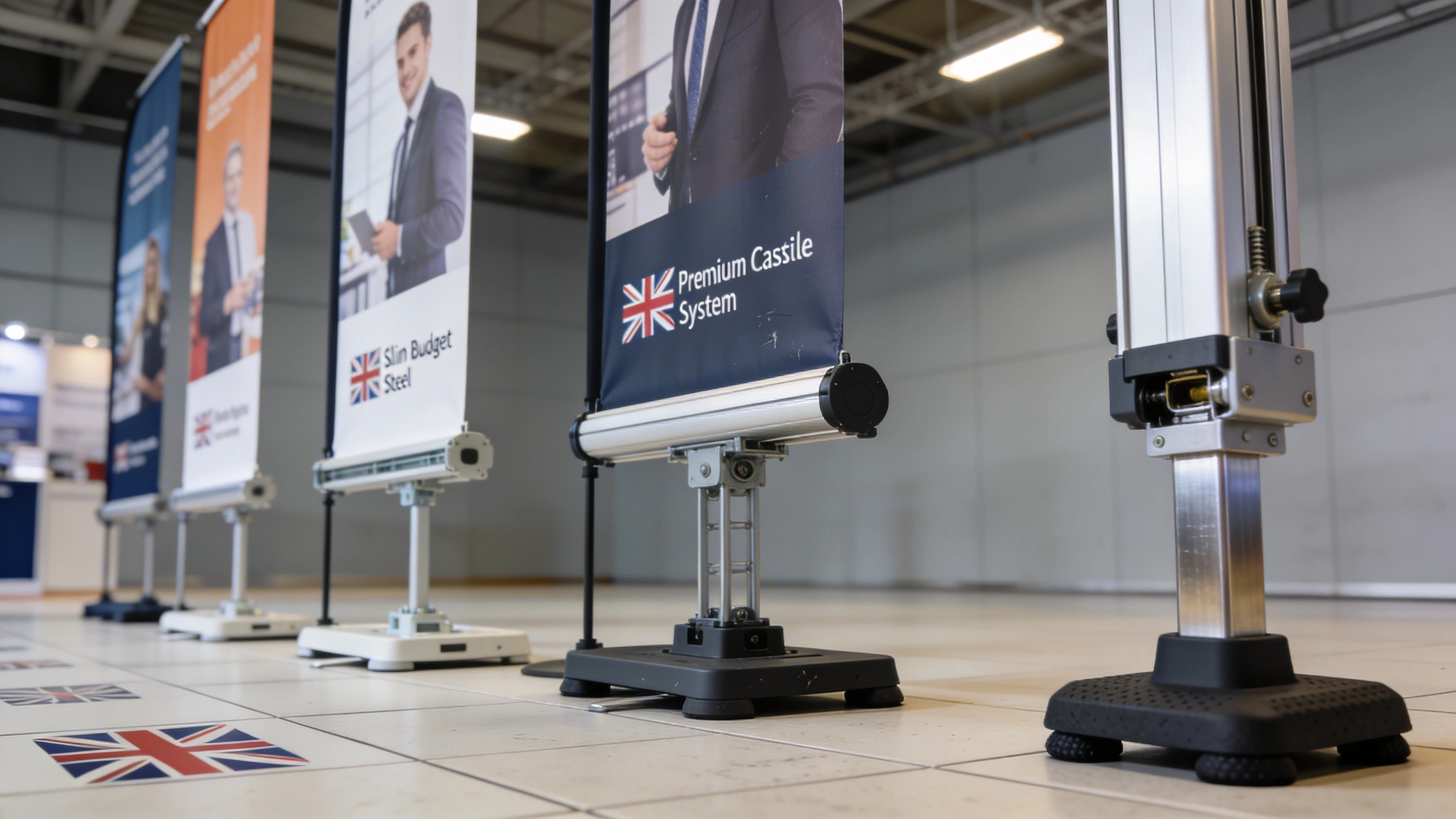
When comparing types of roller banner stands available in the UK, it helps to see how economy, standard and premium cassette systems differ in footprint and finish. Basic models may suit short campaigns, while better-engineered units with stronger bases and smoother mechanisms are more appropriate for regular exhibitions and long-term brand use.

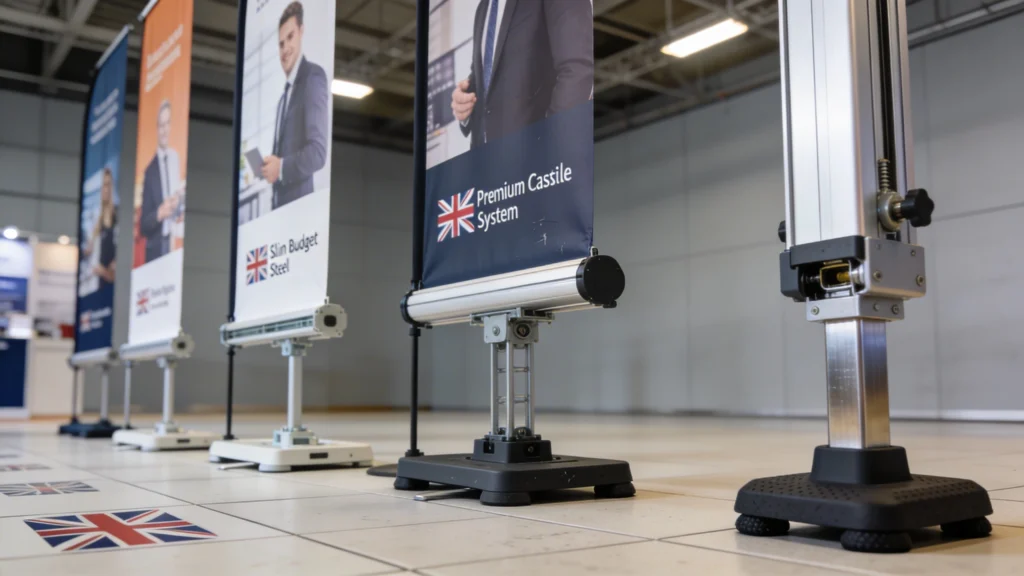
UK suppliers typically group roller banner stands into three or four tiers, each aimed at different usage frequencies and budgets. At the entry level, lightweight economy stands use thinner aluminium extrusions and simpler spring mechanisms, ideal for one-off promotions. Mid-range models strengthen the base and pole system, while premium cassette stands prioritise long-term reuse and effortless graphic changes.

Economy, Standard and Premium Tiers

Economy roller banner stands around 800–850mm wide usually cost £25–£45 including print, using 0.3mm–0.4mm aluminium housings. Standard ranges step up to 850–1000mm widths at £60–£90, with thicker 0.6mm housings and more stable feet. Premium cassette stands often start near £130 and reach £220, adding reinforced end caps, better bearings and lifetime hardware warranties.

Single-Sided, Double-Sided and Cassette Systems

Single-sided stands dominate roller banner UK sales because they face aisles or walls, while double-sided units support traffic from both directions in open spaces. Double-sided bases are deeper and heavier, typically 6–8kg versus 3–5kg for single-sided. Cassette systems allow graphics to be swapped in under five minutes, avoiding re-buying full hardware when campaigns change quarterly.

2

Comparing Roller Banner Stands by Build Quality and Durability

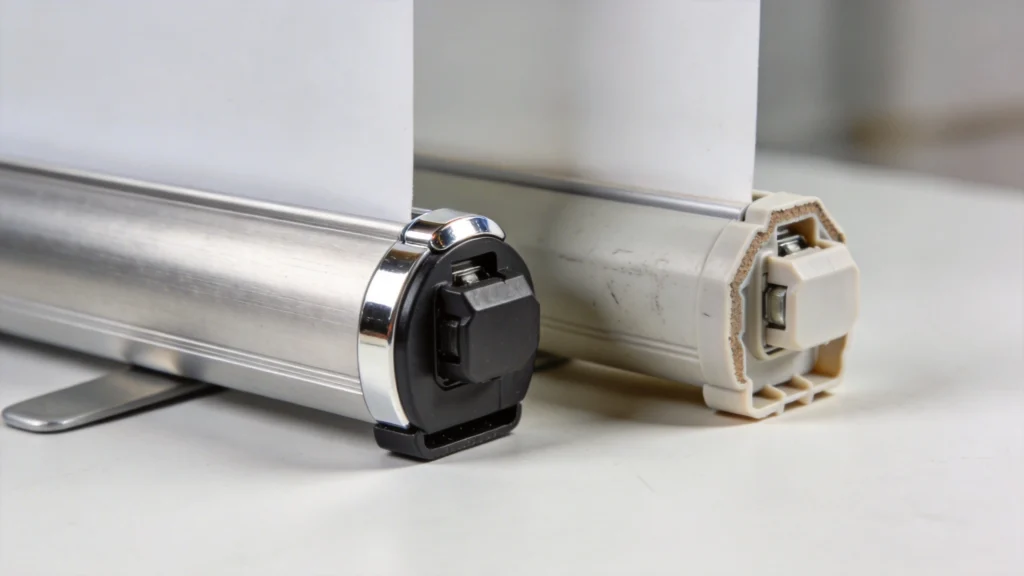
Build quality in roller banner stands is mainly governed by aluminium thickness, internal spring design and how securely the top rail grips the graphic. Cheaper housings flex when lifted, stressing the spring and causing uneven tension over time. Higher-grade units feel denser, with smoother retraction that reduces shock loading on the printed panel edges.

Comparing Roller Banner Stands by Build Quality and Durability

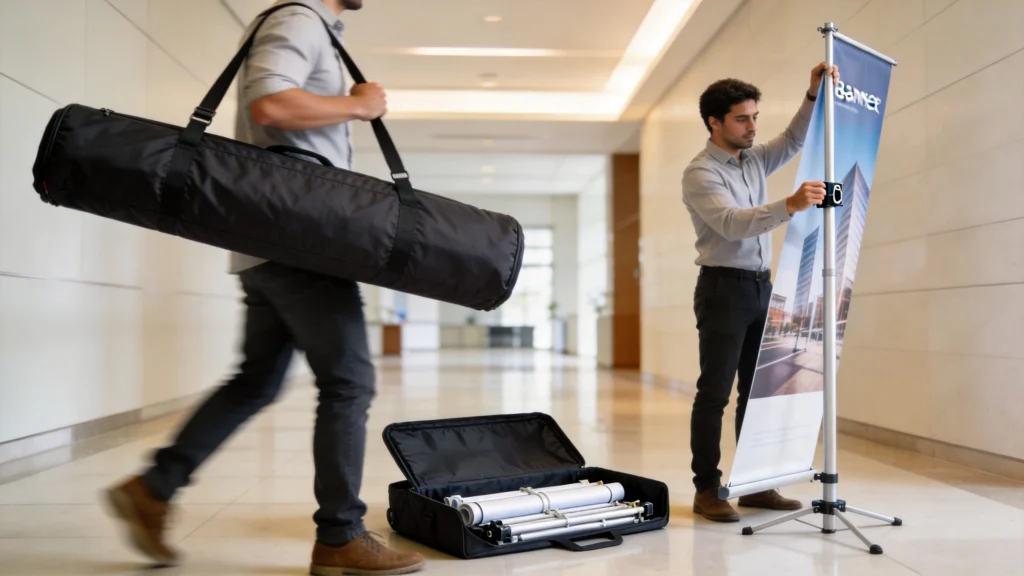
Portability is crucial for teams travelling between UK venues, so many choose roller banner stands that pack into lightweight padded bags. Simple, tool-free assembly allows staff to arrive, set up and dismantle quickly without specialist training, reducing stress and minimising the chance of damaging the roller mechanism or printed panel.

Materials, Mechanisms and Stability Features

Entry-level stands often use 0.3mm aluminium with plastic end caps, making dents and warping more likely after courier transit. Mid-range models move to 0.6mm aluminium and metal end caps, plus thicker bungee poles to resist bending. Premium stands add precision springs, sealed bearings and adjustable feet, so they remain level on uneven exhibition carpets.

When comparing durability, lift the stand by one end: any twisting or rattling signals weak extrusion or loose components. A solid, non-flexing base and firm pole socket typically survive dozens of setups, protecting both the mechanism and your print from misalignment and edge damage.

Graphic Protection and Long-Term Use

Durability is not only about the metal; it also concerns how the stand protects graphics between events. Deeper bases keep the printed roll further from impact, while full-length metal top rails distribute tension evenly along the 800–1000mm width. Over two to three years, these details prevent fraying corners and creases that make panels look prematurely tired.

3
wide roller banner

Roller Banner Stands vs Wide Roller Banner Hardware

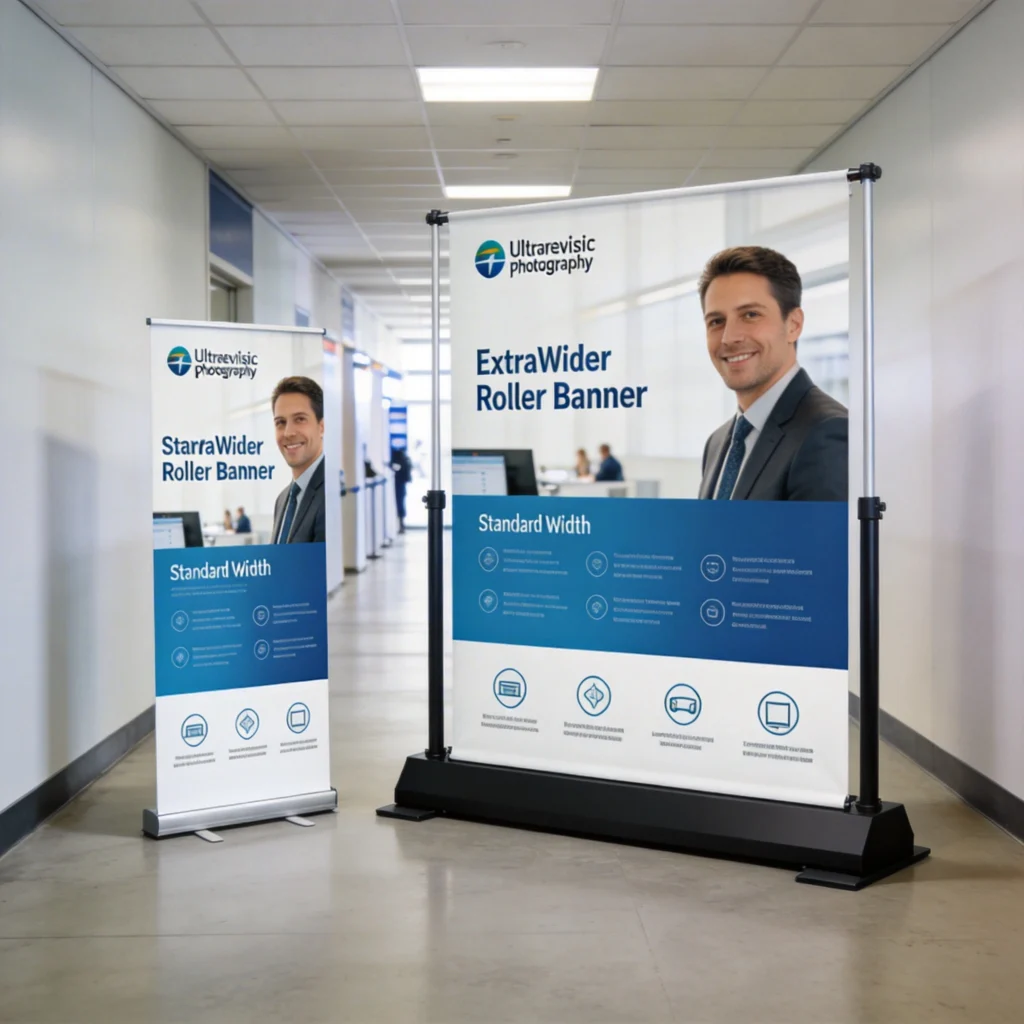
Standard roller banner stands in the UK typically range from 800mm to 1000mm wide, suiting most shell-scheme exhibition spaces and small retail entrances. Wide roller banner hardware stretches this concept to 1200mm, 1500mm or even 2000mm widths, creating near-back-wall coverage. Scaling up width demands heavier bases, thicker poles and often twin support feet for stability.

Roller Banner Stands vs Wide Roller Banner Hardware

Wide roller banner hardware offers a stronger visual presence than standard units, creating a near-backdrop effect for presentations or product demos. However, the increased width demands heavier bases and sturdier support poles, so it is vital to balance impact with practicality and ensure the mechanism can cope with the larger graphic panel.

Size and Stability Differences

Once you exceed 1000mm width, the centre of gravity shifts, so base weight must increase from about 3–5kg to 7–12kg. Wide roller banner systems frequently use twin or telescopic poles to prevent visible bowing along the top rail. Some 2000mm-wide models incorporate two cassettes side by side, reducing strain on a single internal spring mechanism.

Width (mm) Typical Height (mm) Approx. Weight (kg) Use Case
800 2000 3.0–3.5 Reception areas, small pop-up promotions, narrow retail aisles
850 2000 3.5–4.5 Standard exhibition shell schemes, conference backdrops
1000 2000–2150 4.5–6.0 Open exhibition spaces needing stronger visual impact
1200 2150 7.0–9.0 Wide roller banner backdrops for photo areas or demo zones
1500–2000 2150 9.0–12.0 Large event stages, portable media walls, product launches

Choosing between standard and wide roller banner hardware depends on how much uninterrupted graphic area you need versus how often you’ll transport it. A 1200mm-wide stand can replace two 800mm units, simplifying setup but increasing weight. For teams travelling alone by train, two standard stands may prove more manageable than one very wide, heavier unit.

4

Portability and Ease of Use of Different Roller Banner Stands

Portability becomes crucial once stands are moved between offices, cars and venues weekly. Roller banner stands may weigh only 3–4kg individually, but carrying three or four plus literature quickly adds up. UK suppliers usually include padded carry bags with shoulder straps, yet differences in zip quality, padding thickness and handle stitching affect real-world usability.

Portability and Ease of Use of Different Roller Banner Stands

Build quality becomes obvious once banner stands are used repeatedly. Thicker aluminium walls, solid end caps and well-engineered roller mechanisms resist dents, tilting and jamming during transport. Investing in robust hardware reduces the risk of failures at busy events, protecting both your printed graphics and your brand’s professional reputation.

Weight, Bags and Setup Time

Economy stands often keep total weight under 3.5kg by using thinner aluminium and lighter poles, reducing strain during long walks from car parks. However, their bags may use 300D fabric and single stitching, which can fray within a year. Better stands pair 600D bags, reinforced ends and smoother zips, surviving dozens of exhibition cycles without tearing.

  • Check total packed weight listed by suppliers; 3–4kg suits train travel, 7–9kg suits van-based event teams.
  • Look for padded ends on carry cases to protect the cassette corners from drops on stairs or pavements.
  • Test pole assembly time; bungee poles usually assemble in under 30 seconds compared with loose multi-part poles.
  • Prefer clip-on or snap-rail top bars that engage positively, avoiding fiddly Allen keys or loose end caps.
5

Choosing Roller Banner Stands for Exhibitions vs Retail

Exhibition environments are demanding: stands may be assembled at 7am, dismantled at 6pm and driven to another venue the same week. Retail placements, by contrast, often stay in position for months, exposed to customers brushing past. These differing conditions change which roller banner stands offer the best balance of durability, appearance and cost.

Choosing Roller Banner Stands for Exhibitions vs Retail

Exhibition-Focused Selection

For exhibitions, prioritise stands with heavier bases, robust pole sockets and reliable retraction, as they’ll be cycled repeatedly. Mid to premium ranges with 0.6mm housings, metal end caps and lifetime hardware guarantees reduce failure risk mid-event. Telescopic poles also help adjust height under low ceilings, especially in older UK venues with uneven structures.

When budgeting for exhibitions, assume each stand may be used at least 15–20 times over two years. Dividing a £150 premium stand by 20 uses equates to £7.50 per event, often cheaper long term than replacing a £40 economy stand after only four or five outings.

Retail and Semi-Permanent Use

Retail locations benefit from slimmer, more discreet bases that minimise trip hazards while still resisting accidental knocks from trolleys or bags. Double-sided roller banner UK models work well in shopping centre walkways where traffic flows from both directions. UV-stable, scratch-resistant overlaminates also matter in bright shopfronts, preventing graphics from fading or scuffing prematurely.

6

Compatibility of Roller Banner Stands with Standard Roller Banner Size Graphics

Compatibility of Roller Banner Stands with Standard Roller Banner Size Graphics

Most UK roller banner stands are designed around standard widths such as 800mm, 850mm and 1000mm, but graphic drop heights and visible areas vary. Ordering replacement prints without checking hardware specifications can leave you with artwork that either disappears into the cassette or leaves an exposed silver bar at the top.

Checking Sizes, Visible Areas and Leader Strips

Before printing, confirm three dimensions: total graphic height, visible height and the bottom area hidden inside the base, usually 100–150mm. Many wide roller banner systems require slightly thicker media, around 440–510gsm, to prevent edge curling at 1500–2000mm width. Matching the original leader strip width and fixing method avoids misalignment or skew when retracting.

  • Measure the existing panel with a tape measure rather than relying solely on old invoices or product names.
  • Photograph the top rail and bottom fixing so your printer can match clamp style and leader strip attachment.
  • Confirm whether the stand allows cassette access; sealed economy units may not support cost-effective re-skins.
  • Request a print template from your supplier, showing bleed, safe area and any non-visible lower section.
7

Cost Breakdown and Value for Money in Roller Banner Stands

Pricing for roller banner stands in the UK reflects hardware grade, print material and sometimes warranty length. Comparing only headline prices ignores lifetime cost, especially if you refresh graphics annually. Evaluating £ per use, plus the cost of potential failures during key events, reveals that mid-range and premium stands often deliver better value than the very cheapest options.

Cost Breakdown and Value for Money in Roller Banner Stands

Price Tiers and What You Gain

Economy kits around £25–£45 typically use 510gsm PVC or 300-micron polypropylene prints with basic springs and feet. Mid-range at £60–£90 often upgrades to anti-curl grey-back films and sturdier housings, improving appearance and straightness. Premium cassette systems from £130 upward justify their price through swappable cassettes, thicker aluminium and multi-year warranties.

Tier Typical Price (inc. print) Expected Uses Approx. Cost per Use
Economy £30–£40 3–6 events £5.00–£13.30
Mid-Range £60–£90 10–20 events £3.00–£9.00
Premium Cassette £130–£200 25–40 events £3.25–£8.00
Wide 1200mm £120–£180 10–20 events £6.00–£18.00
Wide 1500–2000mm £180–£260 10–20 events £9.00–£26.00

When considering value, factor in how often your messaging changes. If campaigns update quarterly, premium cassette stands let you swap graphics for £40–£70 each time instead of rebuying full kits. For static branding used occasionally, a solid mid-range stand balances professional appearance, manageable weight and sensible long-term cost without over-investing in advanced mechanisms.

Cart