
When it comes to roller banners, the undisputed king in the UK is the 850mm wide by 2000mm tall model. It's the industry standard for a very good reason: it hits that perfect sweet spot between grabbing attention and being easy to lug around, making it a brilliant all-rounder for almost any indoor event.
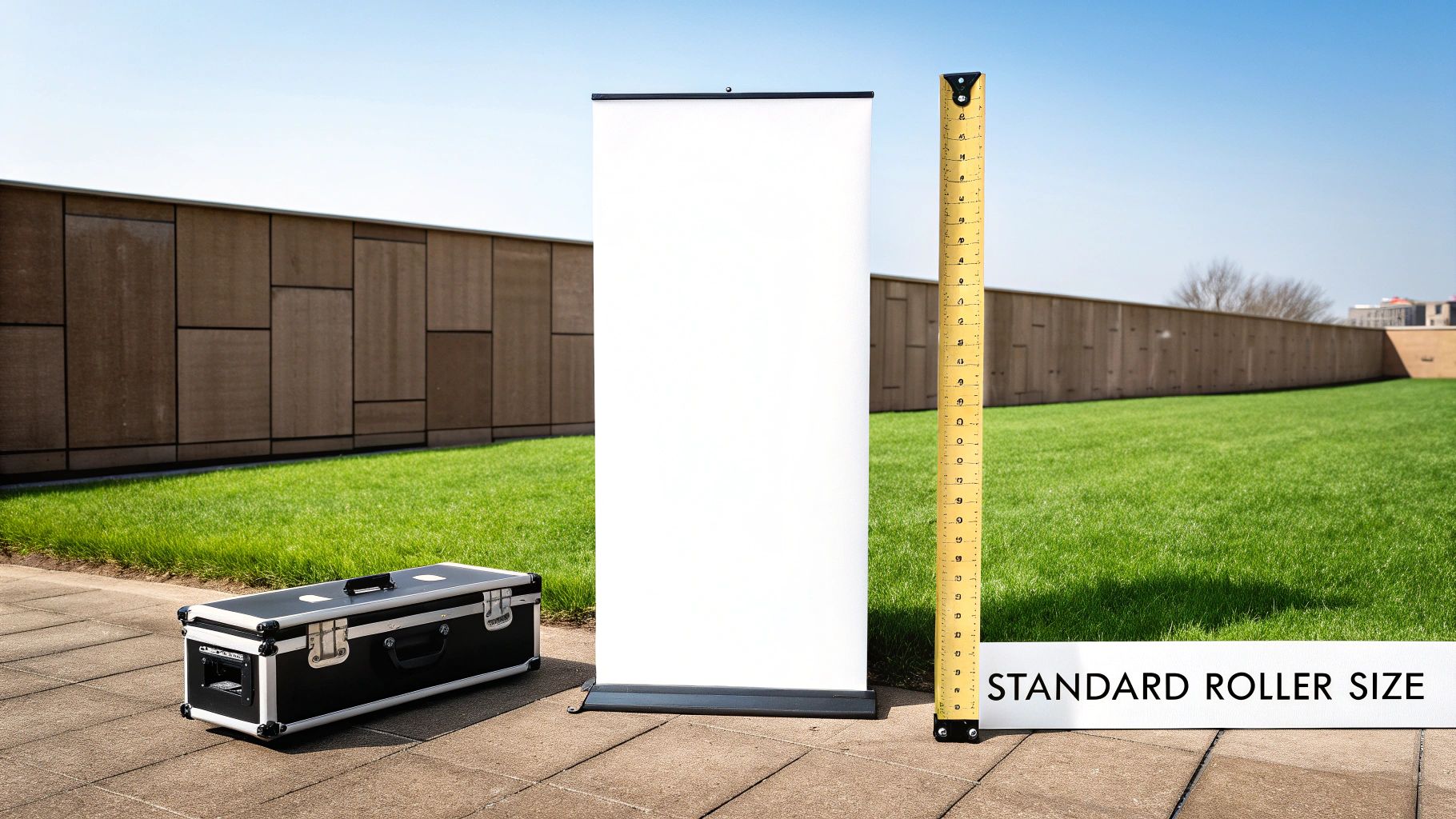
A Quick Guide to Standard Roller Banner Sizes
Picking the right roller banner is a bit like choosing the right tool for a job. You wouldn't use a tiny screwdriver on a massive bolt, and you definitely don't want a small banner getting lost in a huge exhibition hall. Getting to grips with the standard sizes is the first step to making sure your message lands with real impact.
Think of it this way: these sizes didn't come about by accident. They’ve been honed over years in the UK's print and display market to fit the most common scenarios you'll face. The 850mm x 2000mm size is the most popular, but you'll also find narrower 600mm options for tight spots and wider 1000mm banners for when you really want to own the space.
To make it even easier, here’s a quick-reference table to help you match the right banner to your next event.
Common Roller Banner Sizes and Their Best Uses
| Banner Size (Width) | Typical Height | Best For | Key Benefit |
|---|---|---|---|
| Narrow (600mm) | 2000mm | Tight retail spaces, small shell schemes, beside reception desks. | Maximises message in a minimal footprint without blocking walkways. |
| Standard (850mm) | 2000mm | Exhibitions, conferences, reception areas, open days, networking events. | The versatile industry favourite – big enough to be seen, compact enough for anywhere. |
| Wide (1000mm+) | 2000mm | Large exhibition stands, media backdrops, stage presentations. | Creates a powerful visual statement and acts as a focal point. |
This table gives you a solid starting point. Each size has a role to play, from a subtle nudge to a bold shout.
Why Is The Height Always The Same?
You’ve probably noticed that while the widths change, the height of most standard banners sits firmly at 2000mm (or 2 metres). That’s by design.
This specific height is tall enough to position your key branding and headlines just above the average person's eye level. It ensures your message is seen over the heads in a crowd, past desks, and across a busy room.
Crucially, it’s also short enough to fit comfortably under standard UK ceiling heights, so you never have to worry about whether it will fit in the venue. This consistency takes the guesswork out of planning. As you browse our full range of high-quality roller banners, you’ll see this smart design at work, helping you find the perfect width for your project.
Matching Your Banner Size to Your Venue
Choosing the right roller banner size isn't about ticking boxes; it's about strategy. Think of yourself as an event planner for a moment. Your job isn't just to fill a space but to command it, steering eyes exactly where you want them to go. Your banner's size is one of the most effective tools in your arsenal to do just that.
A banner that seems huge on a website can vanish in a vast exhibition hall. On the flip side, that same banner can feel overwhelming and almost aggressive in a cosy boutique shop. It’s the classic case of matching the tool to the job at hand.
The trick is to size up your environment before you even begin designing. A wide 1200mm banner, for instance, can create a powerful, branded backdrop in a big conference hall, acting as the visual anchor for your entire stand. In contrast, a slim 600mm model is perfect for a tight retail corner, packing a promotional punch without getting in the way of customers.
Think About Your Audience's Journey
Put yourself in your audience's shoes. How will they first see your banner? From across a crowded room, or up close while waiting in a queue? The answer completely changes what size you need for maximum impact.
At a buzzing trade show, for example, attendees are scanning a sea of visuals from a distance. You need to cut through that noise. A wider banner with a bold, simple headline is your best bet. But in a quiet office reception where visitors are just a few feet away, a standard 850mm banner with more detailed info is much more effective.
"Your roller banner is a silent salesperson. Its size determines whether it whispers or shouts. Choose wisely based on the room's 'personality' and how close your audience will get."
Adapting to Different Venue Types
Every environment has its own rules. Picking the right roller banner size means knowing how to play the game in each one.
- Large Exhibition Halls: Go big or go home. Wide banners (1000mm+) create a real sense of presence and are perfect as backdrops to define your space.
- Retail Shops: Here, every inch counts. Slimmer banners (600mm or 850mm) are ideal for entrances, product displays, or tills without blocking the aisles.
- Corporate Lobbies: Professionalism is everything. A standard 850mm banner looks polished and is great for welcome messages or directions without dominating the decor.
- Community Events & Fetes: Portability is your friend. The standard 850mm is a winner because it’s a breeze to transport and set up anywhere, from a school hall to a market stall.
Getting this right is crucial, especially when you consider the scale of the UK events industry. It's a massive £42 billion economy, and around 14% of event marketing budgets go on physical assets like banners. Making the right size choice from the start ensures your investment pays off. You can explore more UK event marketing statistics to get the full picture.
Viewing Distance and Eye Level
Finally, never forget viewing distance and eye-level. A classic mistake is putting your most important information way down at the bottom of the banner. The most valuable real estate is always the top third—the area right at eye level.
For a banner that needs to grab attention from across the room, this top section is where your logo and a punchy headline must live. If it’s for up-close viewing, you can put more detailed text or a QR code lower down, where it’s easier to read and scan. By thinking about where your audience's eyes will naturally fall, you make sure your message isn't just seen, but actually read.
Preparing Your Artwork for a Perfect Print
Getting your design file spot-on for printing can feel a bit technical, but trust me, it’s far more straightforward than it sounds. A little bit of prep work is all it takes to make sure the brilliant design on your screen looks just as good in real life as a physical, high-impact roller banner.
Skip these steps, and you risk blurry images, weird colour changes, or even having your crucial contact details chopped off. Nobody wants that.
Think of it like giving your design file a passport for its journey to the printer. It needs to have all the right information in the right places to get through customs without any trouble. This comes down to a few key details: resolution, colour mode, and understanding bleed and safe areas. Get these right, and you're golden.
The Three Pillars of Print-Ready Artwork
Before you hit 'save' for the final time, there are three non-negotiable settings you need to check. These are the absolute foundation of a professional print job and make all the difference between a sharp banner and a costly reprint.
-
Resolution (DPI): For something as large as a roller banner, your artwork needs a resolution of at least 150dpi (dots per inch) when set to its final print size. You might hear 300dpi mentioned for things like business cards, but for a banner that’s viewed from a few feet away, 150dpi is the sweet spot. It keeps the image crisp without creating a monstrously huge file. Any lower, and you're heading into blurry, pixelated territory.
-
Colour Mode (CMYK): Your screen glows with light using an RGB (Red, Green, Blue) model. Printers don't glow; they lay down ink using a CMYK (Cyan, Magenta, Yellow, Black) model. To avoid any nasty surprises, always design and save your file in CMYK. This ensures the colours you approved on screen are what actually come out of the printer.
-
File Format (PDF): The undisputed champion for sending files to print is a print-ready PDF. This clever format locks in all your fonts, images, and layout details into one neat package. It’s a guarantee that what you see is what we see, wiping out any risk of fonts going missing or images shifting about.
Understanding Bleed and Safe Areas
Ever tried to frame a photo and found a sliver of white border showing because the print was exactly the same size as the frame? Bleed is how we prevent that in printing.
Bleed is simply a small extra margin of your background design that extends past the final trim edge. For roller banners, a 3-5mm bleed on all sides is perfect. It gives us a tiny bit of wiggle room when trimming, ensuring your design goes right to the very edge without any unsightly white lines.
On the flip side, the safe area is the "safe zone" well inside the trim lines. This is where all your vital information—your logo, phone number, and key text—needs to live. Keeping it away from the edges protects it from being accidentally trimmed off or disappearing into the banner's base mechanism.
The golden rule: Bleed is for the background you want to get trimmed. The safe area is for the content you can’t afford to lose.
As you can see, thinking about your venue and size first is a huge part of the process, as it directly impacts how you'll set up your artwork file.
Your Final Pre-Flight Checklist
Before you upload that file, give it one last look-over with this quick checklist. It's saved countless people time, money, and headaches.
- Is the document size correct? Double-check it matches the banner you’re ordering.
- Is the resolution 150dpi? Make sure this is checked at the full, final print dimensions.
- Is the colour mode CMYK? This is your best defence against unexpected colour shifts.
- Have you added bleed? That crucial background extension needs to be there.
- Is all key text inside the safe area? Keep your logo and contact details well away from the edges.
- Have you converted text to outlines (or curves)? This locks your fonts in place so they can't change.
- Is the file saved as a high-quality PDF? This is the format we need to print from.
Following these steps will give you the confidence that your artwork is ready for a flawless print. If you want a bit more detail, our guide to uploading artwork for custom banners has even more pro tips to get it right every single time.
Why Banner Materials and Print Quality Matter
You’ve nailed down the perfect size for your roller banner – brilliant. But that’s only half the battle. The actual material it’s printed on, and the quality of that print, is what will make people stop and look. It's the difference between a sharp, professional display and one that looks tired after a single event.
Think of it like buying a good suit. The right fit is essential, but it’s the quality of the fabric that gives it that premium look and feel. Cutting corners on the material might save a few quid upfront, but you’ll pay for it later with curled edges, faded graphics, and a banner that gives up long before you do.
Investing in the right material ensures your banner stands tall, looks crisp, and represents your brand with the quality it deserves.
Navigating Your Material Options
The material you choose has a huge impact on how vibrant your colours look and, crucially, how well the banner keeps its shape. In the UK market, you’ll mainly come across two options: standard PVC and premium 'lay-flat' materials. They might look similar at first glance, but their performance is worlds apart.
Let’s break down what you're really getting with each type:
- Budget PVC (Polyvinyl Chloride): This is a popular, cost-effective choice for short-term or one-off events. It’s tough, for sure. But its biggest weakness is a tendency to curl at the edges over time, which instantly cheapens the look.
- Premium 'Lay-Flat' Polyester/PVC: For anyone planning to use their banner more than once, this is the one to go for. It’s a composite material specifically engineered to resist that dreaded edge-curling, keeping your banner perfectly flat and taut from top to bottom.
- Grey-Back or Blockout Material: This is a clever bit of kit. It features an opaque grey backing that stops light from shining through from behind. It’s an absolute must-have if your banner will be near a window or under the harsh spotlights of an exhibition hall, preventing your design from looking washed out.
The material is your banner's foundation. A premium lay-flat material is a small upfront investment that pays dividends in longevity and a consistently professional appearance. It's the best defence against the dreaded edge curl that plagues cheaper alternatives.
Before we move on to printing, let's compare these materials side-by-side to make the choice even clearer.
Roller Banner Material Comparison
This table breaks down the most common materials, helping you match the right one to your specific needs and budget.
| Material Type | Key Features | Best For | Durability Rating |
|---|---|---|---|
| Standard PVC | Cost-effective, water-resistant, durable for short-term use. | Single-use events, tight budgets, temporary indoor displays. | ★★★☆☆ |
| Premium Lay-Flat | Anti-curl properties, smooth finish, excellent colour reproduction. | Repeat use, trade shows, corporate receptions, long-term indoor displays. | ★★★★★ |
| Grey-Back / Blockout | Opaque backing prevents light bleed, superior vibrancy, lay-flat. | Brightly lit venues, exhibition halls, placements near windows. | ★★★★★ |
| Textured Polyester | Scuff-resistant, textured finish, premium fabric feel. | High-traffic areas, luxury branding, creating a sophisticated look. | ★★★★☆ |
Ultimately, for a banner that's going to be a workhorse for your brand, a premium lay-flat or blockout material is always the smartest choice.
The Science Behind a Flawless Print
Great material is nothing without great printing. The technology used to get the ink onto the banner is what truly brings your design to life, creating a finish that can withstand scuffs, scratches, and the fading effects of UV light.
Modern print tech is what gives your banner its staying power. Advances in UV and latex inks have been a game-changer, dramatically improving both durability and colour depth.
Here’s a quick rundown of what to look for:
- UV (Ultraviolet) Inks: These inks are dried, or 'cured', instantly with UV light as they are printed. This creates a tough, solid layer of ink on the surface that is incredibly resistant to fading and scratching. It's the perfect choice for banners that will be packed, unpacked, and used frequently.
- Latex Inks: As a water-based alternative, these inks are more environmentally friendly and produce stunningly vibrant, odourless prints. They also offer fantastic durability and scratch resistance, making them a great all-rounder for indoor and short-term outdoor use.
When you combine a high-quality, lay-flat material with advanced printing inks, you get a banner that doesn’t just look brilliant on day one but continues to work hard for your brand for years to come.
For a deeper look into the nitty-gritty of banner materials, check out our guide on everything about banner printing in the UK.
Single-Sided vs Double-Sided Banners
Once you've settled on the perfect roller banner size, there's another crucial question to answer: will your audience see your banner from one direction, or from all angles? Choosing between a single-sided or double-sided banner is a strategic decision that directly affects where you can place it and how effective it will be.
It’s a classic case of function dictating form.
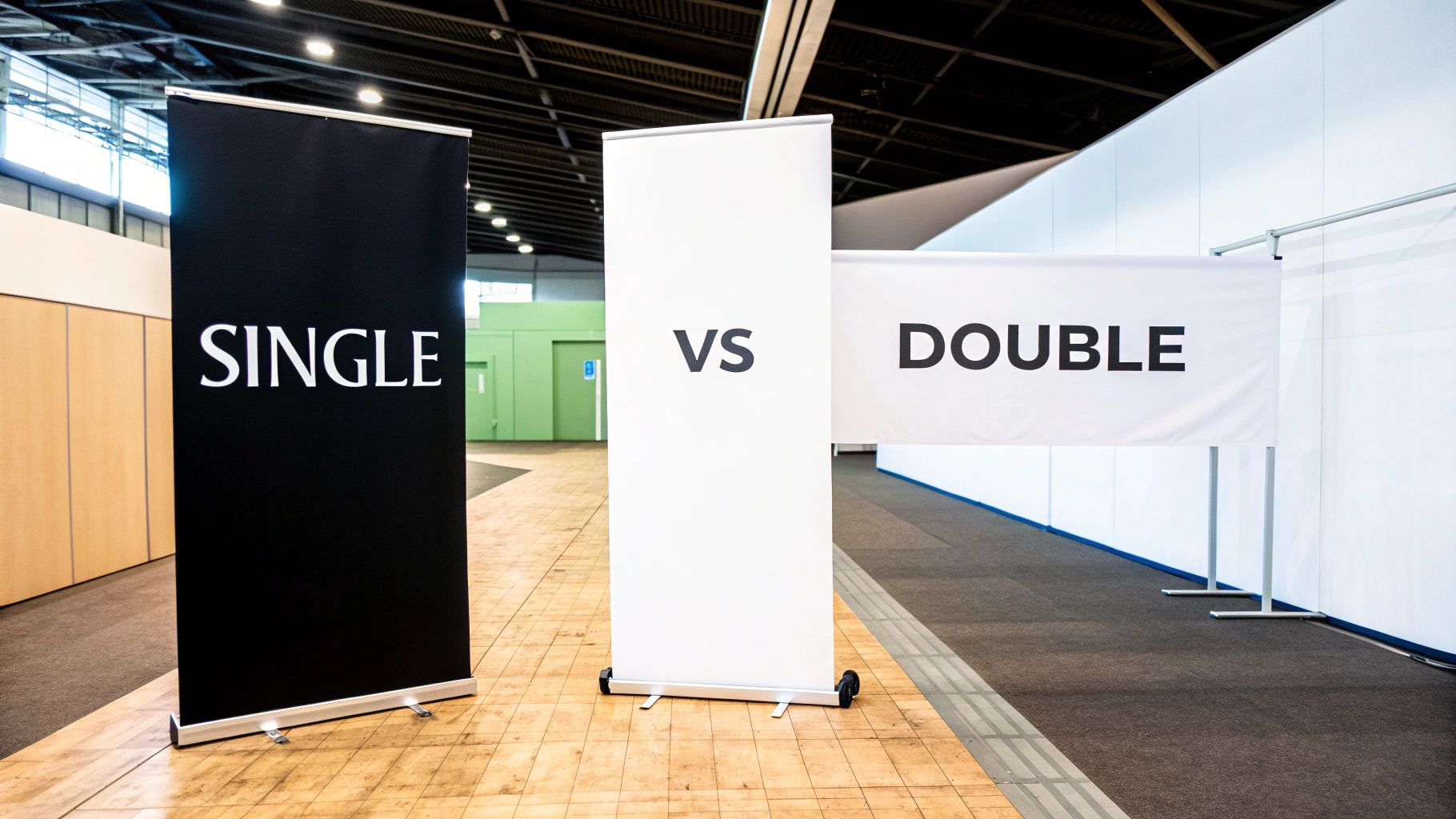
The vast majority of roller banners out there are single-sided. They’re the industry standard for a good reason – they’re cost-effective and absolutely perfect when you know your banner is going against a wall, inside a shell scheme, or at the back of an exhibition stand. In these situations, why pay for a second graphic nobody will ever see?
But the moment you step into an open space, the game completely changes.
The Power of 360-Degree Visibility
Imagine your stand is plopped right in the middle of a busy exhibition aisle, with people streaming past on both sides. Or maybe you're setting up a pop-up display in a wide-open shopping centre concourse. With a single-sided banner, you’re instantly invisible to half the people there.
This is where a double-sided banner proves its worth. It’s built with two separate graphics that retract from a central pole, making sure your message is seen from the front and the back. It works twice as hard, grabbing attention from people coming and going. You’re effectively doubling your advertising space and your chances of making a connection.
A double-sided roller banner isn’t just two banners stuck together. It’s a strategic tool for high-traffic, open environments. It turns a one-way message into a 360-degree conversation starter, squeezing maximum value out of your investment in busy spots.
While they do cost a bit more upfront, their ability to engage people from all directions often delivers a much better return, especially when you’re fighting for every glance.
Key Differences in Build and Cost
The mechanics of a double-sided banner are a little different. Instead of a single graphic, the base cassette houses two, which pull out in opposite directions. This means the base itself needs to be heavier and more robust to support both graphics without toppling over, which naturally adds to the cost.
Let’s break down the main points for each:
-
Single-Sided Banners
- Best For: Placing against walls, in corners, or at the back of a defined stand.
- Key Advantage: Very cost-effective and lighter to carry around.
- Limitation: Only visible from one direction, which really limits your placement options in open areas.
-
Double-Sided Banners
- Best For: Central locations, open-plan exhibition stands, aisles, and reception areas.
- Key Advantage: Doubles your visibility by catching footfall from both directions.
- Limitation: A higher initial cost and a bit heavier due to the sturdier base.
Making the Right Strategic Choice
The decision boils down to one simple question: where are people going to be? If you have a solid backdrop, a single-sided banner is the smart, economical way to go. But if you’re competing for attention in a dynamic, open space where people are moving all around you, investing in a double-sided banner is a strategic move that ensures your message is never missed.
Your Final Checklist Before Ordering
Right, you’ve sifted through the different roller banner sizes, pictured it in your venue, and got your head around the artwork specs. Now, it’s time to pull it all together. Before you hit that ‘buy’ button, running through a quick final checklist is the best way to make sure you’ve nailed every single detail.
Think of it as your pre-flight check. A few minutes spent double-checking everything now will save you the headache and cost of a reprint later on. It’s all about getting that peace of mind before your order goes to print.
Step 1: Confirm Your Goal and Message
First things first, take a step back and look at your design one last time. Does it get your main point across in a split second? A great banner hooks people in with a clear, punchy headline.
Don’t try to cram your entire company history onto it. The banner’s job is to start a conversation, not to be a brochure. Make sure your most important message is right at the top, smack-bang at eye level, where it’ll do the most work.
Step 2: Double-Check Your Measurements and Banner Type
Go back to your notes about the venue. Have you actually measured the spot where the banner will live? Make sure the size you’ve picked—whether it’s a slim 600mm or a wider 1000mm—fits properly. You don’t want it blocking a walkway or looking tiny in a huge space.
While you're at it, have another think about whether a single-sided banner will do the trick. If you’re in an open area with foot traffic coming from all directions, a double-sided model might be a much smarter investment to maximise eyeballs.
Step 3: Finalise Your Artwork with a Technical Review
This is your last chance to spot any technical gremlins before your design is sent to the printers. Give your file a final once-over with this quick tech list:
- Resolution: Is your file a solid 150dpi when set to its full print size?
- Colour Mode: Have you saved it in CMYK? RGB is for screens and will print looking dull.
- Bleed: Is there a 3-5mm bleed around the edges? This ensures a clean, edge-to-edge colour finish.
- Safe Area: Are your logos and essential text tucked safely inside the designated safe zone?
- File Format: Is it saved as a print-ready PDF?
Taking a moment to tick off these technical specs is hands-down the most important thing you can do to guarantee a perfect print. It's the final quality gate between your digital design and the physical banner in your hands.
Step 4: Choose a Reputable UK Supplier
Finally, make sure you’re ordering from someone who knows the score when it comes to UK businesses and events. Look for a printer that offers to pre-flight check your artwork, gives you clear delivery times, and has a solid history of happy customers. A good partner will often spot a potential problem you might have missed.
With all that sorted, you can place your order with total confidence, knowing you’ve made a smart, strategic choice for your next event.
Got Questions? We've Got Answers
Even when you think you’ve got it all figured out, a few last-minute questions always seem to pop up just before you’re about to place your order. That’s completely normal. Getting these final details sorted is what gives you the confidence that you're making the right call.
Think of this as your quick-fire FAQ section. We’re going to tackle the common queries we hear day in, day out, clearing up the essential nuts and bolts that take you from planning to printing without any guesswork.
How Tall Is a Standard Roller Banner?
The most common height for a standard roller banner here in the UK is 2000mm – a nice, round 2 metres tall. This isn't just a random number; it's a very deliberate design choice that perfectly blends visibility with pure practicality.
That 2-metre height is engineered to sit just above the eye level of the average person. This makes it brilliant at grabbing attention in a busy exhibition hall or a crowded reception area. Crucially, it’s not so tall that you’ll have trouble fitting it under a standard ceiling. It really is the ideal sweet spot for almost any indoor venue you can think of.
Can I Replace the Graphic in My Banner Stand?
Whether you can pop an old graphic out and a new one in comes down to one thing: the model of the banner stand you've got. It's a classic case of you get what you pay for.
- Budget-Friendly Stands: Most entry-level cassettes are built for a single campaign. The graphic is fixed in place permanently, making them a fantastic, low-cost choice for one-off events where you don't need to change the message.
- Premium Cassettes: On the other hand, higher-end models are built for the long haul. Their mechanisms are designed specifically to allow for easy graphic swaps, letting you update your marketing message as your offers change, without needing to buy a whole new unit.
If you know you'll be switching up your branding or running different promotions, it's always worth asking your supplier if the stand is designed to be reusable. It’s a small question that can save you a serious amount of money down the line.
Our Top Tip: For real marketing flexibility, investing in a roller banner stand that lets you replace the graphics is one of the smartest moves you can make. It turns your banner from a single-use item into a sustainable marketing tool you can use again and again.
What Is the Best File Format for My Artwork?
Hands down, you should always aim to supply your artwork as a print-ready PDF. This is the undisputed gold standard in the printing world, and for very good reason.
A PDF essentially locks your entire design—fonts, images, colours, and layout—into one self-contained package. This completely removes the risk of things like fonts going missing or images shifting around when the file is opened on a different computer. It gives the printer exactly what you see on your screen, ensuring a flawless, consistent result every single time.
Ready to bring your vision to life? At Banner Printing Ltd, we combine high-quality materials with expert printing to create roller banners that stand out. Design your perfect banner with us today!


