

At its heart, hoarding for advertising is about turning a necessary evil—like a construction site fence—into a massive, unmissable billboard. It takes a purely functional barrier and transforms it into a powerful marketing tool, giving your brand a huge physical presence in high-traffic areas.
Defining Your Brand’s Physical Footprint
Picture a busy city street corner, sectioned off by a plain, drab plywood fence. It’s an eyesore, something people walk past without a second glance. Now, imagine that same fence brought to life as a vibrant, sprawling canvas, showcasing a stunning preview of the building to come. That’s the magic of advertising hoarding. It gives a boring, temporary barrier a strategic commercial purpose.
This makes it a cornerstone of Out-of-Home (OOH) advertising, the catch-all term for any visual media you see outside your home. While you can easily scroll past a digital ad or skip a TV commercial, a well-designed hoarding is practically impossible to ignore. It captures the attention of pedestrians, drivers, and local residents 24/7.
Why It’s More Than Just a Big Sign
It's tempting to think of hoarding as just a "big sign," but that really misses the point. A simple banner just sends a message; a full hoarding installation creates an immersive brand environment. It doesn't just display an advert—it temporarily takes ownership of that physical space for your brand.
By wrapping an entire development site or event space, your brand stops being just another advertiser and becomes part of the local streetscape. This constant visibility builds familiarity and anticipation in a way few other advertising formats can match.
This round-the-clock presence is where the real value lies. It allows a brand to tell a story over weeks or months, building excitement for what’s on the horizon. For example, a property developer can use hoarding to:
- Generate Off-Plan Interest: Display impressive CGI renders of the finished project, complete with contact details to capture early leads.
- Build Community Goodwill: Feature artwork from local artists or share information on how the new development will benefit the area.
- Create a Sense of Place: Establish the branding and vibe of a future retail or residential space long before it even opens.
A Blank Canvas for Your Message
Ultimately, advertising hoarding gives you a unique chance to grab a local audience’s attention on a grand scale. It’s all about turning a legal requirement for site safety into a prime marketing opportunity. Instead of a dull wooden wall that fades into the background, you create a visual landmark that actively engages the public, communicates your vision, and helps you hit your commercial goals. This shift from a passive barrier to an active marketing machine is what makes it so incredibly effective.
Exploring Hoarding Materials and Their Best Uses
Choosing the right material for your advertising hoarding is far more than a technical detail. It’s a strategic decision that shapes the look, feel, and lifespan of your entire campaign. Think of it like an artist selecting a canvas—the surface itself can either elevate the final piece or let it down.
Each option brings something different to the table, suited to specific environments, project lengths, and budgets. Getting this choice right ensures your message doesn't just look brilliant on day one but stays sharp and professional for the long haul. A poorly matched material can mean faded graphics, weather damage, or a finish that just doesn't do your brand justice.
This diagram shows exactly how a simple hoarding transforms from a site barrier into a powerful billboard and brand-building machine.
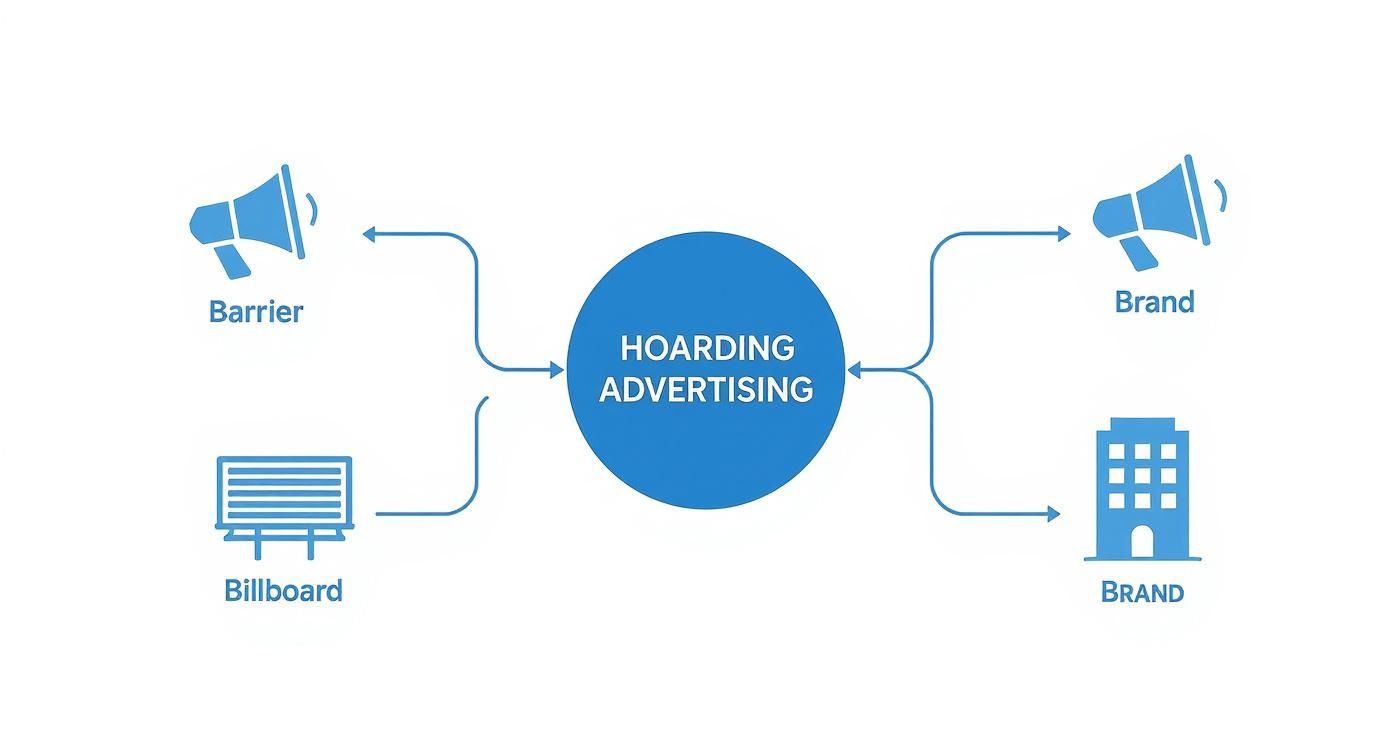
As you can see, it's a multi-purpose asset, ticking the box for site security while creating a huge canvas to broadcast your brand.
The Industry Standard: Aluminium Composite Material (ACM)
When it comes to high-end, durable hoardings, the undisputed workhorse is Aluminium Composite Material (ACM), often known by the brand name Dibond. It's made by sandwiching a tough polyethylene core between two thin aluminium sheets, creating a panel that’s surprisingly lightweight yet incredibly rigid.
Why is it so popular? ACM’s perfectly flat, smooth surface is a printer’s dream, allowing for flawless, high-resolution graphics. This translates to razor-sharp images and vibrant colours that give any project a premium, polished look. It’s also exceptionally weather-resistant, making it the top choice for long-term construction projects exposed to the unpredictable UK elements for months, or even years.
For campaigns where brand image is everything and durability is a must, ACM is the gold standard. It resists warping and buckling, ensuring your graphics stay pristine from start to finish.
In some cases, hoardings need to integrate with existing structures. Using specialised shipping container cladding solutions can provide another tough, customisable surface that works brilliantly alongside materials like ACM for a seamless and striking site presence.
To help you decide, here's a quick rundown of the most common materials and where they shine.
Comparing Hoarding Materials for Your Project
A clear comparison of common hoarding materials, outlining their key features, durability, and ideal applications to help you make an informed decision.
| Material Type | Key Features | Best Use Case | Typical Lifespan |
|---|---|---|---|
| Aluminium Composite (ACM) | Rigid, perfectly flat surface, premium finish, extremely durable. | Long-term construction sites, high-end retail, property developments. | 3-7+ years |
| PVC Banner | Flexible, waterproof, excellent colour vibrancy, cost-effective. | Short-term events, temporary site fencing, promotional campaigns. | 1-3 years |
| Mesh Banner | Perforated to allow wind flow, lightweight, reduces 'sail effect'. | Exposed, windy locations, high-rise buildings, large fence wraps. | 1-3 years |
| PVC-Free Eco Board | Sustainable, recyclable, good print quality, reduces environmental impact. | Brands with strong green credentials, public-facing projects. | 1-5 years |
This table makes it clear that your project's timeline and location are just as important as your budget when selecting a material.
Flexible and Cost-Effective Banner Options
For shorter-term projects or wrapping existing chain-link fences, printed banners are a versatile and wallet-friendly alternative to rigid panels. They generally come in two flavours:
-
PVC Banners: Built from heavy-duty vinyl, these banners are fully waterproof and produce brilliant, saturated colours. They’re perfect for festival branding, temporary promotions, or anywhere you need a durable, eye-catching graphic for a few weeks or months.
-
Mesh Banners: This is a clever twist on PVC, featuring thousands of tiny holes. These perforations let the wind pass straight through, dramatically reducing the strain—or ‘sail effect’—on the fence it's fixed to. This makes mesh the only real choice for exposed, windy sites like coastal developments or open fields.
Choosing between the two is vital for both safety and performance. To get into the nitty-gritty, you can learn more by comparing mesh vs PVC banners in our detailed guide, which will help you match the material to your site’s conditions perfectly.
The Rise of Sustainable Hoarding Materials
With corporate social responsibility now front and centre for UK brands, the demand for greener advertising has soared. In response, the industry has come up with some brilliant PVC-free alternatives that deliver great print quality and durability without the environmental baggage of traditional vinyl.
Choosing a PVC-free hoarding sends a clear message. It shows the public that your commitment to sustainability is more than just talk—it's built into every part of your operation, right down to your marketing materials. While they can sometimes cost a little more upfront, the positive impact on brand perception often makes it an investment that pays for itself.
The Strategic Benefits of Hoarding Advertising
Hoarding advertising does far more than just hide a messy site boundary. It's a powerful marketing tool that can completely change how the public sees your project. Its sheer scale demands attention, making it one of the very few ad formats you simply can’t skip, mute, or scroll past. This creates a constant, unmissable brand presence in a specific local area.
When done right, a printed hoarding isn't just a big banner; it becomes a local landmark. It projects a sense of authority that fleeting digital ads can only dream of, embedding your brand into the daily routines of thousands of commuters, locals, and passers-by. That constant exposure is brilliant for building brand recognition and trust over time.
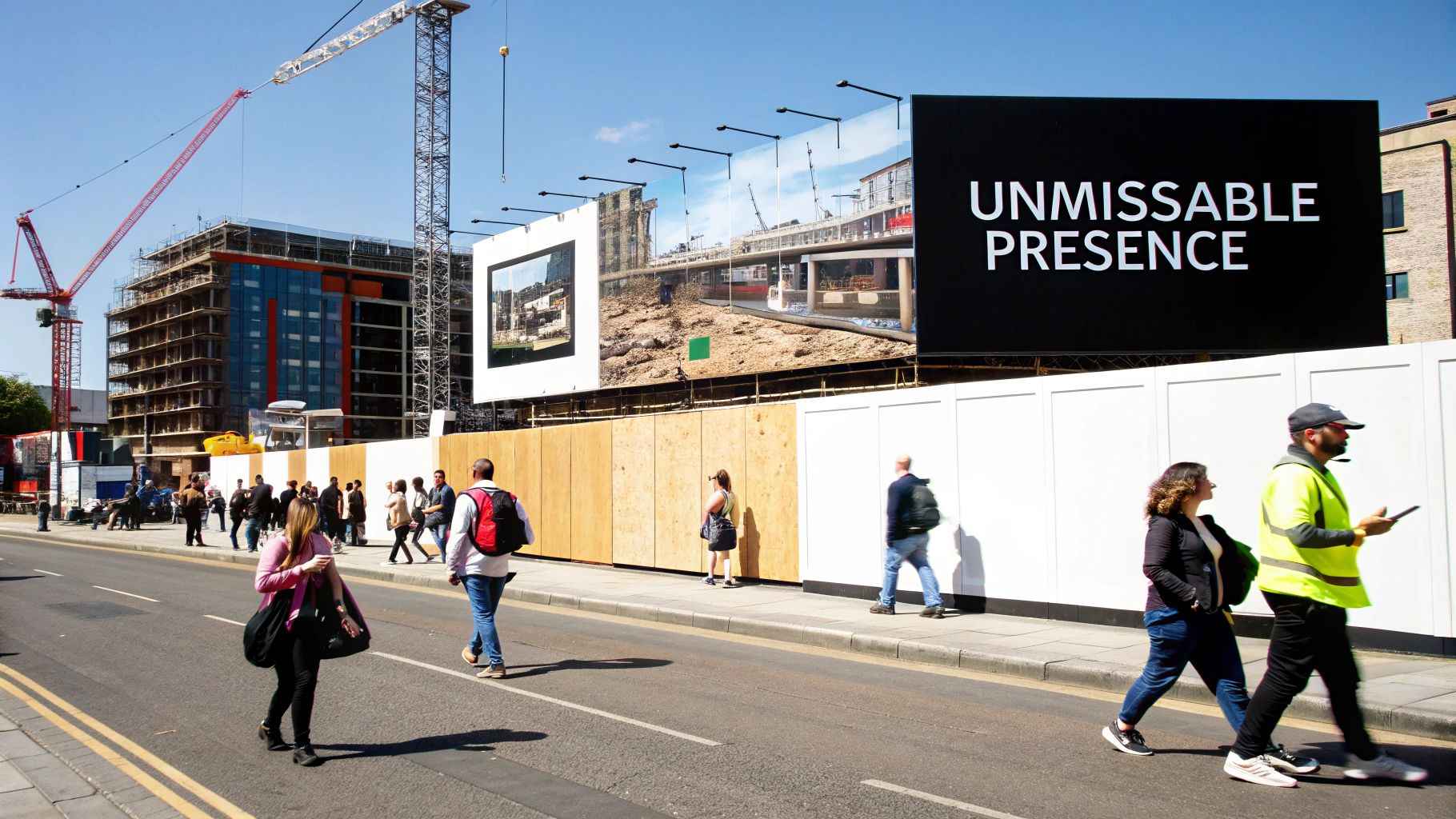
This physical dominance allows you to hit marketing goals that are tough to achieve with other methods.
Turning Construction Sites into Previews
One of the cleverest uses of hoarding is to transform a chaotic construction site into a vibrant sneak peek of what's to come. Instead of letting people wonder what's happening behind the fence, developers can show off stunning architectural renders and create a vision of the future that builds real excitement.
This is a game-changer for:
- Property Developments: Generate off-plan sales leads by plastering contact details next to visuals of the finished homes or offices.
- New Retail Openings: Build a massive buzz for a new store months before it opens, counting down to the launch and guaranteeing footfall from day one.
- Public Infrastructure Projects: Keep the community in the loop about the project's benefits, helping to reduce frustration over the disruption and build local support.
By showing a compelling vision, the hoarding flips the script from inconvenience to progress.
Hoarding advertising allows you to control the narrative around your site. Instead of being a source of disruption, your perimeter fence becomes a storytelling canvas that actively builds positive sentiment and commercial interest long before the project is complete.
Creating Immersive Brand Experiences
The massive canvas of a hoarding is perfect for creating immersive brand experiences, especially for big events and festivals. A well-designed hoarding can wrap the entire perimeter of a venue, setting the tone and atmosphere before your guests have even scanned their tickets. It’s an essential tool for reinforcing sponsor visibility and making the whole experience feel more premium.
Think about a music festival: the hoarding can display the lineup, site maps, and sponsor logos, turning a necessary security barrier into a useful and visually engaging part of the event. This large-scale branding helps create a professional, cohesive feel that elevates the entire event.
Building Community Goodwill and Engagement
People today expect brands to do more than just sell. They want them to give something back. Hoardings offer a fantastic platform to do just that. By dedicating some of your panel space to public art projects or working with local artists, you can create a beautiful installation that genuinely improves the local area.
This approach builds incredible goodwill and creates a positive connection with your brand. It shows your company is invested in the community, not just using it for profit. These kinds of projects often get picked up by local media and shared on social media, giving you an authentic marketing boost that feels earned, not bought. It’s a smart way to build lasting brand loyalty by showing you care.
Navigating UK Planning and Safety Regulations
Getting your advertising hoarding up in the UK isn't as simple as just printing some panels and bolting them to a fence. There’s a serious legal and safety framework you need to navigate, and for good reason—it’s there to protect the public and make sure your structure is sound.
Get it wrong, and you could be looking at hefty fines, massive project delays, or even a dangerous collapse. Your best marketing asset could quickly become your biggest liability.
The first port of call, before a single panel goes up, should always be your local council. Most large advertising hoardings, especially if they're staying up for a while or are over a certain size, will need planning permission. This is to make sure the hoarding is suitable for the area, doesn't get in anyone's way, and fits with the local vibe.
Trying to skip this step is a huge gamble. Councils have the power to issue enforcement notices, demanding you take down any hoarding that isn't compliant. That means dismantling your entire investment at a total loss.
Understanding Your Safety Obligations
Beyond getting the council's blessing, every single hoarding installation must follow the strict guidelines of the Health and Safety Executive (HSE). Since it's a temporary structure, often right next to busy public footpaths, its stability is absolutely critical. This isn't just about looking good; it's about standing up to everything the unpredictable British weather can throw at it.
Here's what you absolutely must have covered:
- Structural Assessments: A qualified engineer needs to sign off on the proposed structure. They'll check everything from the timber frame and fixings to the stability of the ground it's on.
- Wind Loading Calculations: This is non-negotiable. You need proper calculations that prove the hoarding can handle the maximum wind speeds expected in that specific location.
- Regular Inspections: Once it's up, the hoarding needs regular checks for any signs of damage, wear, or weakness, especially after a storm or a period of high winds.
A hoarding that gives way in high winds is a genuine danger to the public. Proper wind loading calculations aren't just a good idea—they're a fundamental requirement to prevent accidents and show you've done your due diligence.
The Importance of Material Choice in Safety
The materials you choose have a direct impact on safety, particularly in exposed spots. Solid panels look great, giving you a perfect, unbroken canvas for your design. But in strong winds, they act like a massive sail, putting immense strain on the entire structure.
This is where your choice of material becomes a crucial safety decision.
For windy construction sites or exposed fences, using a material with perforations is essential. Take a look at our guide on the best mesh banners for construction sites to see how their breathable design lets wind pass straight through. This massively reduces the load on the fence and its fixings. That simple choice can be the difference between a secure installation and a dangerous failure.
Ultimately, compliance is more than just ticking boxes; it’s about professional responsibility. By talking to your local council early, getting proper structural assessments, and picking the right materials for the job, you ensure your hoarding for advertising is not just stunning to look at, but completely safe and legally sound.
Designing Hoardings For Maximum Visual Impact
A truly effective hoarding isn't just an oversized sign; it's a masterclass in large-format communication. Just filling the space is a massive missed opportunity. The real goal is to create a visual experience that stops people in their tracks, gets a message across in seconds, and leaves a lasting brand impression. This demands a specific design approach, one that’s built for its unique scale and environment.

Unlike a website or a brochure that people view up close, a hoarding has to work from a distance. Your audience is almost always on the move—walking, driving, or cycling past—so your message has to land instantly. That means prioritising clarity and immediate impact over fussy, intricate details.
Mastering The Art Of Simplicity
When you're designing for a canvas this big, it's tempting to cram it full of information. This is a classic mistake, and it only leads to visual clutter that makes the whole thing unreadable. The golden rule for effective hoarding design is simple: less is more. Your entire design should hang on a single, powerful idea.
The ultimate test for any hoarding design is the three-second rule. Can someone passing by understand who you are, what you offer, and what they should do next in just three seconds? If not, it’s time to simplify.
To nail that clarity, focus on these core elements:
- Bold Typography: Go for large, clean, and easily readable fonts. Delicate or script fonts that look lovely on paper will just become a blurry mess from 50 feet away.
- High-Contrast Colour Palette: You need a strong visual pop. Use colours that stand out against each other and, crucially, against the surrounding environment. Think bold brand colours on a neutral background, or the other way around.
- A Singular, Powerful Image: One stunning, high-resolution photo or graphic will have far more impact than a collage of smaller, competing images.
Crafting A Clear Call To Action
Every piece of hoarding for advertising needs a clear purpose. What do you want people to do after they see it? The design has to guide them to that action without any confusion. A single, concise call to action (CTA) is absolutely crucial.
Ditch vague instructions. Instead of a weak "Learn More," try something direct like "Visit Our Show Home This Weekend" or "Scan to See the View." A clear, benefit-driven CTA tells people exactly what to do next and gives them a reason to do it. Place it somewhere prominent, but don’t let it overpower the main visual. It should feel like the logical conclusion to your visual story. For brands wanting to really push the boundaries, exploring dynamic LED video wall solutions can add unparalleled brightness and movement for key messages.
Ensuring Brand Consistency At Scale
When your hoarding stretches across dozens of panels, keeping your brand consistent is vital. The design has to feel like one single, cohesive piece, not a jumble of disconnected signs. You achieve this by using your brand's colours, fonts, and logo consistently across the entire length.
A great technique is to use a continuous background image or pattern that flows seamlessly from one panel to the next. This creates a powerful sense of motion and scale, turning a simple perimeter fence into a true visual journey. By briefing your design team on these principles, you ensure the final product isn’t just beautiful—it’s a commercially successful asset that works hard for your brand.
A Step-by-Step Guide to Preparing Your Artwork
Getting a design from your screen to a giant hoarding panel is where the magic happens. But to make sure it’s the good kind of magic—not the kind that results in blurry images or weird colours—your artwork needs to be prepped properly.
Getting your files print-ready from the very start is the single best way to avoid delays, extra costs, and disappointment. Think of it as your pre-flight check; a few minutes spent double-checking the technical details now will save you a world of headaches later on.
Core File Specifications
Large-format printing has its own set of rules, which are quite different from designing for a website or a business card. For your hoarding panels to look sharp and professional, hitting these technical marks is non-negotiable.
Here’s what we need to see in every file you send us:
- File Format: Always save your final design as a high-quality, print-ready PDF. This format is fantastic because it locks everything—fonts, images, and vectors—into one neat package. Nothing will shift, disappear, or look different when we open it on our end.
- Colour Mode: Your artwork must be in CMYK (Cyan, Magenta, Yellow, Key/Black). This is the colour language of professional printing. If your file is in RGB (the standard for screens), our systems will have to convert it, and that can cause some noticeable and often disappointing shifts in your brand colours.
- Resolution: Any photographs or raster images in your design need a resolution of at least 150dpi (dots per inch) at their final, full printed size. Anything less, and you risk the image looking pixelated or fuzzy when it’s blown up to full scale.
Getting the Bleed and Panel Layouts Right
Ever seen a print job with a thin, accidental white line along the edge? That’s what happens when there’s no bleed. To get that clean, edge-to-edge finish, you need to extend your design slightly beyond the panel’s final dimensions.
Always add a 5mm bleed on all four sides of your artwork. So, for a standard 8ft x 4ft panel (2440mm x 1220mm), your artwork file should actually be 2450mm x 1230mm. That little bit of extra design gives us the margin needed for a perfect trim every time.
If your hoarding design stretches across multiple panels, please supply it as one single, continuous artwork file. This allows our production team to slice the design perfectly across each board, guaranteeing every element lines up seamlessly during installation.
For a full rundown on how to get your files just right, take a look at our guide on uploading artwork for custom banners. Following these steps will make the entire process, from submission to production, run like clockwork.
Print-Ready Artwork Checklist
Before you hit 'send', run through this quick checklist. It covers the essentials our team looks for to ensure your hoarding panels are printed to the highest standard without any delays.
| Checklist Item | Specification | Why It Is Important |
|---|---|---|
| File Format | Print-Ready PDF | Locks all fonts and images, preventing missing elements or layout shifts. |
| Colour Mode | CMYK | Ensures colour accuracy and prevents unexpected colour shifts during printing. |
| Resolution | Minimum 150dpi at 100% size | Guarantees images are sharp and clear, not pixelated or blurry. |
| Bleed | 5mm on all sides | Allows for a clean, edge-to-edge finish with no unwanted white borders. |
| Fonts | Outlined or Embedded | Prevents font substitution issues if we don't have the exact font file. |
| Panel Layout | Supplied as one continuous file | Ensures seamless alignment of graphics across multiple hoarding panels. |
Getting these details right from the start is the key to a smooth process and a final product that looks absolutely brilliant on site.
Your Hoarding Questions, Answered
Even after getting the basics down, you probably have a few specific questions. It's completely normal. Here, we'll run through the most common things we get asked by clients, giving you clear, straightforward answers to help you get your project moving.
How Do You Actually Measure the ROI on a Hoarding?
This is the big question, isn't it? Unlike a digital ad, you can't just track clicks. But that doesn't mean you can't measure its impact. You just have to be a bit clever about it.
The trick is to give people something specific to do. By printing a unique website address, a special QR code that goes to a dedicated landing page, or even a phone number that’s only used on that hoarding, you can directly trace any resulting web traffic or enquiries right back to that exact spot. It’s a simple but incredibly effective way to see what's working.
To get the full picture, you can mix in a few other methods:
- Brand Awareness Surveys: A quick "before and after" survey in the local area can show you just how much brand recognition has lifted.
- Website Analytics: Keep an eye on your web traffic. A spike in visitors from the hoarding’s geographic location is a pretty clear signal.
- Social Media Buzz: Search for your brand or project name on social platforms to see if locals are mentioning or posting photos of your hoarding.
- Footfall and Sales: If you're a retail business, tracking the change in shoppers and sales after the hoarding goes up is one of the most powerful metrics you have.
Putting these pieces together gives you a solid understanding of how well your campaign is performing and what your true return on investment looks like.
What's the Typical Lifespan of an Advertising Hoarding?
How long your hoarding will last really comes down to the material you pick and how much weather it has to put up with. For shorter projects, a printed PVC banner is a great, cost-effective choice and will typically look good for 2-3 years before you see any major fading.
But for bigger, long-term developments like a major construction project, Aluminium Composite Material (ACM) panels are king. These things are built to last. They're rigid, weather-resistant, and will keep your site looking premium for 5 years or more.
Don't forget, the quality of the print and the finish makes a huge difference. Using UV-resistant inks and adding an anti-graffiti laminate can massively extend the life of your graphics, protecting your investment from both the sun and any would-be vandals.
The bottom line? Always match the material's durability to your project timeline. It's the best way to make sure it looks professional from day one to the very end.
How Are Hoarding Panels Installed Securely?
When it comes to installation, safety is everything. Hoarding panels are almost always fixed onto a sturdy timber frame, which acts as the skeleton for the whole structure.
First, that frame has to be anchored securely. For more permanent sites, the timber posts are set directly into concrete. If it's a temporary site and you can't break ground, the frame is weighted down with massive concrete blocks to keep it from going anywhere.
With the frame in place, the printed panels (usually tough ACM) are drilled and screwed right onto the timber. Getting this done professionally is non-negotiable—it ensures the structure is sound and can handle strong winds. For long hoardings with one continuous image, the panels are butted up tightly against each other to create that seamless, impressive look.
To give it a polished look, a few finishing touches are added:
- Header Boards: These strips run along the top for a clean, finished edge.
- Kicker Boards: Placed at the bottom, these protect the panels from scuffs and knocks.
- Corner Trims: Used to hide the joints and give the whole thing a neat, professional appearance.
Before any work starts, a proper installation team will always conduct a full site survey and a detailed risk assessment. This makes sure every safety box is ticked, keeping the public safe and your hoarding secure for the entire campaign.
Ready to turn your site perimeter into a powerful advertising canvas? At Banner Printing Ltd, we specialise in high-quality, durable hoarding panels designed for maximum impact. From initial file checks to fast, free UK delivery, we make the process simple.


