
Ever wonder what the secret is behind those flawless, professional photos? It's often what's happening behind the subject. A great backdrop and a solid stand are the unsung heroes that turn an ordinary room into a proper studio, giving you a controlled, distraction-free canvas to work your magic.
Your Foundation for Flawless Photos
Behind every stunning portrait or crisp product shot, you'll find a carefully controlled environment. The key ingredients? Backdrops and stands for photography. These two pieces of kit work as a team to banish distracting backgrounds, shape the light, and set a specific mood or brand vibe. The stand is your sturdy framework, and the backdrop is your creative canvas.
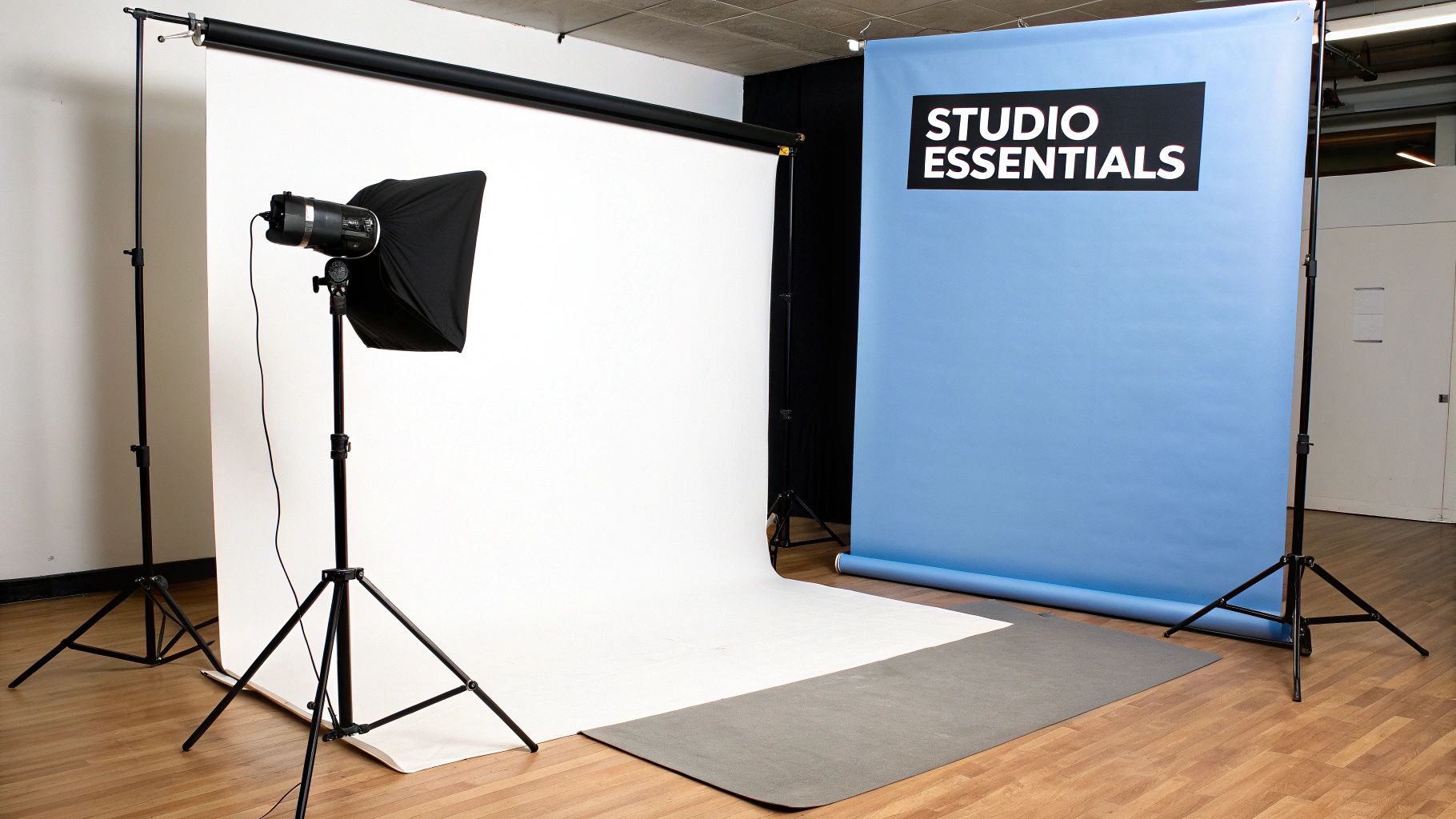
This gear isn't just a nice-to-have; it's a fundamental investment for anyone serious about quality. Whether you’re a studio portrait artist, a mobile event photographer, or a content creator churning out videos, the right setup is your ticket to consistent, professional-looking work.
Why This Combination Matters
Investing in a reliable backdrop and stand system pays off immediately, giving you practical benefits that will genuinely elevate your photography. Think of it as upgrading your entire creative process.
- Total Creative Control: You can switch from a clean, minimalist white void to a rustic wood texture or a bold, on-brand colour in minutes.
- A Professional Polish: Getting rid of background clutter like light switches, furniture, or that stray houseplant instantly gives your photos a high-end feel.
- Consistent Results: Nail the exact same look and feel across an entire photoshoot. This is absolutely vital for product catalogues, corporate headshots, and branding campaigns.
- Better, Faster Workflow: A dedicated setup just makes life easier. It streamlines your process, saving you precious time during the shoot and cutting down on editing afterwards.
This kind of efficiency is a big deal in the UK's photographic industry, which is made up of around 8,100 businesses and generates about £1.9 billion each year. A sturdy, adjustable stand means less time faffing about with setup and more flexibility to adapt on the fly—a must-have in a fast-moving market.
The right backdrop and stand don't just hold up a background; they support your creative vision and your business goals. They are the first step in turning any space into a professional studio.
Of course, the backdrop is just the beginning of building your scene. To really bring it to life, take a look at this a practical guide to props for photography studios.
Choosing the Right Backdrop Material
The material you choose for your backdrop is just as important as the stand holding it up. It sets the texture, mood, and durability of your entire setup. This isn't just an aesthetic choice; it’s a practical one that will shape your workflow from the moment you set up to the final edit.
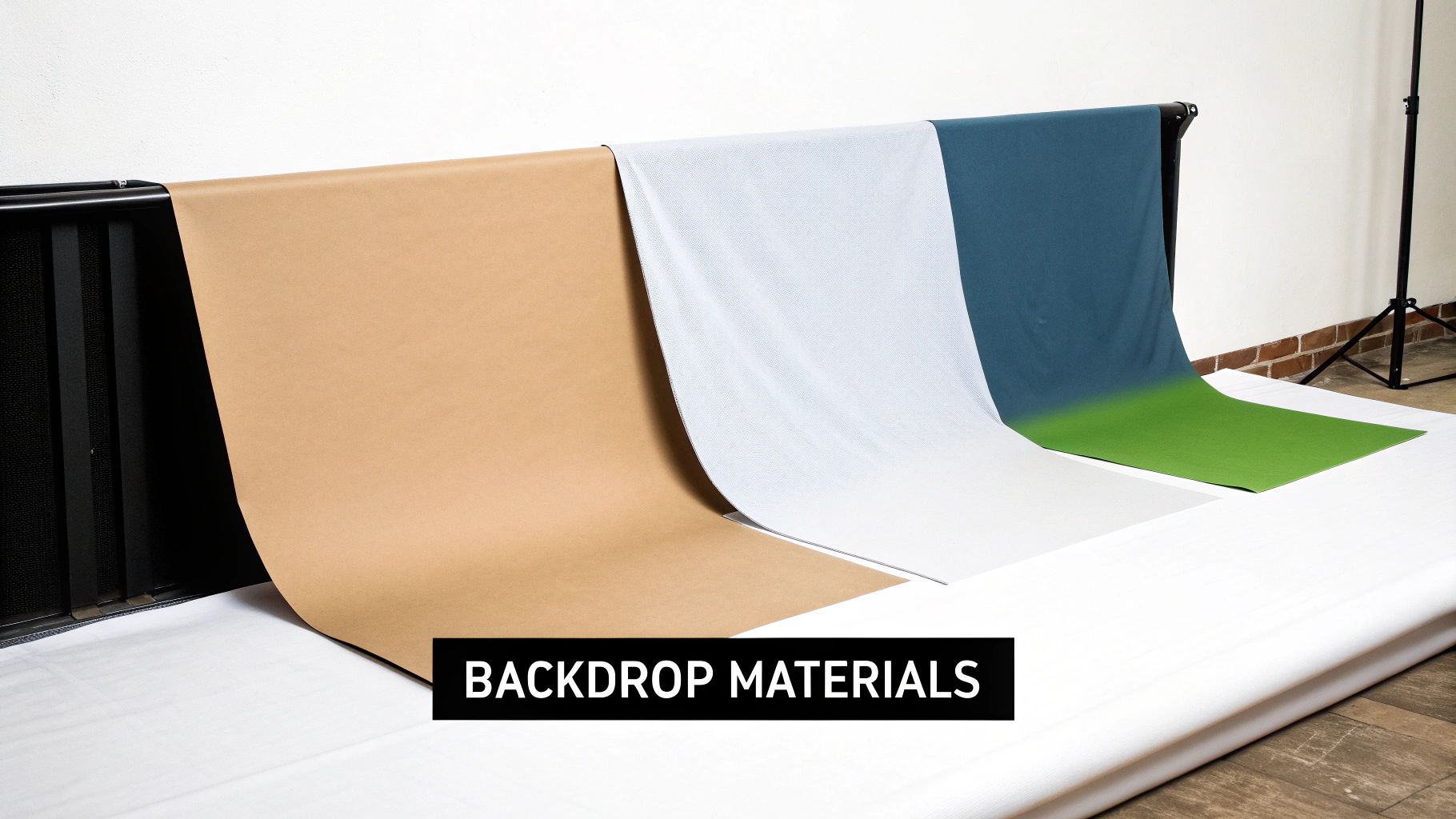
Think of it like an artist choosing a canvas. A rough, textured surface creates a completely different painting than a smooth, glossy one. In the same way, the material of your backdrops and stands for photography will define the character of every shot you take.
Paper Seamless Backdrops
Paper seamless rolls are a studio workhorse for a very good reason. They deliver a perfectly smooth, non-reflective surface that's unbeatable for clean headshots, crisp product photography, and that classic "infinite void" look.
When a paper backdrop gets scuffed or dirty, you just snip off the used part and roll down a fresh, clean section. This makes them incredibly efficient for high-volume shoots where you need consistency above all else. Their weakness? They're fragile and hate moisture, so keep them away from messy shoots or outdoor locations.
Fabric Backdrops
Fabric backdrops, like classic muslin or canvas, are all about adding texture and depth. Muslin is lightweight and drapes beautifully, creating soft, elegant patterns that portrait photographers love for achieving a more artistic, less clinical feel.
Canvas backdrops are the heavyweights. They're often hand-painted, providing a rich, unique background perfect for dramatic and painterly portraits. The main trade-off is their tendency to wrinkle, so you'll probably need to steam or stretch them before a shoot to get them looking perfect.
Your backdrop material is a silent partner in your storytelling. A forgiving, textured fabric suggests warmth and tradition, while a crisp, seamless paper creates a modern, clean-cut impression.
To get a better sense of how different materials translate on camera, it’s worth checking out guides on the best headshot backgrounds to see real-world examples.
Vinyl and PVC Backdrops
When you need something bombproof and easy to clean, nothing beats vinyl. This material is a lifesaver for food photographers, newborn shoots, or any situation where liquids and messes are part of the job. A quick wipe-down is all it takes.
Vinyl backdrops are also incredibly durable, resistant to wrinkles, and come in a huge range of colours and printed designs—including convincing wood, brick, and stone textures. Our detailed guide on event backdrop banners shows how versatile materials like PVC vinyl are for large-scale displays. The only thing to watch for is that some cheaper versions can have a slight sheen, which might cause glare if you're not careful with your lighting.
Comparison of Backdrop Materials
To help you weigh up the options, here’s a quick comparison of the most popular backdrop materials.
| Material Type | Best For | Pros | Cons |
|---|---|---|---|
| Paper | Product shots, headshots, e-commerce | Smooth, non-reflective, consistent colour | Easily damaged, not reusable if dirty |
| Fabric | Portraits, artistic shoots, video | Textured, portable, drapes beautifully | Wrinkles easily, can be hard to clean |
| Vinyl | Food photography, messy shoots, events | Extremely durable, wipeable, wrinkle-free | Can be reflective, heavy to transport |
Ultimately, the best material depends entirely on what—and where—you’re shooting. Many photographers keep a mix of all three on hand to be ready for any creative brief.
Selecting Your Ideal Backdrop Stand System
If your backdrop is the canvas, then the stand system is the sturdy easel holding it all together. It's the unsung hero of your setup, providing the rock-solid stability and flexibility you need to get professional results. Choosing the right one is a crucial balancing act between portability and durability, making sure your backdrops and stands for photography are both safe and effective.
A great stand does more than just hold things up; it adapts to how you work. Think of it as the skeleton of your creative space. A flimsy one leads to constant, frustrating adjustments and can even collapse, while a robust system gives you the confidence to focus on what really matters—your subject.
The Anatomy of a Good Stand
Getting to know the components of a stand system helps you make a much smarter choice. These key elements determine how it will perform in different situations, from a cramped home studio to a busy event hall.
- Height and Width Adjustment: Look for stands that offer a wide range of adjustments for both height and the crossbar width. This versatility lets you handle everything from a single headshot to a full family portrait.
- Base Stability: The legs or feet of the stand are critical. A wider footprint generally means more stability, which is absolutely essential when you’re using heavy backdrops like vinyl or canvas.
- Load Capacity: Every stand has a maximum weight it can safely support. Always check this spec to make sure it can handle your heaviest backdrop material without putting anything (or anyone) at risk.
- Ease of Assembly: For photographers on the move, a stand that assembles and breaks down quickly without needing tools is a massive advantage. Time is money, after all.
Standard Support Systems vs T-Stands
The two most common types of stands serve very different needs. The standard background support system—the one with two tripod-style stands and a telescopic crossbar—is the workhorse for most. This design is versatile, stable, and perfect for the wider backdrops you’d use in a studio or for group shots.
On the other hand, a T-stand uses a single central support with a crossbar at the top. It’s far more compact and lightweight, making it ideal for smaller backdrops, tight spaces, or headshot sessions on location. The trade-off? Its smaller footprint makes it less stable, especially with wider or heavier materials.
Your choice of stand directly impacts your efficiency. A solid, easy-to-use system becomes an invisible part of your workflow, while a poorly matched one creates constant friction and slows you down.
This need for reliable, efficient gear is reflected across the UK's professional photography market. Valued at approximately £1.9 billion in 2025, the sector thrives on getting the job done well, particularly in competitive hubs like London where over a third of photography businesses are based. You can read more about these insights into UK professional photography market trends.
For event planners and exhibitors, the principles of stability and ease of use are just as important. In fact, many photographers find that our guide on portable display stands for exhibitions offers helpful advice on selecting reliable hardware for any on-location job. Ultimately, choosing a stand is about matching the hardware to the demands of your specific work, ensuring safety and a seamless creative process every single time.
Matching Your Gear to the Photography Job
The best backdrops and stands for photography are never a one-size-fits-all affair. Far from it. A setup that works beautifully in a controlled studio can become a complete liability at a fast-paced outdoor event. The real secret to a smooth workflow and professional results is simple: match your equipment to the job at hand.
Think of your kit like a toolbox. You wouldn't bring a sledgehammer to fix a watch, and you wouldn't use a tiny screwdriver to build a garden wall. Your choice of backdrop and stand should be just as specific, a direct response to what the shoot demands.
Studio Portraits and Headshots
When you're in the studio, your world is controlled. Here, your priorities shift to stability, generous sizing, and achieving a perfect, seamless finish. This is the natural habitat for a heavy-duty background support system. It's built to safely hold wide, heavy rolls of seamless paper or luxurious canvas, giving you plenty of room to pose your subjects and arrange your lighting.
For corporate headshots, you can't go wrong with crisp white, grey, or black seamless paper – it’s the industry standard for a reason. If you're aiming for more creative portraits, a hand-painted canvas or a richly coloured fabric can introduce gorgeous texture and mood. Since you're not packing up and moving, portability is a non-issue. Go for the most robust, permanent setup you can.
Event Photography and Photo Booths
Once you step out of the studio and onto location for an event, the game changes completely. Portability and lightning-fast setup are now your top priorities. A lightweight, collapsible stand isn’t just nice to have; it's essential. You need something you can assemble and take down in moments, often in crowded or awkward spaces.
This is where wrinkle-resistant fabric backdrops really prove their worth. They are an event photographer's best friend – light, easy to transport, and designed to be stretched taut to pull out any creases. Here in the UK, the photo booth scene is also seeing a big push towards sustainability, with clients increasingly asking for eco-friendly backdrops and stands at everything from corporate functions to festivals. If you want to dive deeper into this, you can explore market reports on the UK photo booth industry.
This simple decision tree can help you pick the right gear based on where you'll be shooting.
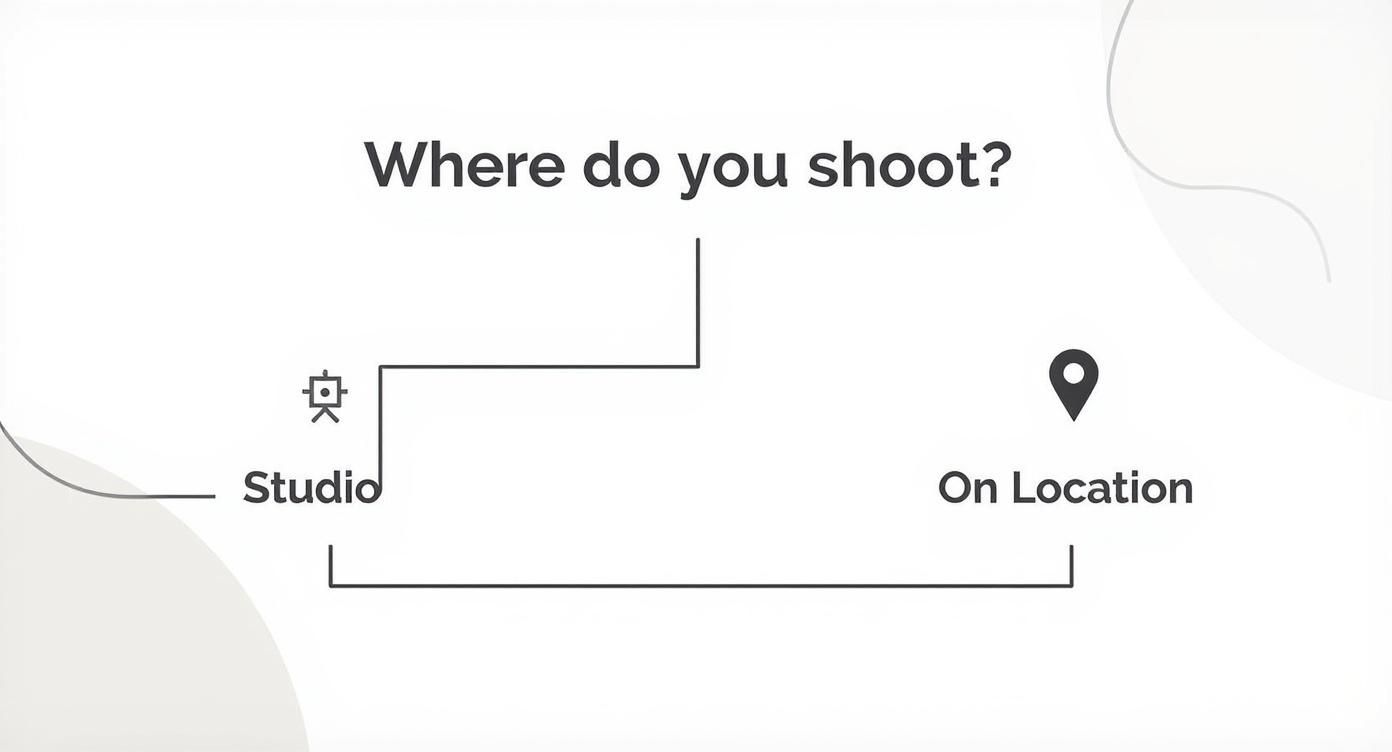
As the graphic shows, studio work is all about heavy, permanent systems, while jobs on the move demand gear that’s light and portable.
Outdoor and Location Shoots
Taking your kit outdoors introduces a whole new cast of troublemakers: wind, uneven ground, and unpredictable light. Suddenly, stability isn't just a priority; it's absolutely critical. You’ll need a stand with a wide, sturdy base and, crucially, the ability to be weighed down with sandbags.
For outdoor work, your stand isn't just a support; it's an anchor. A gust of wind can turn a flimsy setup into a dangerous sail, so never compromise on stability.
As for the backdrop material, a darker, matte fabric or vinyl is often a smart move, as it’s less likely to get washed out by bright sunlight. Portability is still a factor, of course, but it has to be balanced with the need for a system that can stand up to the elements safely and reliably. Building a versatile kit means you’ll always be ready to adapt to whatever your client needs.
Essential Tips for Setup and Maintenance
Getting professional results isn't just about buying the right gear—it’s about knowing how to use it and look after it. A perfectly smooth, flawless backdrop begins with a safe, secure setup, which ensures your backdrops and stands for photography not only look great but last for years.
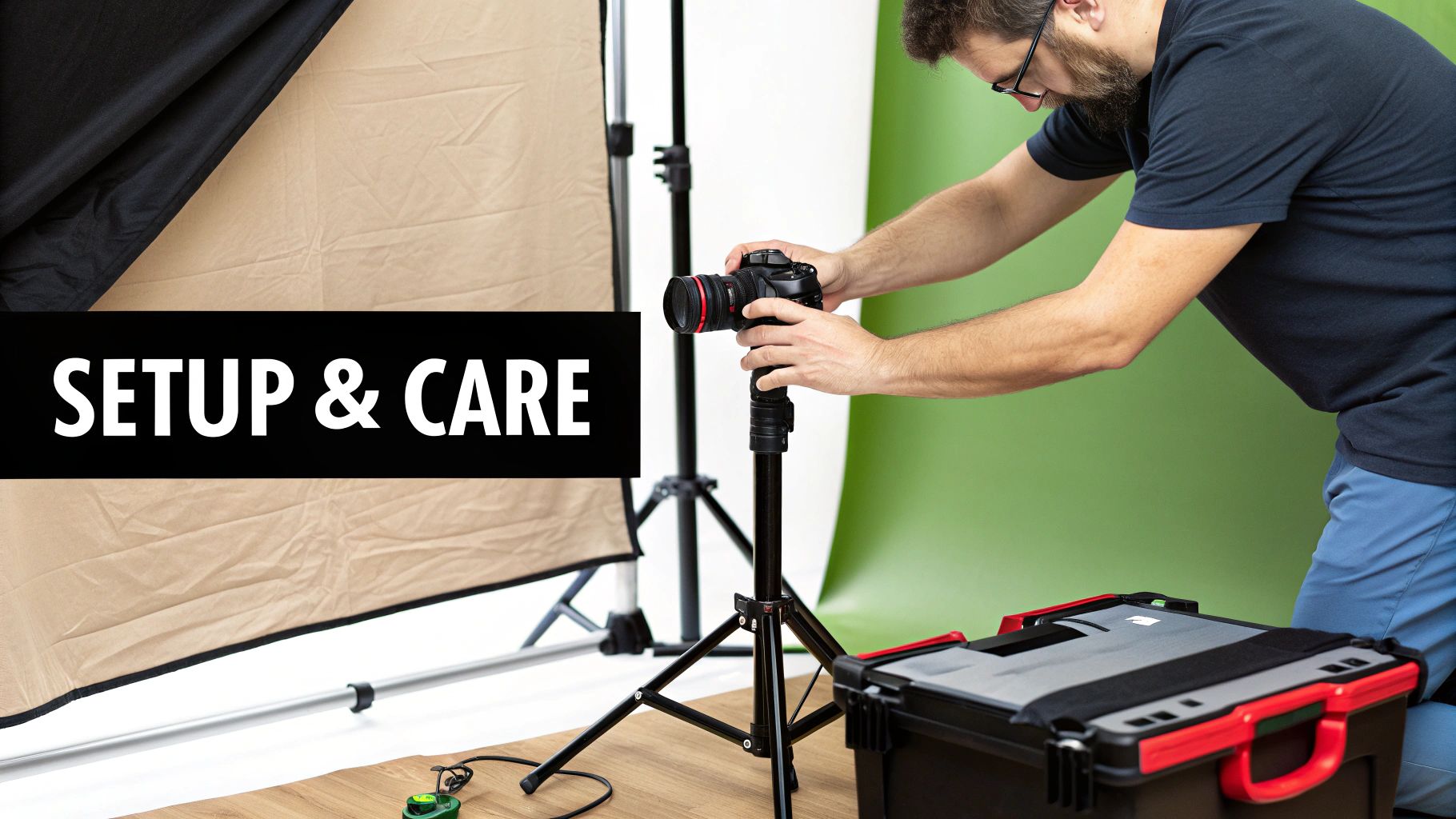
Always start by assembling your stand on a level surface. Give it a wide, stable base by extending the tripod legs as far as they’ll comfortably go. Raise the vertical poles one section at a time, making sure to lock each one securely before extending the next. This simple habit prevents nasty surprises like a collapsing stand mid-shoot.
Achieving a Flawless Surface
With the stand securely in place, the real goal is to get rid of every last wrinkle, crease, and shadow. A polished, professional finish comes down to one thing: even tension across the entire backdrop surface.
For this, A-clamps are a photographer's secret weapon. Use them to clip the backdrop to the crossbar first, then pull everything taut along the vertical poles. It’s a game-changer.
- Top Edge: Start by securing the backdrop to the crossbar. Let it hang straight before you do anything else.
- Side Tension: Now, gently pull the sides of the backdrop and clamp them to the stand's vertical poles. This little trick works wonders on most vertical wrinkles.
- Bottom Edge: For materials like fabric or vinyl, you can weigh down the bottom with a spare pole or some sandbags to pull it perfectly smooth.
Taking a few minutes to get this right will save you hours of tedious editing in post-production. Trust us, it’s worth it.
A wrinkle-free backdrop is the foundation of a clean shot. By mastering tensioning techniques, you control the canvas and eliminate distractions before you even press the shutter.
Protecting Your Investment
A bit of proper care and maintenance will dramatically extend the life of your equipment. Different materials need different cleaning methods, so always check what you’re working with to avoid causing any permanent damage.
Here's a simple checklist to protect your gear:
- Cleaning: Vinyl backdrops can be wiped with a damp cloth. Most fabrics can be gently steamed or spot-cleaned. For seamless paper, you just cut off the dirty or damaged bit at the end. Easy.
- Storage: The number one rule is to always roll your backdrops tightly around a core—never fold them. Folding creates permanent creases that are almost impossible to get out. Store them upright in a dry, cool place.
- Stand Inspection: Every so often, give your stand a quick once-over. Check for loose screws, bent poles, or any locking mechanisms that look worn out. Catching minor wear and tear early prevents a catastrophic failure on a job.
By building these simple setup and care routines into your workflow, your backdrops and stands will remain reliable assets, ready to deliver a perfect finish for every single project.
Final Checklist Before You Buy
Before you hit that order button, it’s always worth running through a final pre-flight check. Thinking about a few practical details now can save you from a world of headaches later, ensuring the backdrops and stands for photography you choose fit your workflow perfectly from day one.
Consider the entire process, from the click of a button to the final setup. If you’re getting a custom-printed backdrop for an upcoming shoot, what’s the turnaround time? At Banner Printing Ltd, most orders are out the door within 24-48 hours, but this is a critical detail to confirm if you’re working to a tight client deadline.
Finishing Options and Stand Compatibility
How your backdrop is ‘finished’ – meaning how the edges are prepared – is a small detail that makes a huge difference. It directly impacts how you can hang it and whether it’s compatible with your stand, so getting it right is vital.
- Pole Pockets: These are simply loops of material sewn along the top and sometimes the bottom edges of the backdrop. They’re designed to slide straight onto a stand’s crossbar, giving you a clean, taut, and professional display. This is the most common and secure choice for standard backdrop support systems.
- Grommets (Eyelets): These are reinforced metal rings punched along the edges. Grommets give you far more versatility, letting you hang the backdrop with hooks, rope, or even cable ties. They’re perfect for attaching backdrops to walls or custom-built frames but can look a little less tidy on a standard stand if not pulled tight.
To help you decide, here’s a quick guide to the most common finishing options we offer and where they shine.
Backdrop Finishing Options Guide
| Finishing Option | Description | Best Use Case |
|---|---|---|
| Pole Pockets | A loop of material sewn along the top/bottom edge for a crossbar. | Standard adjustable backdrop stands for a seamless, taut look. |
| Grommets/Eyelets | Reinforced metal rings punched into the banner's edges. | Hanging on walls, fences, or custom frames with hooks or ties. |
| Hemmed Edges | The edges are folded over and sewn for extra durability. | A good base for any finish, preventing fraying on fabric backdrops. |
| Clean Cut | The material is cut precisely to size with no extra finishing. | Best for tension fabric systems where the frame itself holds the graphic tight. |
Choosing the right finish ensures your backdrop hangs smoothly without sagging or wrinkles. A classic 8ft x 8ft backdrop stand, for instance, is practically made for pole pockets, creating that seamless look everyone wants. If you already have a stand you love, you can always order a new graphic and grab the backdrop stand hardware only to make sure everything lines up perfectly.
Think of finishing options as the final handshake between your backdrop and your stand. Mismatched choices lead to sagging, wrinkles, and a frustrating setup experience.
Sustainable Material Choices
Finally, take a moment to think about the environmental impact of your gear. More and more photographers and clients are looking for sustainable options, and the demand for eco-friendly materials is only growing.
Keep an eye out for PVC-free materials or fabrics made from recycled content. Choosing a durable, high-quality backdrop that you can use again and again isn't just better for the planet—it’s a much smarter long-term investment for your business. This last check makes sure your new equipment aligns with your creative needs, your practical realities, and your professional values.
Your Backdrop & Stand Questions Answered
Getting started with backdrops and stands for photography always brings up a few questions. We get it. To help you get set up and shooting faster, here are the answers to the queries we hear most often.
How Big Should My Backdrop Be?
It all comes down to what you’re shooting. For a simple headshot or a single portrait, a backdrop around 1.5 metres wide will do the trick perfectly.
But if you're planning to photograph couples, small groups, or need those full-body fashion shots, you’ll want to go wider. Aim for at least 3 metres to give yourself plenty of room to work without the backdrop edges creeping into your frame.
How Do I Stop Reflections on a Vinyl Backdrop?
That annoying glare on a vinyl backdrop is a classic lighting problem. It’s caused by a hard, direct light source hitting the glossy surface. The fix is simple: soften your light.
Instead of pointing your light straight at the backdrop, use a large softbox or an umbrella. Position it at an angle to feather the light across the surface. This creates a gentle, even illumination that kills the glare instantly.
Can I Use a Backdrop Stand Outdoors?
Yes, you absolutely can, but you have to be careful. The wind is not your friend here.
Always use a heavy-duty stand with a wide, stable base. Most importantly, you must anchor it securely with sandbags on the legs. A gust of wind can turn your backdrop into a giant sail, which is a serious safety risk if it’s not properly weighed down. It’s also wise to use a heavier material like vinyl, as it will flap around far less than a lightweight fabric.
Ready to create a professional look for your next shoot? Banner Printing Ltd offers a wide range of high-quality, custom-printed backdrops and reliable stand systems to fit any project. Explore our durable, vibrant options and get fast, free UK delivery at https://bannerprintingltd.co.uk.


