
In a world buzzing with digital notifications and fleeting online ads, it’s easy to think the humble banner has had its day. But you’d be wrong. Banners are one of the most effective, high-impact physical marketing tools a UK business can have in its arsenal, perfect for grabbing attention, driving footfall, and shouting about your events.
Why Banners Are Still a Powerhouse for Advertising
Think about it. A well-placed banner doesn't just ask for attention; it commands it. It's a real-world presence that cuts through the digital clutter and delivers a clear, tangible message to the people you want to reach most: your local community.
Unlike an online ad you can scroll past in a heartbeat, a printed banner takes up physical space. It becomes part of the local scenery—whether it’s tied to the railings outside a new coffee shop, hanging from scaffolding on a building site, or standing tall at a trade show. That physical presence builds brand recognition in a way that digital just can't replicate.
Turning Passers-By Into Customers
Banners are fantastic at sparking real-world action precisely when and where it matters. They act as bold signposts, guiding people straight to your door or event. The benefits are simple but powerful:
- Immediate Local Impact: Announce a grand opening, a flash sale, or a community event to the people who are right there, ready to act.
- Seriously Cost-Effective Reach: Forget endless monthly ad spend. A single, quality banner is a one-off investment that can keep working for you for months, or even years.
- Builds Trust and Authority: A professionally printed banner shows you’re a serious, established business. It signals permanence and credibility.
Not Just Surviving, But Thriving
Physical advertising isn't just holding on; it's making a serious comeback. In the first quarter of this year alone, the UK's out-of-home advertising market saw banner revenue jump by an incredible 19% year-on-year, part of a total market worth £294.5 million. That’s a huge vote of confidence from businesses who know what works.
If you want to dig deeper into why banners are more relevant than ever, you can explore more about banner printing's growing importance in our 2025 UK update.
A banner is more than just printed vinyl; it's a physical handshake with your community. It says, "We are here, we are open, and we have something valuable to offer you right now."
This guide is your complete playbook for getting it right. We'll walk you through everything—from picking the perfect banner type and material to designing a message that stops people in their tracks and installing it for maximum impact. By the time you're done, you'll know exactly how to make a simple banner one of your most powerful advertising tools.
Choosing the Right Banner for Your Advertising Goal
Picking the right banner for your advertising campaign is like choosing the right gear for a specific job. You wouldn't use a delicate paintbrush to paint a house, and you wouldn't bring a sledgehammer to hang a picture frame. In the same way, your banner has to be a perfect match for its purpose and environment to really get your message across.
Not all advertising banners are created equal. Far from it. Each type is engineered for a specific scenario, bringing its own unique strengths to the table. Nailing this choice from the get-go ensures your message lands with maximum impact, whether you're trying to flag down passing cars or impress clients at a corporate event.
The decision is actually pretty straightforward once you pin down your main objective. Are you going for big, bold, outdoor brand awareness? Or do you need a sleek, portable display for an indoor trade show? Answering that one question is the first step to finding your perfect banner.
This simple flowchart helps connect your goal directly to the ideal banner type.
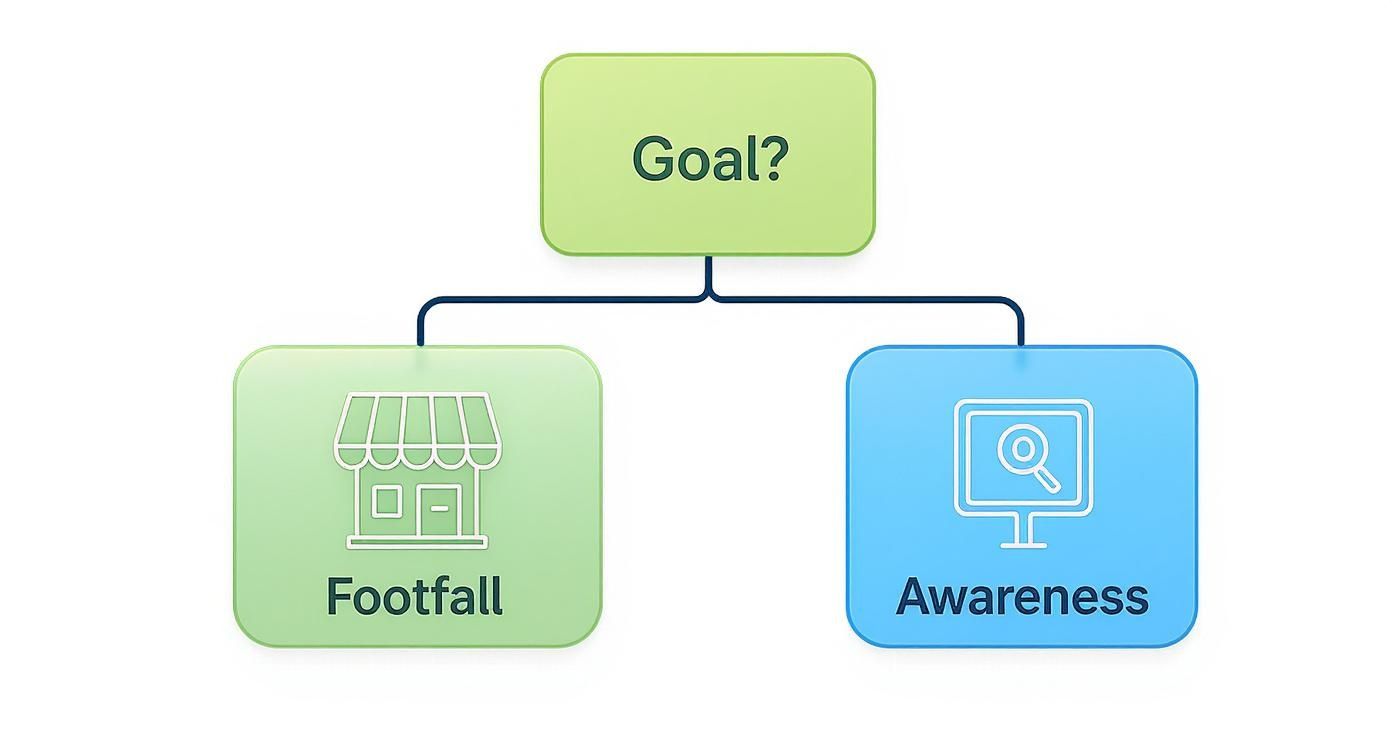
As you can see, your core objective—whether it's driving immediate footfall or building long-term brand awareness—points you toward specific banner solutions designed for that very task.
To help you get a quick overview, this table breaks down the most common banner types and their ideal uses.
Matching Banner Types to Your Advertising Needs
| Banner Type | Best For | Key Advantage | Ideal Environment |
|---|---|---|---|
| PVC Vinyl | High-impact outdoor advertising & promotions | Durability, weatherproof, vibrant print quality | Shopfronts, roadsides, events, building sites |
| Mesh | Large banners in windy or exposed locations | Wind-permeable, reduces 'sail effect' strain | Scaffolding, fences, bridges, open-air festivals |
| Roller | Indoor events, exhibitions & trade shows | Highly portable, fast setup, professional look | Conferences, reception areas, retail spaces |
| Fabric Backdrop | Photo opportunities, media walls & brand events | Glare-free, premium look, seamless finish | Press events, trade show booths, red carpets |
Now you've got the lay of the land, let's dive into the specifics of each banner type to see which one fits your needs best.
The Workhorse: PVC Vinyl Banners for Maximum Visibility
Think of the classic PVC vinyl banner as the rugged, reliable workhorse of the advertising world. It’s tough, fully weatherproof, and built to shout a bold message outdoors for weeks or months on end. This is your go-to for high-impact, long-lasting campaigns.
Its solid, opaque surface is the perfect canvas for stunning, high-resolution printing. Colours absolutely pop and text stays razor-sharp, making it ideal for detailed graphics and photos that need to grab attention from a distance.
Ideal Applications for Vinyl Banners:
- Shopfront Promotions: Announcing sales, new stock, or a grand opening.
- Building Wraps: Covering scaffolding with huge branding during construction.
- Event Signage: Directing festival-goers, marking entrances, and promoting sponsors.
- Roadside Advertising: Catching the eye of thousands of commuters every day.
The Smart Choice: Mesh Banners for Windy Locations
Ever tried to fly a solid sheet of plastic in a storm? It doesn't end well. A standard vinyl banner in an exposed, windy spot faces the same problem—it acts like a giant sail, putting incredible strain on its fixings.
This is exactly where the mesh banner comes in.
Mesh banners are cleverly perforated with thousands of tiny holes, allowing wind to pass straight through. This simple but brilliant design reduces the dangerous 'sail effect' by around 37%, protecting both the banner and whatever it’s attached to from damage.
While the perforations mean the print is slightly less saturated than on solid vinyl, that trade-off is absolutely essential for safety and longevity in blustery conditions. It's the only sensible choice for large banners in exposed areas.
Opt for a mesh banner when your advertising spot is prone to high winds, such as:
- Construction site fencing or scaffolding.
- Bridges and the perimeters of open-field festivals.
- Large-scale building advertisements.
The Professional: Roller Banners for Indoor Events
When you move indoors, the game changes. Durability against the elements is swapped for portability and a polished, professional look. A roller banner (or pull-up banner) is essentially a portable presentation in a tube. It's lightweight, dead simple to transport, and can be set up by one person in seconds.
This makes it an absolute must-have for any business attending trade shows, conferences, or indoor exhibitions. It gives you a substantial, professional branding presence without the logistical nightmare of a big, complicated display. Because it's so compact, you can easily carry it on a train or pop it in the boot of your car.
The Showstopper: Fabric Backdrops for Photo Opportunities
Finally, for those times when you need to create a truly immersive brand experience, you need a fabric backdrop. These large-format banners are printed on non-reflective, tensioned fabric, creating a seamless and seriously professional wall of branding. Think of it as your portable red-carpet moment.
They are perfect for press conferences, premium trade show booths, and photo opportunity walls where a glare-free, high-end finish is non-negotiable. The fabric material gives a softer, more luxurious look than vinyl, guaranteeing your brand looks its absolute best in photos and videos. It’s a fantastic investment for any event where you expect a media presence or want to encourage social media sharing.
Understanding Banner Materials and Finishes
Getting the material right for your banner is one of those details that makes a world of difference. It's not just a technical spec; it's what determines how long your banner lasts, how good it looks, and whether you get a real return on your investment. Choose wisely, and your banner will look sharp and professional whether it's battling the wind on a construction site or looking polished at an indoor expo.
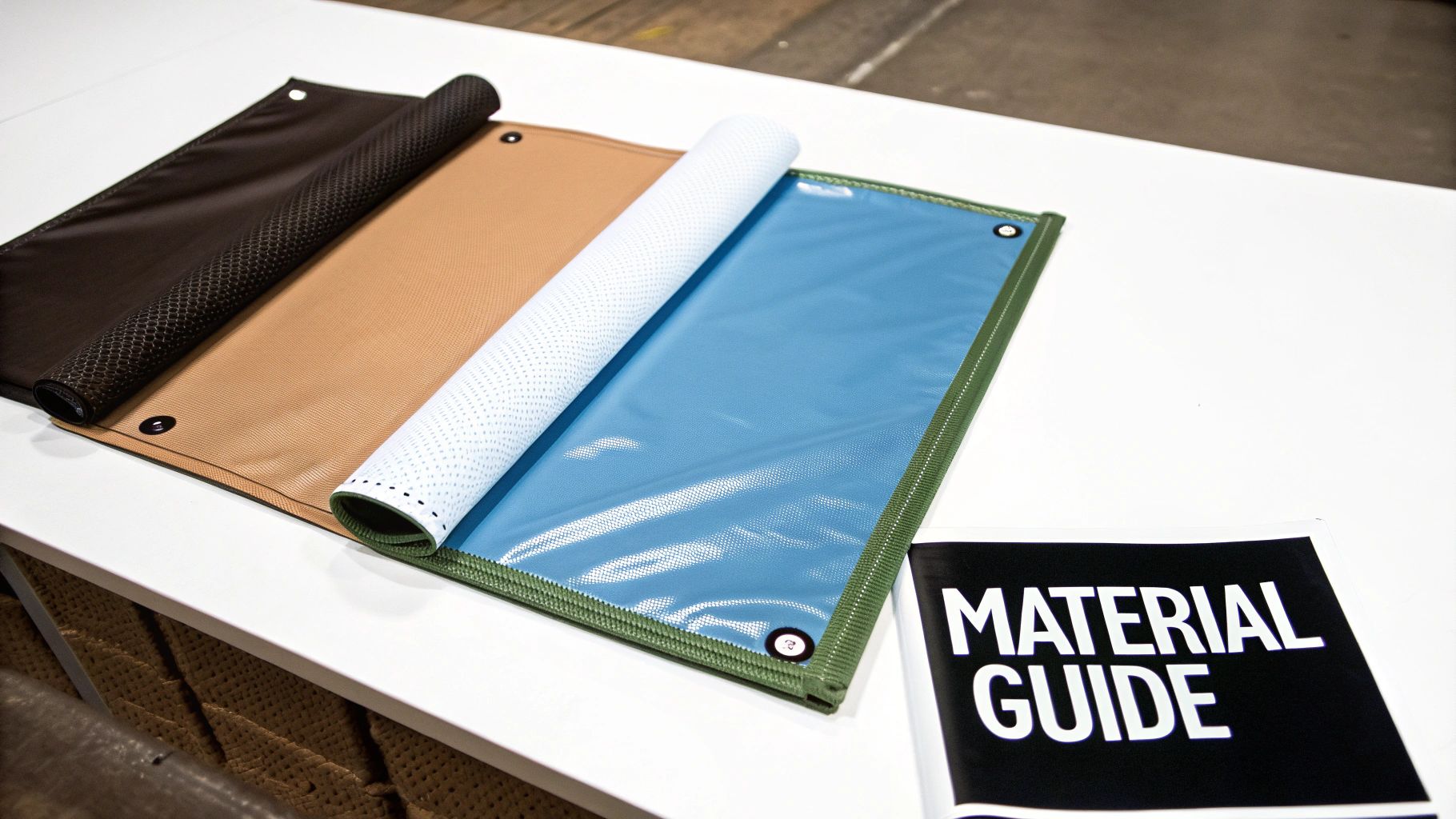
Think of it like picking a coat. You wouldn't wear a light rain mac in a blizzard, would you? The same logic applies here. A lightweight fabric banner that’s perfect indoors will get torn to shreds by the Great British weather if you hang it outside. Knowing the difference between the main options—PVC vinyl, mesh, and fabric—is the first step to making a smart choice.
Decoding GSM: The Key to Durability
When you’re browsing materials, you'll see the term GSM a lot. It stands for Grams per Square Metre. Don't let the acronym put you off; it's just a straightforward way to measure the material's weight and thickness.
A good comparison is regular office paper. A flimsy 80gsm sheet is fine for everyday printing, but for a CV or certificate you want to impress with, you’d reach for a thicker, more substantial 160gsm card.
It’s exactly the same for banners:
- Higher GSM: This means a heavier, thicker, and generally tougher material. A 510gsm PVC vinyl is a robust, heavy-duty option built to last outdoors for the long haul.
- Lower GSM: This points to a lighter material. For instance, a 340gsm mesh banner is lighter by design to let wind pass through, not because it’s lower quality.
Understanding GSM gives you the power to see past vague descriptions and make a proper decision based on real numbers. It’s the difference between hoping your banner will last and knowing it’s built for the job.
The Core Material Choices
Where your banner is going and what it's for will point you to the right material. While there are some specialist options out there, most advertising needs in the UK are covered by these three main players.
1. PVC Vinyl: The All-Round Outdoor Champion
Standard PVC (polyvinyl chloride) is the absolute workhorse of the banner world. It's a solid, opaque material that’s famous for its durability and the vibrant, punchy print quality it delivers. Because it’s fully weatherproof and UV-resistant, it's the go-to choice for the vast majority of outdoor advertising banners.
2. Mesh: The Wind-Resistant Solution
Mesh banners are a clever twist on PVC. They’re perforated with thousands of tiny holes, which allows wind to pass straight through. This is a game-changer because it slashes the "sail effect," stopping the banner from tearing or putting too much strain on its fixings. The print is a touch less vivid up close because of the holes, but it’s the only sensible choice for large banners on scaffolding, fences, or bridges. If you're weighing up the options, our guide on comparing mesh vs PVC banners gives you a full breakdown.
3. Fabric: The Premium Indoor Option
For indoor events, trade shows, and backdrops, fabric banners bring a touch of class. They give you a sophisticated, high-end look that’s lightweight, dead easy to transport, and has a glare-free finish. That last part is key—it looks absolutely superb in photos and under bright event lighting.
Finishing Touches That Maximise Lifespan
It’s the small details in how a banner is finished that can make a huge difference to how long it lasts and how professional it looks.
- Reinforced Hems: We fold the edges of the banner over and weld or stitch them to create a double-thick border. This simple step massively strengthens the banner and stops the eyelets from tearing out when you pull it tight.
- Sturdy Eyelets: These are the metal rings punched along the hem that you use for hanging the banner with rope or cable ties. We use nickel or brass eyelets because they're rustproof and provide solid, reliable anchor points.
- Lamination (Matt vs Gloss): We can apply a clear protective layer over the print. A gloss laminate makes colours really pop but can catch the light, while a matt laminate gives a subtle, non-reflective finish that’s much easier to read in direct sunlight.
When you're thinking about the physical side of your advertising, it's worth noting how insights from large-format poster printing materials show the impact material choice has on the final look and durability. Physical and digital advertising work best together. While UK digital advertising is projected to grow by 15.1% thanks to precise targeting, it complements, rather than replaces, the crucial role that high-quality physical banners play in a well-rounded campaign.
Designing a Banner That Actually Gets Noticed
A great banner isn't just a big bit of print; it's a masterclass in rapid, powerful communication. When your audience is a passing car or a shopper on a mission, you don’t have minutes to make your case. You barely have seconds.
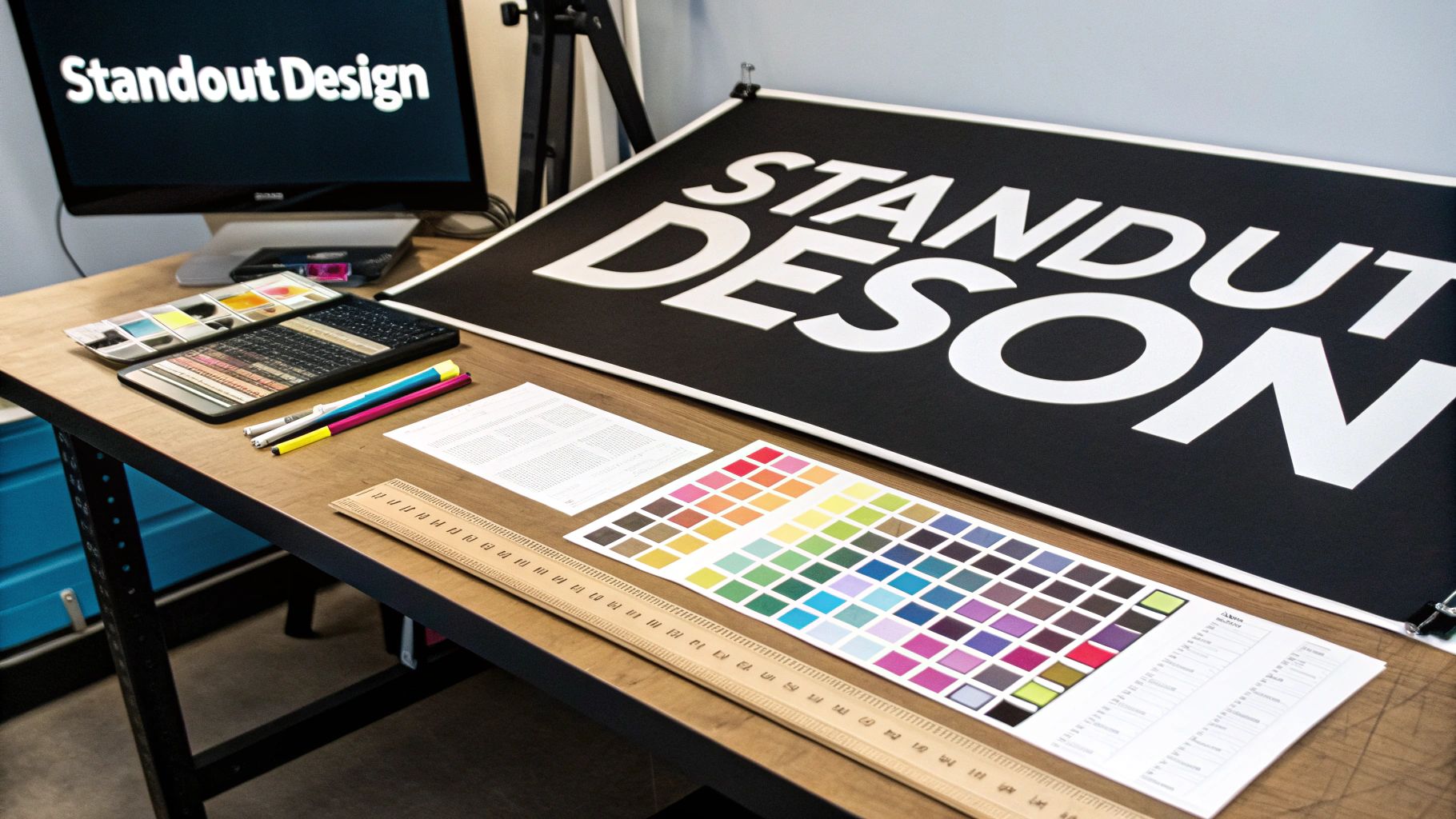
This is where the 'three-second rule' comes into play. If someone walking past can't figure out who you are, what you're offering, and what they should do next in roughly three seconds, that opportunity is gone for good. This simple principle should be the driving force behind every design decision you make.
Crafting a High-Contrast Colour Palette
First things first, your banner has to stand out from its background. A design that looks stunning on a bright computer screen can completely vanish when it’s up against a busy brick wall or a row of colourful shopfronts. The secret to being seen from a distance is high contrast.
Think simple, bold pairings that the eye can process instantly. A dark-on-light or light-on-dark approach is a classic for a reason—it works every single time.
Give these high-impact combinations a try:
- Black on Yellow: Absolutely unbeatable for grabbing attention. It’s no coincidence it's used for safety and warning signs.
- White on Royal Blue: This pairing has a clean, corporate feel. It looks professional and is incredibly easy to read.
- Yellow on Dark Green: Delivers excellent contrast but feels more natural and less aggressive than the black and yellow combo.
Steer clear of low-contrast pairings like grey on white or pastels on a light background. They might seem subtle and sophisticated up close, but from ten metres away, they just become a blurry mess. Your goal here is legibility, not subtlety.
Choosing Fonts for Readability
When it comes to the text on your banner, clarity beats creativity every single time. Forget fancy script fonts or thin, delicate typefaces—they are the enemy of the three-second rule. You need fonts that are bold, clean, and can be read in a flash.
Stick to reliable sans-serif fonts like Helvetica, Arial, or Open Sans. Their clean lines and even thickness make them a breeze to read from a distance. If you need a secondary font for a small detail, that’s fine, but make sure your main headline and contact details use the clearest, boldest option you can find.
The most beautifully designed banner in the world is a failure if no one can read it. Prioritise bold, simple typography to ensure your core message is delivered instantly and without effort from the viewer.
Don't forget that size is just as important as style. A good rule of thumb is to have at least one inch of letter height for every ten feet of viewing distance. So, if you want your banner to be readable from 50 feet away, your main headline letters need to be at least five inches tall.
Focusing on a Single, Powerful Message
One of the biggest mistakes people make with banner design is trying to say too much. A banner is not a brochure. If you bombard people with a long list of services, multiple offers, and complex contact details, you guarantee they'll remember absolutely none of it.
Your banner needs one clear job. What's the single most important thing you want people to know or do?
- Grand Opening Friday
- Summer Sale 50% Off
- Festival Entrance This Way
Once you've nailed your core message, support it with only the absolute essentials: your company name, a website, or a date. Everything else is just noise that weakens your main point.
Finally, every great banner needs a clear Call to Action (CTA). This is a short, punchy phrase that tells people what to do next. "Visit Our Website," "Call Today," or "Scan to Book" are all fantastic CTAs. For a deeper dive, our guide with 5 tips for custom banners in the UK will help you really sharpen your message and get results.
Banner Placement and Installation Best Practices
A fantastic banner in a terrible spot is a complete waste of money. Think of it like this: you wouldn't set up a pop-up shop in a deserted alley. The same logic applies to your banners. Nailing the placement and installation is the final, make-or-break step in turning your design into a marketing tool that actually works.
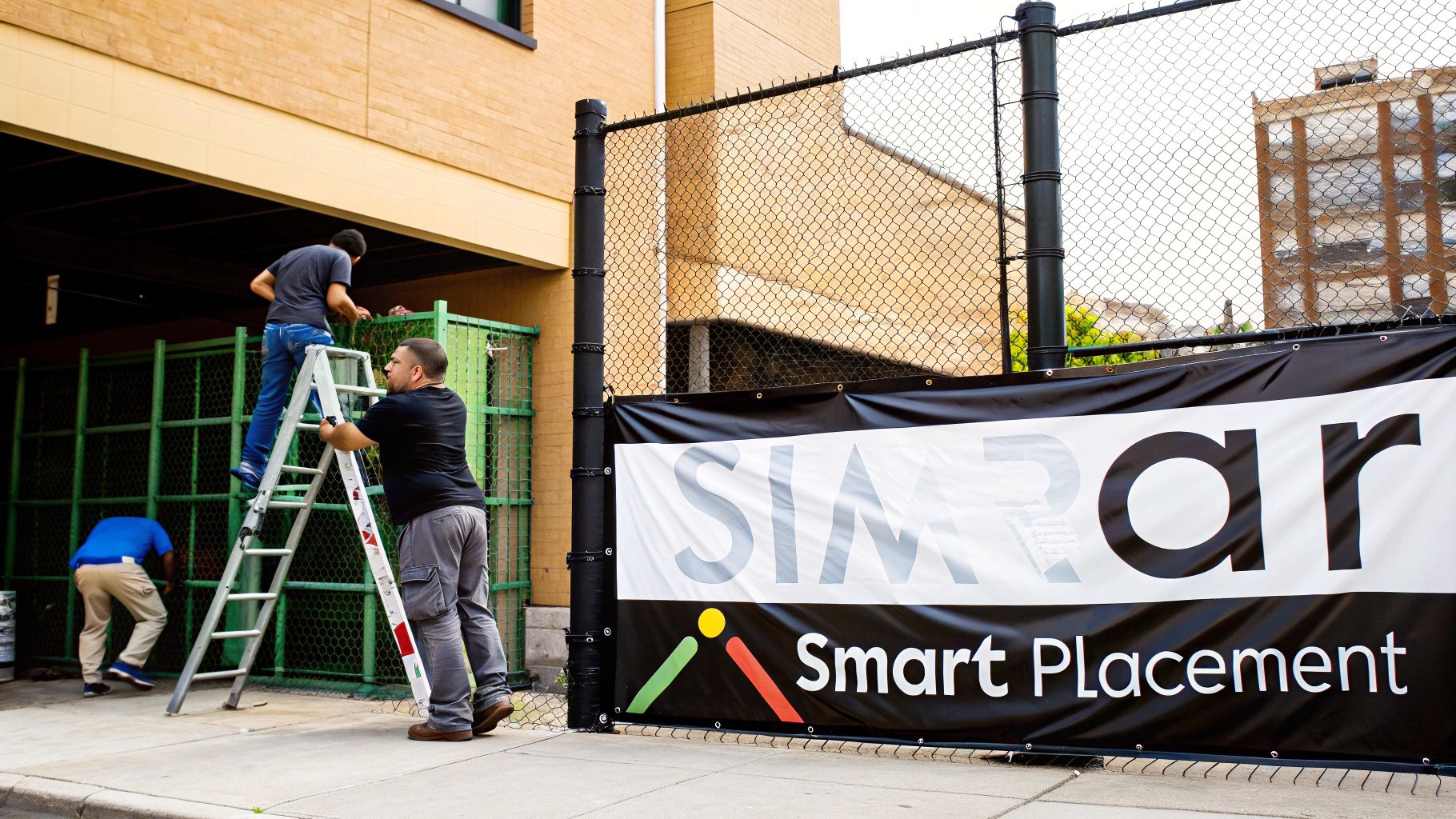
This process starts way before you grab a drill or a handful of cable ties. It begins with one simple question: can people actually read your message from where they'll be standing? If they have to squint, you've already lost.
Sizing for Maximum Readability
There’s a straightforward rule every business owner should memorise when it comes to banner text. It’s all about connecting the height of your letters to the viewing distance.
For every 10 feet of viewing distance, your main headline text needs at least one inch of height.
This little nugget of wisdom ensures your core message cuts through the noise, whether it's seen from across a busy road or a packed exhibition hall.
- Viewing from 30 feet: Your headline letters should be at least 3 inches tall.
- Viewing from 100 feet: You’ll need massive 10-inch-tall letters to be seen clearly.
Always put yourself in your audience's shoes. Are they strolling past your shopfront on foot, or are they flying past in a car on a main road? Your answer dictates how big your text needs to be.
Strategic Placement for High Impact
Once the sizing is sorted, finding the perfect spot is your next mission. You need to hunt for locations with the highest visibility for your target audience. Think about the natural flow of people and traffic.
Look for high-traffic "choke points"—places where people naturally slow down or gather. This could be a bustling intersection, the entrance to a festival, or even the queue for a popular food van. Placing your banner here gives you a captive audience with more time to soak up your message.
Also, think about the angle. Don't just slap your banner flat against a wall if people are approaching from the side. Angling it at 45 degrees towards oncoming traffic can massively boost its visibility and how long people have to read it. It's a simple trick that applies to all forms of advertising, right up to sophisticated digital outdoor signage.
Secure Installation for Safety and Longevity
How you hang your banner is just as important as where. A poorly installed banner isn't just unprofessional—it's a genuine safety hazard. The method you use will depend entirely on the surface you're working with.
Common Installation Scenarios:
- Brick or Concrete Walls: You'll need wall plugs and screws fitted with large washers over the eyelets. Don't skip the washers! They spread the tension and stop the eyelets from ripping out under strain.
- Wire Fences (e.g., Construction Sites): Heavy-duty cable ties are your best bet. Thread one through every single eyelet and pull the banner tight against the fence to stop it from flapping about.
- Between Posts or Freestanding Frames: Go for bungee cords or strong rope. The little bit of give in bungee cords is brilliant for absorbing wind gusts, which reduces the stress on the banner itself.
Whatever you do, make sure the banner is pulled taut. A saggy, flapping banner looks scruffy and is far more likely to be damaged by the wind. You're aiming for a tight, drum-like surface.
Mitigating Wind Risk for Outdoor Banners
The Great British weather is the ultimate stress test for any outdoor banner. Wind is your number one enemy, and it can turn a large banner into a giant, destructive sail in seconds. Luckily, there are ways to fight back.
Choosing a Mesh Banner is by far the best move for windy, exposed spots. The thousands of tiny holes let the wind pass straight through, cutting the load on the fixings by around 37%. This is non-negotiable for big banners on scaffolding or exposed fences.
For standard PVC banners, you can ask for wind slits. These are small, half-moon-shaped cuts that help relieve some of the pressure. While they help a bit, they aren't as effective as a proper mesh banner and can interfere with your design.
Your Banner Questions, Answered
Even when you've got a solid plan, a few questions always pop up right before you commit. It’s completely normal. Getting clear, practical answers is key to feeling confident you're making the right call for your business or event. We've pulled together the most common questions we hear to help fill in any blanks.
These are the real-world queries that come up time and time again. From wondering how a banner will handle the famously unpredictable UK weather to the nitty-gritty of artwork files, these answers will give you that final piece of the puzzle.
How Long Will My Outdoor Banner Last in UK Weather?
This is the big one, isn't it? The lifespan of your banner boils down to a mix of three things: the material, the finish, and how well you install it. A well-made, heavy-duty PVC vinyl banner that’s been properly secured using all its eyelets can easily last 3-5 years in typical British weather.
Of course, where you hang it matters. A banner in a sheltered spot will naturally fare better than one on an exposed coastal promenade, getting battered by high winds and salty air. To get the absolute most from your investment, always go for reinforced hems. And if a big storm is on the way, it’s always a smart move to take it down temporarily to avoid any damage.
A quick clean helps, too. Just wiping it down with a damp cloth a few times a year will stop dirt and grime from building up and keep your colours looking sharp.
Think of a banner like a quality coat. Good fabric is a great start, but it's the strong seams and solid fastenings that truly make it last through the winter. A banner's durability isn't just in the material; it's in the finishing and installation.
What Is the Difference Between a PVC and a Mesh Banner?
The easiest way to think about this is to compare a solid raincoat to a breathable windbreaker. They both do a job, but they’re designed for different conditions.
A PVC banner is a solid, non-porous material. This gives it a perfect, smooth surface for really vibrant, punchy colours and super-crisp graphics. It delivers maximum visual impact, which is why it’s the go-to for most situations where you want your message to be as bold as possible.
A Mesh banner, on the other hand, is still a PVC material, but it’s perforated with thousands of tiny holes. These little holes are the secret sauce—they let the wind pass straight through. This massively reduces the "sail effect," which is the strain the wind puts on the banner and its fixings. Your print will still look great, but it’s naturally a little less saturated up close because of the perforations.
So, how do you choose?
- Go for PVC for: Most standard uses like shop fronts, indoor events, and sheltered outdoor spots where you want the most vivid print possible.
- Go for Mesh for: Big banners in windy, exposed locations. Think construction site fencing, scaffolding, bridges, or breezy outdoor festivals.
What Resolution Should My Artwork Be for a Large Banner?
This is a really common point of confusion, but the answer is much simpler than you'd think. When you’re printing something as large as a banner, you absolutely do not need to design your artwork at 300dpi (dots per inch) at its final size. Doing that just creates enormous, clunky files that are a nightmare to work with.
A good rule of thumb is to create your artwork at 150dpi when set to 100% of the final print size. If you’re going for something huge, like a banner to cover the side of a building, a resolution of 75-100dpi is often more than enough.
Why? It all comes down to viewing distance. No one looks at a giant banner from a few inches away like they would a business card. From several metres back, the human eye simply can't tell the difference. The most important thing is to start with high-quality source files—especially for logos. Vector files (.ai, .eps, .svg) are your best friend here, as they can be scaled to any size without a single shred of quality loss.
How Do I Choose the Right Size for My Banner?
Getting the size right is a balancing act between the space you have and how far away people will be when they read it. First things first: measure the area where it’s going to hang. There's nothing worse than getting a banner delivered that’s way too big or comically small for the wall or fence you had in mind.
Next, think about that viewing distance. Here’s a handy rule: for every 10 feet of viewing distance, your main headline text needs at least 1 inch of height. So, if your banner needs to be readable by drivers 50 feet away, your headline letters should be at least 5 inches tall. This will quickly give you a feel for the overall dimensions you'll need.
And when in doubt? It’s almost always better to go slightly bigger than you think you need. A banner that looks massive on your computer screen can feel surprisingly small once it's up in a big, open space.
Feeling confident and ready to bring your message to life? The team at Banner Printing Ltd is here to help. We combine top-quality materials with expert printing to create banners that get you noticed, all dispatched within 24-48 hours. Start your order today by visiting us at https://bannerprintingltd.co.uk.


