
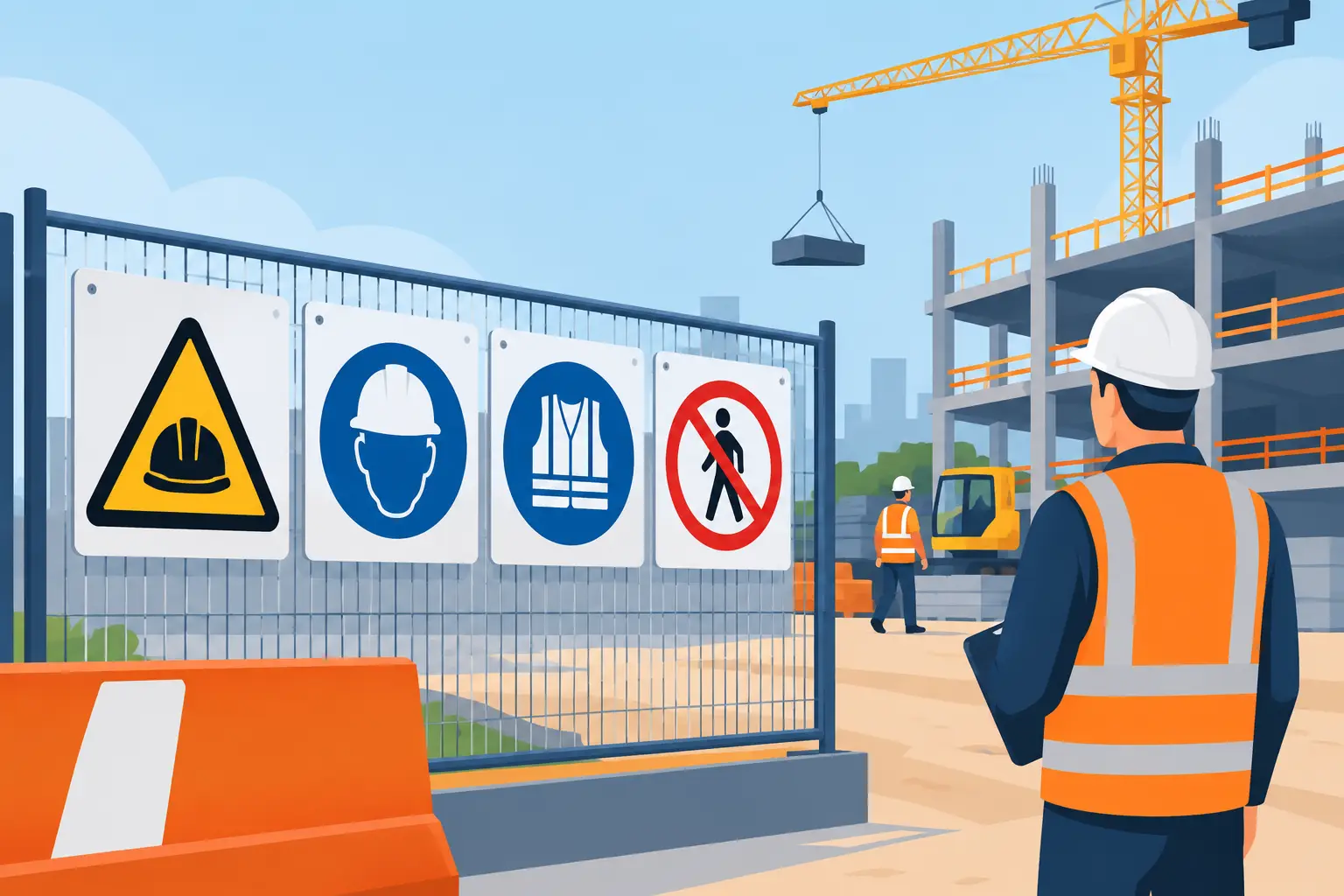
At 7am, before the first delivery lorry arrives and before subcontractors start moving across the site, clear signage should already be doing its job. The best construction site signage examples do more than fill empty fencing: they direct people, reinforce safety rules, protect your perimeter and put your company name in front of passers-by.
For UK contractors, developers and trades, the right sign depends on where it will be used, who needs to see it and how long it must last. A laminated notice may suit an indoor welfare area. A large weatherproof banner is a better fit for a busy roadside hoarding. Here are 12 practical examples worth considering.
Construction site signage examples for every zone
1. Site entrance and project identification signs
Your entrance sign is often the first thing clients, visitors, delivery drivers and neighbours see. It should clearly identify the contractor, project name, site address and a reliable contact number. It can also display the principal contractor’s branding, working hours and a simple instruction to report to the site office.
This sign needs to be easy to read from a vehicle or pavement, so avoid cramming every project detail into a small area. A professionally printed PVC banner or rigid sign gives the entrance a controlled, credible appearance from day one.
2. Mandatory PPE signs
Hard hats, hi-vis clothing, safety boots, eye protection and gloves are common requirements, but workers should not have to guess what applies before entering a work area. Mandatory PPE signs use clear symbols alongside short wording such as “Safety helmets must be worn”.
Place them at every pedestrian entrance, at changing areas and wherever site rules change. If the requirement applies across the whole site, repeat the message rather than relying on one sign by the gate. Consistency is more useful than a large sign that only a few people notice.
3. Hazard warning signs
Warning signs flag specific risks: overhead loads, moving plant, deep excavations, electrical hazards, uneven ground and falling objects. Their purpose is immediate recognition, not detailed instruction.
Use the appropriate recognised safety symbol and keep the sign close to the hazard, at a visible height. Temporary hazards need temporary signs that can be moved as the works progress. For exposed areas, choose a material that will not curl, fade or become unreadable after a week of rain and wind.
4. Restricted access and security notices
Construction sites attract curious visitors, opportunistic thieves and people looking for a shortcut. Signs stating “No unauthorised access”, “Danger – construction site” and “CCTV in operation” help establish a firm boundary around the perimeter.
These messages work best when they are repeated along hoarding, fencing and access points. Large printed banners are particularly effective on long runs of temporary fencing, where a small standard notice can be missed. Security signage is not a substitute for physical security, but it makes the site boundary clear and supports the measures already in place.
5. Traffic management signs
A live site can have pedestrians, vans, forklifts, telehandlers and HGVs sharing limited space. Traffic signs should mark delivery routes, one-way systems, speed limits, reversing areas, pedestrian walkways and loading zones.
Make the route obvious before a driver reaches the decision point. A sign hidden behind plant, placed after a turning point or printed too small will not prevent confusion. Use directional arrows, high-contrast colours and repeated signs on longer routes. On a changing site, durable banner signs fixed to fencing can be repositioned more easily than permanent boards.
6. Emergency information boards
Every site needs a clear point for emergency information. This can include the site address, emergency contact numbers, assembly point, fire procedure, first-aid location and the name of the responsible person.
Keep this information current. A board with an old contact number or a former site manager’s name creates risk and undermines confidence. Position it where people naturally gather, such as the welfare unit, entrance or signing-in point, and make sure the assembly point itself is clearly marked from more than one approach.
7. First aid, fire point and welfare signs
Small operational signs make a significant difference during a busy shift. Clearly label first-aid kits, eyewash stations, fire extinguishers, fire exits, toilets, canteens and drying rooms. These signs reduce unnecessary interruptions and help workers find what they need quickly.
For fire safety signs, follow the required colours, symbols and placement standards. Branded print has a role around welfare areas and information boards, but compliance messages should always remain clear and unambiguous. Design should support safety, not compete with it.
8. Public-facing perimeter banners
A construction site does not have to look unfinished from the street. Branded perimeter banners can screen unattractive work areas, promote the contractor or developer, and make the project feel organised while it is underway.
This is where size and material matter. Standard vinyl banners deliver bold colour and sharp graphics for solid hoarding or walls. Mesh banners are often the better option for open fencing because their perforated finish lets wind pass through, reducing strain on fixings. Both can be printed with logos, project visuals, contact details and simple messages such as “Building for the future” or “New homes coming soon”.
9. Community and considerate-contractor messages
Projects can disrupt nearby homes, shops and roads. A visible sign that shares working hours, a project contact number and a courteous message to neighbours can reduce frustration before it becomes a complaint.
The tone should be direct, not over-polished. Explain what is happening, give people a route to raise a concern and update the sign if the programme changes. On longer projects, a well-presented banner can also share milestones or local employment commitments, helping the public see progress rather than just disruption.
10. Recruitment and subcontractor opportunities
Hoarding is valuable advertising space. If you need labour, apprentices or specialist subcontractors, a recruitment banner can reach local people already passing the project.
Keep the message focused: the role or trade, a contact method and your company name. It is tempting to turn the banner into a full job description, but large-format print performs best when the key message can be understood in seconds. A QR code may be useful, but only if the essential information is still visible without scanning it.
11. Delivery and supplier instructions
Late or misplaced deliveries can hold up a programme. A dedicated sign at the gate can tell drivers where to report, which entrance to use, delivery hours, site speed limits and whether booking is required.
For larger schemes, separate instructions for concrete wagons, waste collections and general deliveries can prevent queues and keep the gate team from repeating the same directions all day. Make these signs practical, large and close to the point where drivers need to act.
12. Progress, sales and completion banners
For housebuilders, commercial developers and refurbishment contractors, site signage can support the next stage of business too. “Units available”, “Show home open” or “Commercial space to let” banners turn a high-visibility perimeter into a sales opportunity.
Use clean branding, one strong call to action and a contact method that is readable at distance. If the sign faces a main road, larger text matters more than additional copy. UV-resistant outdoor print helps colours stay strong throughout the project, especially on sites with long exposure to sunlight.
Choosing the right material and format
A sign only works if it survives its environment. For short-term indoor notices, posters and laminated sheets may be enough. For external fencing, hoarding and access points, weatherproof PVC banner material is often the practical choice because it is strong, portable and straightforward to fix using eyelets and cable ties.
Mesh banners suit windy positions, while standard vinyl is usually better where maximum colour impact is the priority. Consider viewing distance before choosing a size. A detailed safety notice can be compact when viewed up close; a perimeter message facing traffic needs large lettering, bold contrast and plenty of clear space.
Artwork should be checked before print, particularly when logos, safety symbols or small contact details are involved. Banner Printing UK can produce custom banners for urgent site requirements with fast UK turnaround, but the strongest result starts with a clear brief: final dimensions, fixing points, location, deadline and the message people must understand first.
Keep signs current, visible and credible
Site signage is not a one-off task at mobilisation. Walk the perimeter and main routes regularly. Replace damaged banners, remove instructions that no longer apply and check that parked vehicles, stacked materials or new fencing have not blocked key messages.
A well-run site looks well-run before anyone steps through the gate. Clear, durable signs give workers direction, reassure visitors and make every metre of perimeter work harder for your project.