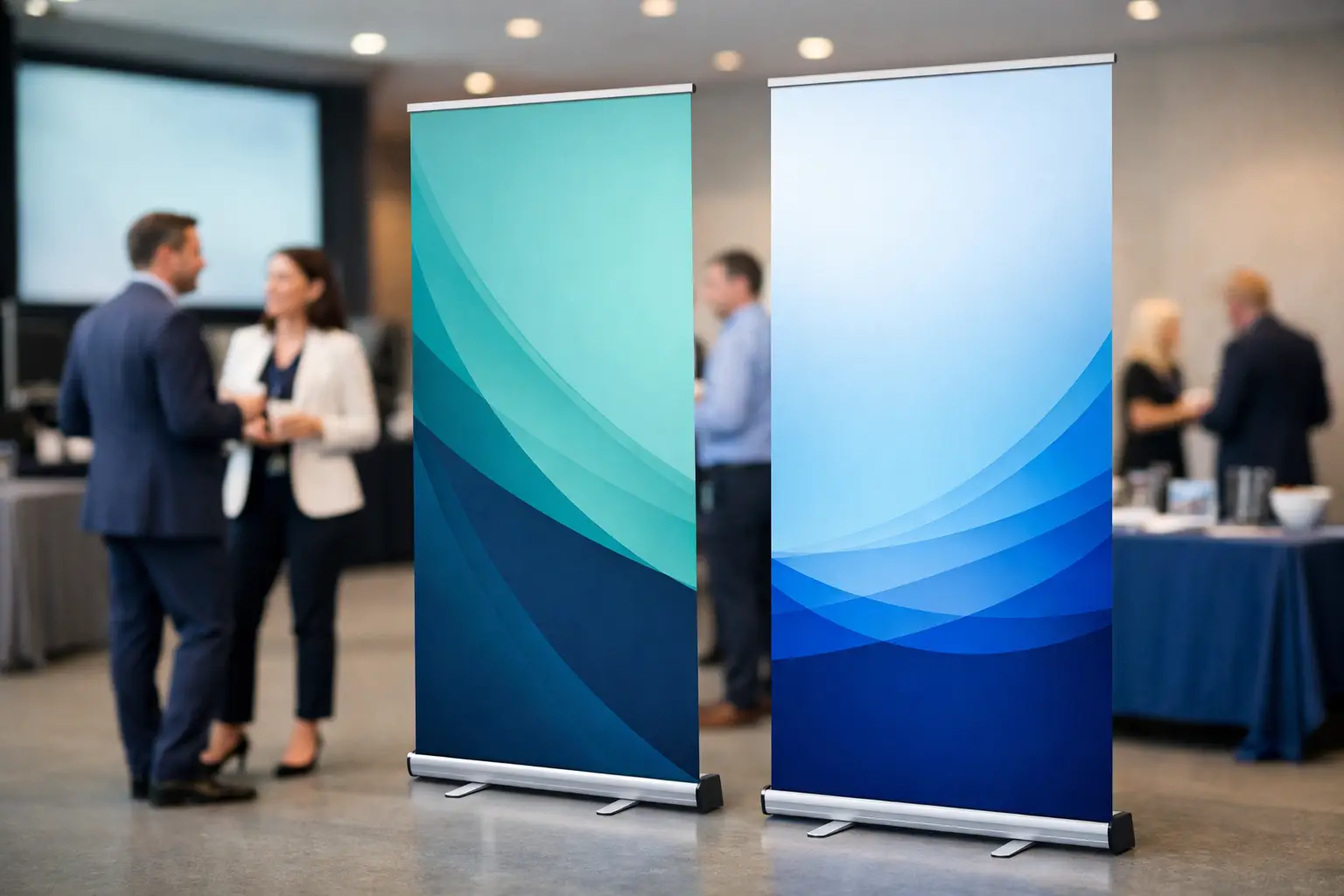
A busy exhibition hall gives you only a few seconds to earn attention. Your team may be ready, your stand may be booked and your offer may be strong, but if visitors cannot quickly see who you are and what you do, they will walk straight past. Roller banner printing gives businesses a practical, portable way to put their message at eye level wherever they need it.
From trade shows and networking events to reception areas, retail promotions and pop-up sales spaces, a well-produced roller banner works hard for a relatively small investment. The key is choosing the right format, preparing artwork that reads from a distance and ordering early enough to avoid unnecessary pressure – especially when an event deadline is fixed.
Why roller banners remain a reliable display choice
A roller banner is designed for real working life. The printed graphic rolls into its base when not in use, protecting it in transit and making it easy to carry between venues. At the event, it can be set up in minutes without tools, wall fixings or a complicated stand build.
That convenience matters for small teams, sales representatives and event organisers who need to arrive, set up and start conversations quickly. It also makes roller banners useful beyond exhibitions. A salon can position one near the entrance to promote a seasonal treatment. A construction company can use one in a sales suite. A café can highlight catering, loyalty offers or new menu items without committing to permanent signage.
They are not the answer to every display requirement. A large shell-scheme stand, for example, may need a full printed backdrop to create stronger visual impact. Outdoor campaigns need weatherproof banner materials and secure fixings rather than a pull-up display. But for indoor promotion, portability and repeat use, roller banners are one of the most dependable options available.
Choosing the right roller banner printing format
The best size depends on where the banner will stand and how far away people need to read it. A standard-width banner is often the sensible choice for exhibitions, retail floors and reception spaces because it provides enough room for a clear message without dominating a compact area.
Wider roller banners make more impact when there is space around them. They suit product launches, presentation stages and larger stands where a narrow display could look lost. At the other end of the scale, compact banners are useful when you are travelling light or working in tight indoor spaces.
Before ordering, think about the banner’s job. Is it there to introduce your business, explain one service, direct visitors towards a counter, or support a specific campaign? One banner can do each of these jobs well, but trying to do all of them at once usually produces a crowded design.
The hardware also matters. A sturdy base keeps the banner standing straight throughout a long event day, while a carry case protects it between uses. If the banner will be used frequently by a travelling team, it is worth prioritising dependable hardware over the cheapest available option. A display that looks tired or leans forward is not a good reflection of your business.
Design artwork for the way people actually read
Roller banners are read differently from brochures, websites and social posts. People usually see them while walking, talking or scanning a room. Your message must make sense quickly.
Start with the most important statement at the top. This might be your business name, a concise service line or a campaign headline. Use a large, legible typeface and give it enough contrast against the background. Pale text on a pale image may look subtle on screen, but it will disappear across a room.
Keep your logo, headline and main visual in the upper and central area. The lower portion of a roller banner is often less visible when people are standing nearby, and the very bottom sits close to the base. Contact details, QR codes and smaller supporting information can sit lower down, but your central message should never rely on that space.
A strong layout normally includes a clear headline, one supporting point, a relevant image or graphic and one action for the viewer to take. That action could be visiting your stand, asking for a quote, booking a consultation or scanning a QR code. If there are five actions, several paragraphs and a long service list, the banner will feel more like a noticeboard than an advertisement.
Use high-resolution images and supplied logos wherever possible. Enlarging a small image from a website can result in soft, pixelated print. Artwork created at the correct final size gives the printer the best chance of producing crisp text, clean colours and a professional finish. If you are unsure, getting the file checked before production is far easier than discovering a problem after delivery.
Make the message specific to the setting
The most effective banners do not simply repeat a company homepage. They answer the question a visitor is likely to have in that particular location.
At a trade show, focus on the problem you solve and why someone should stop. A headline such as “Commercial Signs Printed Fast” is more useful than a broad statement about being a great business. In a reception area, a banner can reinforce trust with key services, accreditations or a simple explanation of what happens next. In retail, it may be all about an offer, a new range or a limited-time promotion.
Consider the viewing distance too. A banner beside a table can include a little more detail because visitors are likely to approach it. A banner placed at the back of a stand must rely on bigger lettering and fewer words. If you want people to scan a QR code, place it at a comfortable height and leave clear space around it. Test it from a normal standing distance before approving artwork.
Plan for print quality, timing and repeat use
A roller banner represents your brand in face-to-face situations, where poor print is immediately noticeable. Colours should look balanced, black text should be sharp and images should retain detail without appearing over-saturated. Good production is not just about how the artwork looks on a screen. It is about how it performs under exhibition lighting, in shop interiors and after repeated handling.
Timing deserves just as much attention. Event deadlines are not flexible, and last-minute changes to artwork can create avoidable stress. UK-based roller banner printing with fast turnaround is particularly useful when plans change, but allowing time for proofing, delivery and a quick physical check is always the safer route.
When your banner arrives, set it up once before the event. Check that the graphic pulls up smoothly, the support pole is secure and the message is readable from the right distance. Repack it carefully after each use, keeping the case dry and avoiding heavy items on top of it. A little care extends the life of a banner and keeps it ready for the next opportunity.
For businesses running regular promotions, it can be sensible to create a small set of banners rather than relying on one generic design. One may cover your core brand message, another a key service and another a seasonal campaign. This gives your team more flexibility while maintaining a consistent look across events and locations.
When a roller banner needs supporting print
A roller banner is excellent at catching attention, but it cannot carry every detail alone. Pairing it with matching flyers, business cards, posters or a printed backdrop can make your display feel more considered and give interested visitors something to take away.
Keep the colours, fonts and offer consistent across every item. If the banner promotes a discount, the leaflet should make that discount easy to understand. If the banner directs visitors to speak to a team member, make sure the stand has a clear conversation point rather than a cluttered table. Print works best when each piece has a distinct role.
Banner Printing UK produces roller banners for businesses that need a professional display without a drawn-out ordering process. With artwork prepared properly and a message built for the setting, a portable banner can continue delivering value long after the first event is over.
The best time to plan your next roller banner is before the diary gets crowded. Decide what one message needs to be seen, build the design around it and give yourself a display that is ready whenever the next opportunity appears.