
It’s a simple concept, but one with a huge impact: food waste signage. Well-designed, clearly placed signs are one of the most powerful tools a business has to guide both customers and staff in disposing of leftovers correctly. It’s about more than just pointing to the right bin; it’s about reducing waste, saving money, and making your sustainability efforts actually work.
By using sharp, visually engaging signs at disposal points, you can massively cut down on the contamination that plagues recycling and compost bins, making your entire operation greener and more efficient.
Why Effective Food Waste Signage Is a Game Changer
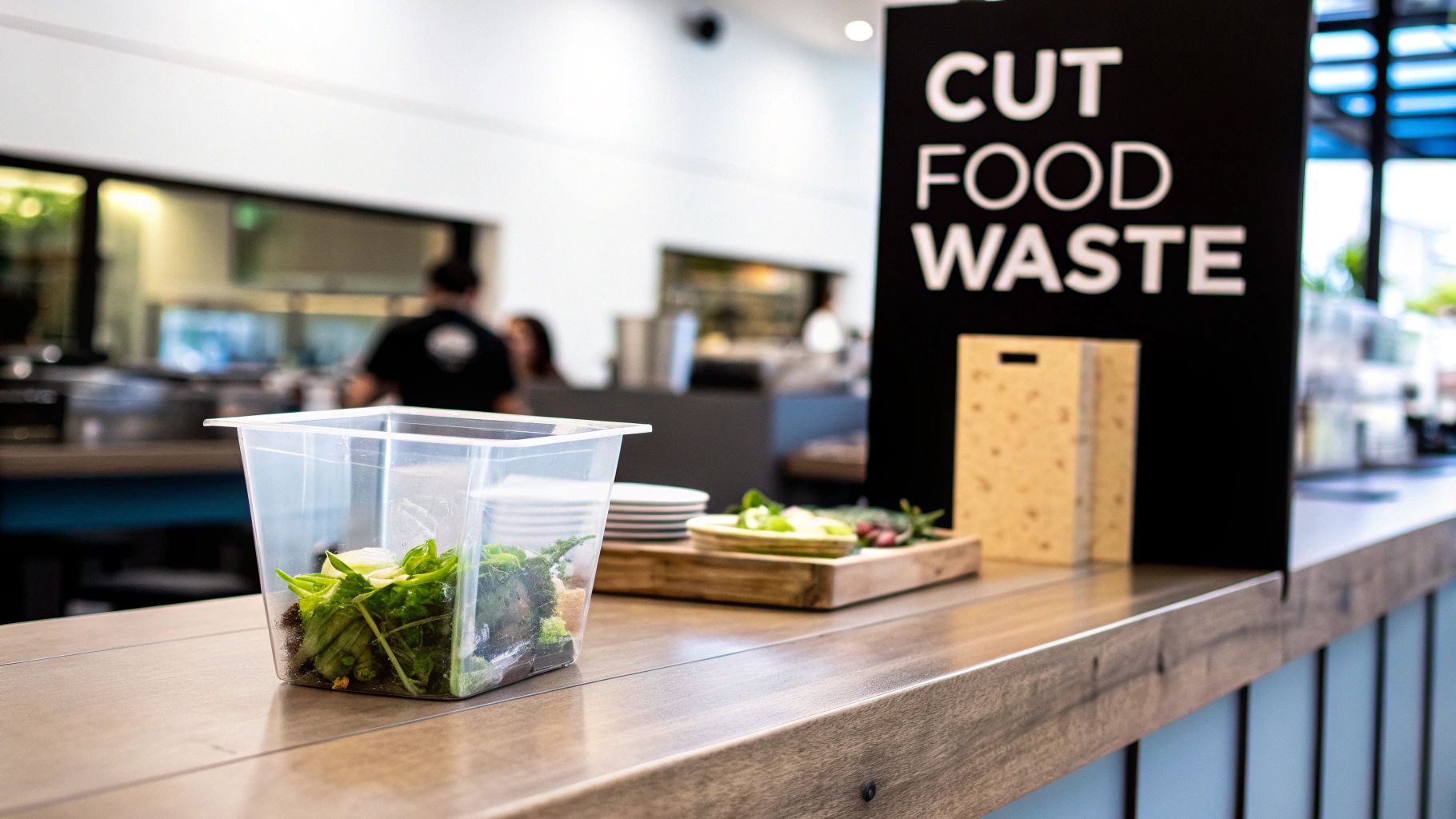
Let's be blunt: food waste is a massive financial drain on businesses and homes across the UK, not to mention an environmental headache. The sheer scale of the problem is genuinely staggering, but that also means there's a huge opportunity to make a real difference. For any business—from a local café to a major festival—tackling waste isn't just about being a good corporate citizen. It’s just smart business.
This is exactly where professionally printed signage comes into play. A well-designed sign acts as a silent guide, influencing behaviour right at that critical moment of decision. It closes the gap between someone wanting to do the right thing and actually doing it.
The Staggering Cost of Wasted Food
To really get your head around this, just look at the national picture. In the UK, households bin a shocking 6.7 million tonnes of food every single year. That accounts for 70% of the UK’s total, and what's worse is that around 4.7 million tonnes of it was perfectly edible when it was thrown away. This waste adds up to an incredible £14 billion hit to the economy annually.
For any business in hospitality or retail, these numbers aren't just abstract stats—they represent a direct blow to your bottom line. Every scrap of unsold produce or leftover on a customer's plate is lost revenue and adds to your disposal costs.
"Treat food waste like a cost centre. Track it, understand it, and manage it with the same discipline you apply to labour and inventory."
That perspective is spot on. Managing waste isn't a side-project; it's a core operational discipline. It demands clear communication and solid processes, and effective signage is the backbone of both.
Turning Signage into a Strategic Tool
This is about much more than just putting a "Food Waste Only" label on a bin. When done right, strategic signage is a powerful communication tool that can:
- Educate Customers: Show people exactly what goes into the compost, recycling, or general waste. This is the key to reducing contamination and avoiding costly sorting fees from your waste contractor.
- Guide Staff: Reinforce your back-of-house procedures for food prep, storage, and disposal. Consistency here is crucial for minimising spoilage before food even reaches the customer.
- Boost Your Brand Image: A visible commitment to sustainability tells a story. It enhances your reputation with eco-conscious consumers who increasingly choose businesses that share their values.
- Drive Profitability: This is the bottom line. Reducing the amount of waste sent to landfill directly lowers your disposal bills and makes your entire operation more resource-efficient.
To really see how this fits into the bigger picture, it’s worth looking at other proven strategies for reducing food waste in restaurants. Custom-printed visuals from Banner Printing Ltd offer a durable, high-impact, and cost-effective way to put these changes into action, making them an essential asset for any modern UK business.
Designing Signs That Actually Work: The Psychology of Colour and Messaging
A sign that gets ignored is just an expensive piece of plastic. To genuinely change behaviour and slash waste, your signage needs to do more than just exist—it must grab attention and deliver a crystal-clear message in seconds. This is where smart design, backed by a bit of psychology, really makes a difference.
Effective design is about more than just a blunt instruction like "Recycle Here". It's about crafting a message that connects. Instead of a chore-like command, try something more inspiring: "Your Plate Could Save Our Planet" or "Turn Today's Leftovers into Tomorrow's Compost". This small shift reframes waste-sorting from a duty into a positive, impactful action.
Harnessing the Power of Colour
Colour is one of the most powerful, non-verbal tools you have. Our brains are hardwired to link certain colours with specific meanings, and you can use this to your advantage. A well-chosen colour scheme makes your signs intuitive, guiding people to the right bin almost subconsciously.
- Green: This is the universal signal for 'eco-friendly', 'compost', and 'go'. It's the obvious—and best—choice for signs pointing to food scrap bins or highlighting sustainable practices.
- Blue: Commonly used for general recycling like paper, plastics, and glass. It's a calm, trustworthy colour that suggests a clean, organised process.
- Yellow/Orange: These are your "pay attention" colours. They're perfect for highlighting critical instructions people often miss, like "No Plastic Bags" or "Empty Liquids First".
- Red/Black: These colours usually mean 'stop' or 'general waste'. They clearly mark the last-resort bin for all the non-recyclable, non-compostable stuff.
Getting the balance right between colours, text, and graphics is key. For more in-depth advice, our comprehensive guide on https://bannerprintingltd.co.uk/how-to-design-a-banner/ is packed with practical tips that apply to any signage project.
Icons and Messaging That Cut Through the Noise
Clarity is everything. In a busy café or at a loud festival, nobody is going to stop and read a paragraph. Your message has to be instant. This is why universally understood icons are so vital—simple, bold graphics of an apple core for compost or a bottle for recycling work far better than text alone.
It's also crucial to be explicit, especially when it comes to common points of confusion. For example, many people don't understand the distinction between compostable and biodegradable items. A simple set of "Yes/No" icons can clear this up instantly.
Think about the bigger picture, too. The UK's hospitality sector generates a staggering 920,000 tonnes of food waste every year, costing businesses millions. For an event manager, a large mesh banner on a kitchen fence proclaiming, "Hospitality Wastes 920k Tonnes Yearly—Plate Smarter, Save £Millions!" can genuinely transform staff behaviour by making the financial stakes impossible to ignore.
To help you visualise this, here's a quick guide to pairing colours and icons for maximum effect.
Effective Colour and Icon Choices for Your Signage
This table breaks down how to choose the right visual elements to prompt the right action from your staff or customers.
| Element Type | Best Practice | Psychological Impact | Example Use Case |
|---|---|---|---|
| Colour | Use consistent, universally recognised colours (Green for food, Blue for recycling, Black/Red for general). | Creates instant recognition and reduces cognitive load, making sorting faster and more accurate. | A green sign over the compost bin and a red one over the general waste bin. |
| Icons | Employ simple, bold, and universally understood graphics (e.g., apple core, bottle, rubbish bag). | Bypasses language barriers and is processed much faster than text, ideal for busy environments. | Using a clear graphic of a plastic bottle with a cross through it on a compost bin. |
| Messaging | Keep text minimal, direct, and action-oriented. Use a positive, motivational tone. | Positive framing ("Feed the Earth") encourages participation more than negative commands ("Don't…"). | A sign saying "Food Scraps Only" instead of a long list of what's not allowed. |
| Contrast | Ensure high contrast between text/icons and the background (e.g., white on green, black on yellow). | Improves readability, especially for those with visual impairments and from a distance. | Bright yellow text on a black sign for a critical "No Liquids" warning. |
Ultimately, great signage is about making the correct choice the easiest choice.
A great sign doesn't make people think; it makes them act. The goal is to remove all doubt, making the correct choice the easiest choice.
Finally, always consider your audience. A sign in a quiet retail shop can afford a softer, more educational tone. In contrast, a sign in a fast-paced festival kitchen needs to be direct, bold, and unmissable. Your design must match the environment to be truly effective.
Choosing the Right Materials and Finishes for Durability
Your food waste signage can have the most powerful message in the world, but if it rips, fades, or can't be cleaned, its impact is dead in the water. The physical stuff your sign is made of is just as critical as the design itself, especially when you’re dealing with the reality of steamy kitchens, rainy outdoor events, and busy public spaces.
Getting the material right means your investment lasts, looks professional, and actually works where you put it. A sign for a bustling commercial kitchen has totally different needs than one destined for a fence at an outdoor festival.
This little guide helps simplify that first big decision, focusing on who you're talking to—which tends to dictate everything else.
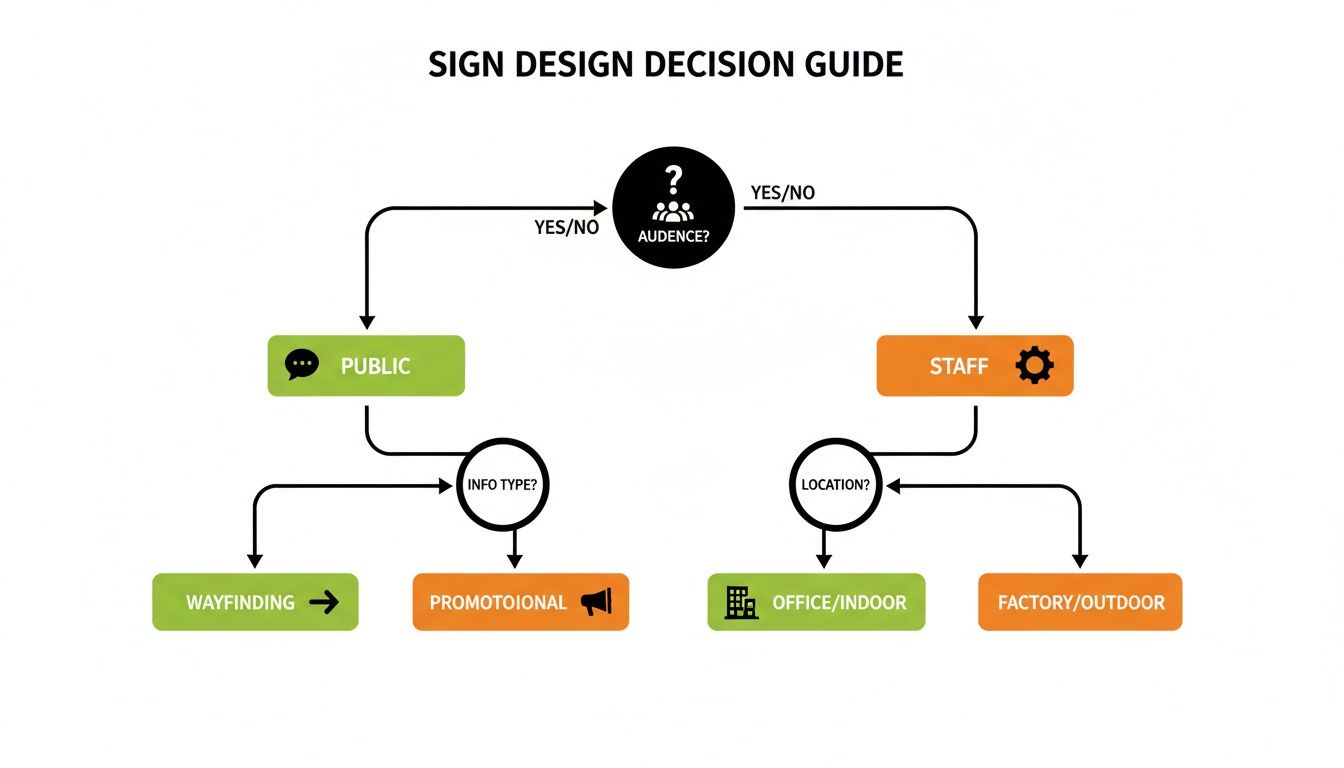
As you can see, whether your signs are for your own staff or the general public is the first fork in the road, shaping all your next design and material choices.
Materials for Indoor and Hygienic Environments
Inside a commercial kitchen or any food prep area, hygiene is everything. Signage here has to stand up to constant cleaning, often with harsh chemicals, without falling apart.
For these spots, Foamex is a fantastic choice. It’s a rigid but lightweight PVC foam board that’s waterproof and a breeze to wipe down, making it perfect for staff instructions above prep stations or waste bins.
Need something for a temporary promotion, like at an indoor conference or inside a shop? A lightweight roller banner is your friend. It’s portable, sets up in seconds, and can carry a lot of information. You could use one to explain a new in-store composting scheme right by the entrance.
Think about the sign's lifespan. A permanent fixture in a kitchen needs to be tough as nails. For a one-day event, portability and cost-effectiveness are probably higher on your list.
Options for Outdoor and Weather-Exposed Settings
When your signage heads outdoors, it’s going into battle against the elements. Rain, wind, and sun will make short work of the wrong material.
For signs attached to bins at a festival or market, weatherproof vinyl banners are a really solid, reliable option. They’re water-resistant and we print them with fade-resistant inks, keeping your message clear and vibrant all weekend long.
If you need to get big food waste messages up on temporary fencing—say, around a construction site canteen or the perimeter of a festival—mesh banners are the way to go. The tiny holes in the material let the wind pass straight through, which massively reduces the strain and stops the banner from tearing or acting like a giant sail.
For more permanent outdoor signs, it’s worth exploring different types of plastic for signs. Materials like Correx offer a brilliant balance of rigidity and weather resistance for longer-term installations. Every choice you make here directly impacts how long your food waste campaign will last and how well it performs.
Strategic Placement for Maximum Visibility and Impact
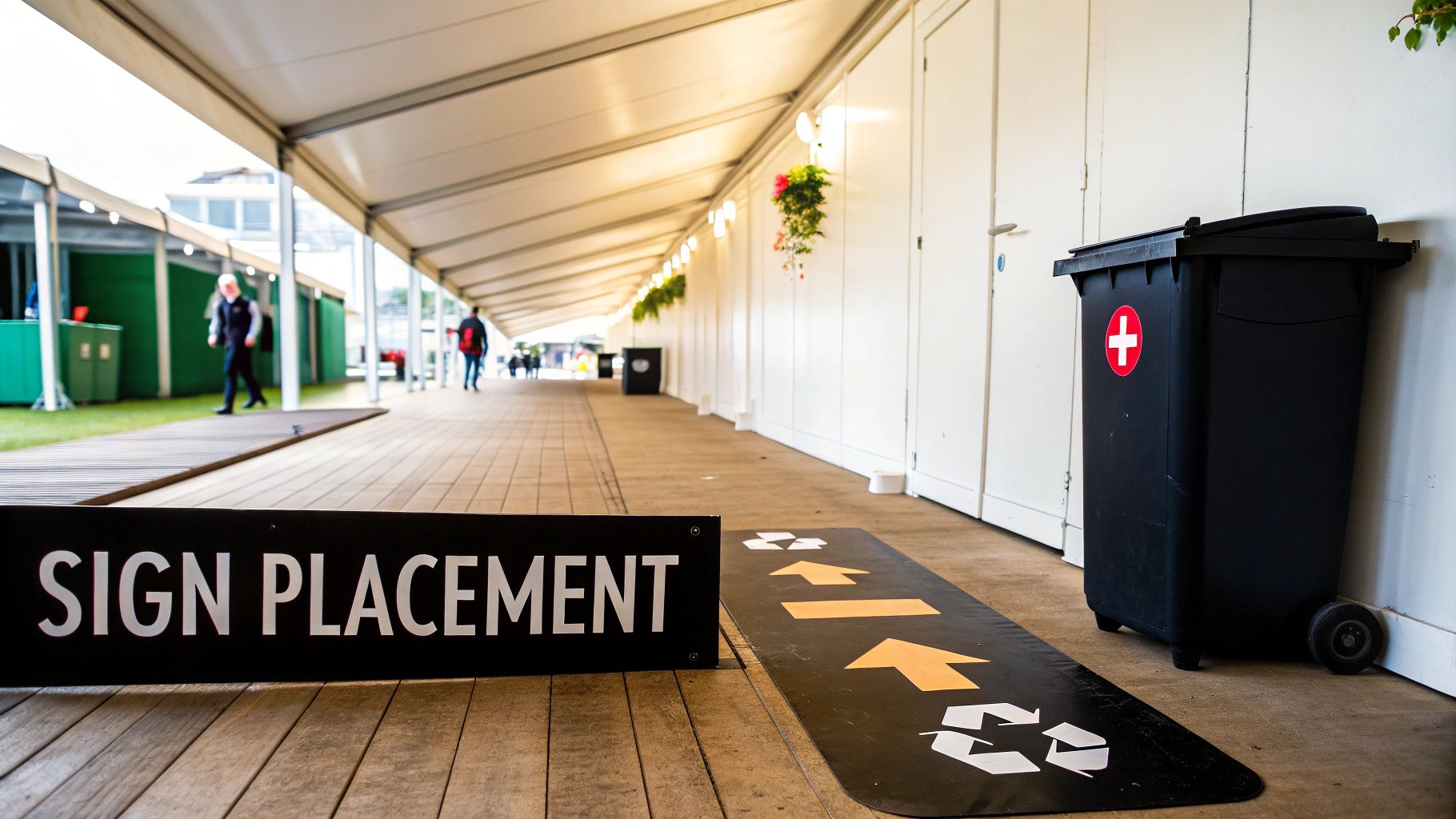
Let's be honest, even the most brilliantly designed sign is completely useless if no one sees it. Strategic placement is what turns a simple piece of printed vinyl or Foamex into a powerful tool that actually changes behaviour.
The real secret is putting your food waste signage directly in someone’s line of sight at the exact moment they’re about to make a decision. Think about the journey your customer or staff member takes. Where do they pause? And most importantly, where do they throw things away?
Placing a sign just above the bin itself is the absolute baseline. It's a non-negotiable starting point. This guarantees the instructions are right there at the point of disposal, clearing up any last-second hesitation or confusion.
Identifying High-Traffic Hotspots
Every business has its own unique hotspots where a sign will make the biggest difference. You need to think about the natural flow of people through your space and pinpoint these key moments for intervention.
- Retail and Cafes: Get your signs up near the tills to catch customers' eyes as they pay. A small, cleverly placed sign can also work wonders next to the milk and sugar station, where people are constantly ditching stirrers and wrappers.
- Events and Festivals: Your waste disposal stations are ground zero. Use large, clear banners that can be spotted from a distance. This helps guide attendees to the right areas before they even get to the bins, making the whole process smoother.
- Back-of-House Kitchens: In a busy kitchen, you need durable, wipe-clean signs. Mount them directly above food prep stations and the designated waste bins. This acts as a constant, at-a-glance reminder for staff during hectic shifts.
A sign's effectiveness multiplies when it becomes a natural part of the environment. Don't just think about adding a sign; think about integrating a message right into a key decision-making zone.
For busy corridors or entranceways, don't be afraid to go big. Large banners or even floor graphics can be incredibly effective. Floor graphics are a great trick – they can create a visual path, literally guiding foot traffic straight to the recycling and composting stations, making correct disposal almost second nature.
Ensuring Accessibility and Readability for All
An effective sign has to be understandable for everyone, and that includes people with visual impairments. Accessibility isn't just about ticking a box; it's about being practical. If a good portion of your audience can't easily read your sign, its impact is instantly crippled.
Keep these simple principles in mind:
- Height and Angle: Always place signs at a comfortable eye level, which is typically between 1.3 and 1.6 metres from the floor. Avoid putting them too high or too low where they can be easily missed or are awkward to read.
- Font Size and Contrast: Stick to large, clear, sans-serif fonts. Make sure you have a high contrast between your text and the background to make it as legible as possible, especially from a distance.
This proactive approach makes sure your food waste signage isn't just there, but is genuinely doing its job. For context, the UK retail sector alone discards around 270,000 tonnes of food annually, often for purely cosmetic reasons. A high-impact banner near the produce displays can start a conversation and influence those habits. If you want to dive deeper into the scale of the problem, check out these insights on food waste from Refresh Surplus.
Your Step-by-Step Guide to Ordering from Banner Printing Ltd
You’ve done the hard work: your food waste signs are designed, you’ve picked the perfect material, and you know exactly where they’ll go. Now for the easy part – turning your vision into a reality.
We’ve made our ordering process as simple as possible. The goal is to get your signage printed, dispatched, and working for you on-site in record time, often within 24-48 hours.
Let's walk through it.
Getting Your Artwork Files Print-Ready
The secret to a great-looking sign starts with the file you send us. A few quick checks before you upload can save a lot of time and guarantee your final product looks sharp, professional, and exactly how you imagined it.
First up, the file format. We can work with most common file types, but for the best possible results, a print-ready PDF is the gold standard. It locks everything in place – fonts, images, layout – so what you see on your screen is precisely what comes off our printers. We also happily accept high-quality JPEGs, TIFFs, and EPS files.
Next, resolution is king. For large format printing, your artwork needs to be at least 150dpi (dots per inch) when set to its final print size. This is what keeps your text crisp and your images clear, avoiding that fuzzy, pixelated look.
A Pro Tip From Our Print Team: Always design your artwork in CMYK colour mode, not RGB. Screens use RGB (Red, Green, Blue), but professional printers use CMYK (Cyan, Magenta, Yellow, Black). Designing in CMYK from the start ensures your colours print true to your design.
Our Simple Online Ordering Process
With your artwork prepped and ready, placing your order online takes just a couple of minutes.
Head over to the product page for the type of sign you need – whether that’s a durable vinyl banner, a rigid Foamex board for a wall, or a mesh banner for an outdoor fence.
You'll just need to confirm a few details:
- Size: Pick one of our standard options or pop in your own custom dimensions.
- Material: Select the material that fits your needs, like our popular PVC or an eco-friendly PVC-free option.
- Finishing: Let us know if you need eyelets for hanging, pole pockets for a frame, or any other finishing touches.
Once you’ve made your choices, simply upload your artwork file directly on the page. Our system will check it over, and you can head to the checkout. Remember, all our orders come with free UK delivery, so there are no hidden surprises.
Your Pre-Order Checklist
Before you hit that final button, a quick once-over can make all the difference. Run through this list to ensure a smooth, speedy process.
- File Format: Is your artwork saved as a print-ready PDF, JPEG, TIFF, or EPS?
- Resolution: Is it at least 150dpi at full size?
- Colour Mode: Did you set it up in CMYK?
- Dimensions: Does the artwork size match the dimensions you’re ordering?
- Proofread: Give all text a final check for any typos. It’s amazing what a fresh pair of eyes can spot!
Our in-house team gives every order a free pre-flight check to catch any obvious technical snags before we go to print. But ticking off these points yourself is the fastest way to get your order moving.
For a really deep dive into the whole process, our complete guide to ordering banners in the UK has you covered.
Your Food Waste Signage Questions Answered
Even with a solid plan, a few questions always pop up. It’s completely normal. Here are the most common things we get asked, with some straight-talking answers to help you get your signs sorted.
How Well Do Your Outdoor Signs Actually Hold Up in British Weather?
This is probably the number one question we get, and for good reason! Our outdoor signs are built specifically to withstand the famously unpredictable UK weather. We stick to heavy-duty weatherproof vinyl and wind-resistant mesh, printing on them with UV-cured inks that are designed not to fade.
What does that mean for you? It means your message stays sharp and vibrant, whether it's pouring with rain, blowing a gale, or (if we’re lucky) basking in sunshine. From a weekend festival to a six-month stint on a construction site, you can be confident these signs will do the job without looking tired or torn.
What’s the Best Signage for a Hectic Commercial Kitchen?
In a kitchen, you need something tough, waterproof, and ridiculously easy to keep clean. For that, we always recommend Foamex. It’s a rigid PVC board that doesn’t absorb moisture, so it won’t become a breeding ground for bacteria.
You can wipe it down every day with your usual cleaning products without any fear of damaging the print. It’s simply the most practical, long-lasting choice for displaying instructions above prep stations or waste sorting areas where spills and splashes are just part of the daily routine.
Can Signs Really Help Cut Our Business Costs?
They absolutely can, and the impact is often quicker and bigger than people expect. When your signage is clear and effective, you dramatically reduce contamination in your recycling and compost bins. This nearly always leads to lower waste disposal fees because clean, properly sorted waste is cheaper for your contractor to process.
One of the first things you'll notice with good signage is cost avoidance. Fewer contaminated loads means fewer penalty fees from your waste management provider. It’s a simple win.
On top of that, signs in staff areas are brilliant for tackling overproduction. A case study at Takeda Pharmaceuticals, for instance, found that making waste data visible with signs helped their kitchen slash food waste by 68%. That’s a huge saving on purchasing costs right there. Your signs make waste visible, turning it from a hidden drain into a manageable expense.
How Fast Can I Get My Signs?
We know things move quickly and deadlines can sneak up on you. We’ve built our whole process around getting things done fast without sacrificing quality. Most of our food waste signage orders are printed and dispatched from our UK facility within 24-48 hours.
Plus, with free tracked delivery across the UK, you can get your signs on-site and working for you in no time.
Ready to create signage that makes a real difference? The team at Banner Printing Ltd is here to help you design and print high-impact, durable signs for any environment. Explore our range and get your project started today.


