
A proper neighbourhood watch sign is far more than just a bit of metal on a lamp post. It’s a powerful, silent warning that tells potential criminals one simple thing: this community is organised, vigilant, and working together. The signs create a perceived risk, forcing offenders to think twice before targeting an area where residents are clearly on the lookout.
Why Neighbourhood Watch Signs Still Matter
Before you even start thinking about materials or fonts, it’s worth remembering the real-world impact these signs have. They’re simple visual cues that change the mindset of everyone who sees them, from residents to would-be criminals, creating a genuine sense of security and community pride. This isn't just about scaring people off; it's about building a visibly connected neighbourhood where people actively look out for one another.
A sign is the first and most obvious symbol that a street isn’t a soft target. It immediately communicates that residents are paying attention and are likely to report anything suspicious. That alone is a powerful psychological barrier. For the people living there, it’s a constant reminder of their shared commitment, which helps build a stronger, more unified community spirit.
A Symbol of Community Strength
The Neighbourhood Watch movement kicked off right here in the UK back in 1982, starting in the small village of Mollington, Cheshire. It has since exploded into the largest voluntary crime prevention group in England and Wales, with over 2.3 million households taking part. By the year 2000, a British Crime Survey found that an incredible 27% of all households were involved in a scheme, proving just how effective and popular the idea had become.
A well-placed sign transforms an ordinary street into a declared zone of vigilance. It tells everyone—from the postman to a potential burglar—that this community is organised and actively participating in its own safety.
This visible, organised front is a massive deterrent. To really grasp the impact, it helps to see these signs as part of a bigger picture. For a wider view on keeping your property safe, have a look at these essential home security tips. At the end of the day, the sign is the visual anchor for a much larger, people-powered security network.
Choosing the Right Sign Material and Size
Once you've decided on your design, the next big practical step is picking the right materials. Your sign needs to be tough enough to handle everything the unpredictable British weather throws at it – from driving rain and gusty winds to the occasional heatwave. A flimsy sign that fades, warps, or cracks after a few months just sends the wrong message.
The material you choose has a huge impact on the sign's lifespan and its ability to stay looking sharp and professional. The non-negotiable here is a weatherproof vinyl finish. Think of this protective layer as your sign's best defence against UV rays that cause colours to fade, and moisture that can lead to peeling or damage. It keeps the message bold and clear for years.
Comparing Popular Sign Materials
When it comes to the core material itself, you've got a few solid options, each with its own pros and cons. The best choice really boils down to your location and your group's budget. To make it easier, here’s a quick rundown of the most common choices.
Comparing Common Signage Materials
This table gives you a quick comparison of the most popular materials for outdoor neighbourhood watch signs, helping you pick the best fit for your budget and location.
| Material | Best For | Durability | Cost |
|---|---|---|---|
| Dibond (Aluminium Composite) | High-traffic areas, long-term installations, and a premium, professional look. | Excellent. Extremely rigid, weatherproof, and rust-proof. Lasts for years. | Higher |
| Rigid PVC (Foamex) | Most residential streets and general use. A great all-rounder for durability and value. | Very Good. A sturdy, waterproof plastic that holds up well in most conditions. | Mid-range |
| Correx | Temporary signs, sheltered cul-de-sacs, or budget-conscious projects. | Fair. Lightweight and waterproof but less rigid and more prone to damage over time. | Lowest |
In short, Dibond is the top-tier choice for maximum longevity, especially on main roads. Rigid PVC is a fantastic and reliable workhorse for most streets, and you can explore different types of plastic for signs to see the options. Correx, the same stuff estate agent signs are made from, is your go-to for a lightweight, budget-friendly solution in quieter spots.
The goal is to invest once and have the sign last for years. Choosing a robust material like Dibond or Rigid PVC for key locations means you won't be dealing with replacements anytime soon, saving your group time and money in the long run.
Getting the Size Just Right
Material is one thing, but size is just as vital for making sure your signs actually get noticed. If a sign is too small, drivers will miss it completely. Too big, and it can look out of place or become an eyesore for residents. The trick is to strike that perfect balance between visibility and fitting in with the local environment.
Visible signs are the first step in creating a stronger, safer community. They act as a constant, subtle reminder that residents are watching out for each other.
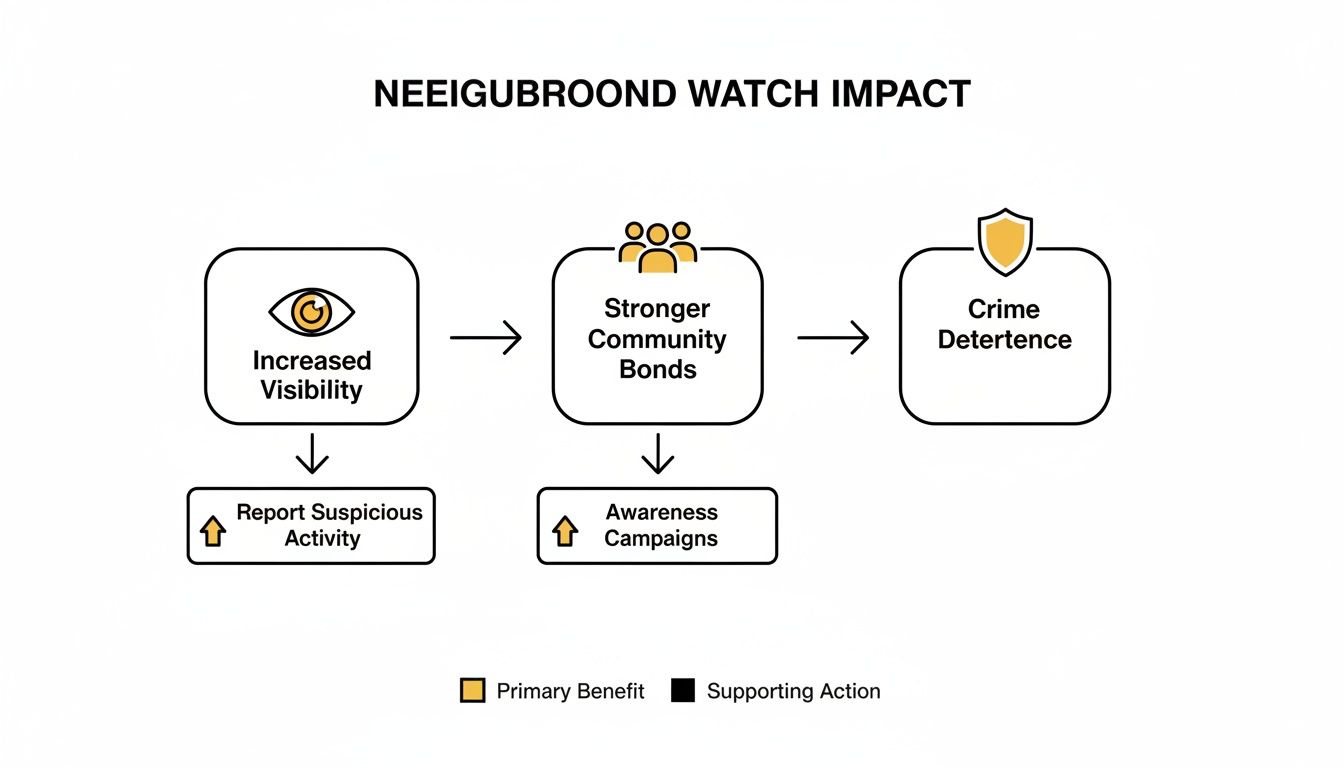
As you can see, that initial visibility is what kicks off the entire process of strengthening community bonds and deterring crime. A well-sized, well-placed sign is where it all begins.
Designing Signs That Get Noticed
A great sign has to deliver its message in a split second. For neighbourhood watch signage, that instant communication is absolutely vital—it's what establishes authority and acts as a credible deterrent. This means your design needs to be clear, bold, and instantly recognisable to residents and passers-by alike.
Let’s be honest, the official Neighbourhood Watch branding—with that distinctive yellow and black colour scheme—is one of the most recognised symbols of community safety in the UK. Sticking to these established guidelines is non-negotiable. It creates a sense of uniformity and legitimacy that a homemade or non-standard sign just can't replicate.
When someone with bad intentions sees the official logo and colours, they don’t just see a sign. They see a community that’s plugged into a national, police-supported network. That consistency builds public trust and sends a powerful signal that your group is serious and organised.
Wording That Works
While the classic “Neighbourhood Watch Area” is a solid starting point, you can boost its impact with a few concise, powerful additions. The trick is to avoid clutter. A sign's effectiveness plummets if it’s too busy or can't be read from a moving car.
Here are a few wording options that pack a punch:
- "In Partnership with Local Police" This simple phrase instantly reinforces the official connection and adds a serious layer of authority.
- "CCTV in Operation" If your area has surveillance, this is a massive deterrent. It tells potential criminals they are being watched and recorded.
- "Reporting All Suspicious Activity" This is active, not passive. It implies that residents are vigilant and ready to take immediate action.
Whatever you choose, the goal is clarity over creativity. The message has to be understood in under three seconds. If you're looking for more tips on making text and visuals work together, our guide on how to design a banner has some great advice that applies perfectly here too.
Choosing Fonts and Layout
Legibility is everything. The font you choose must be clean, bold, and easy to read from a distance, even in rubbish weather like rain or fog. Stick to classic sans-serif fonts like Helvetica, Arial, or Gill Sans—they’re brilliant for their simplicity and clarity. Avoid decorative or script fonts at all costs; they’re a disaster for readability on the street.
Your layout should be just as straightforward. Use a clear visual hierarchy where the most important element—the Neighbourhood Watch logo—is the most prominent. Keep text to an absolute minimum and make sure you have high contrast between the lettering and the background. The classic black-on-yellow is a perfect example of this principle in action.
Put yourself in the shoes of a driver on a grey, rainy day. Can they read the message clearly as they pass by? If the answer is no, the design needs simplifying.
For groups thinking about custom designs, always remember to prioritise function over flair. While adding a local touch can be tempting, it should never come at the expense of readability or the official branding. Keep it simple, stick to the recognised colours, and ensure the core message of a watchful, organised community is impossible to miss.
How to Legally Place Your Signs in the UK
Getting your new neighbourhood watch signs up isn’t quite as simple as picking the best-looking lamppost and getting the drill out. In the UK, you can't just attach things to public property. You absolutely need official permission first.
Any signs put up without approval can be ripped down without warning. Worse, your group could even face a fine, which completely defeats the purpose of showing you're a professional, law-abiding scheme. It all comes down to safety and liability—councils have to make sure their property, like streetlights and poles, remains structurally sound and doesn't pose a risk to the public. So, before a single screw is turned, you have to get the go-ahead.
Securing Official Permission
Your first stop should be your local council. If you're looking at major A-roads, it might be the relevant highways agency instead. Trying to find the right department in a council can feel like wading through treacle sometimes, but you’re usually looking for the team that handles highways, street furniture, or public realm management.
A good shortcut is to search your local council’s website for something like “permission to attach signs to lampposts.” That usually gets you where you need to be.
When you get in touch, have your details ready. They’ll want to know:
- The exact locations you have in mind. Use street names and even pole numbers if you can get them.
- The sign’s dimensions and material. This is for assessing weight and how it will handle the wind.
- How you plan to attach them. Are you using stainless steel banding or specific clamps? Let them know.
- Proof of public liability insurance. Many councils insist on this to cover them in case of any accidents.
Getting permission isn't just about ticking a box. It's about bringing your local authority on board with your scheme. A compliant, well-documented request shows them you’re organised, responsible, and serious about community safety.
Strategic Placement for Maximum Impact
Once you've got the official green light, it's all about placement. You want to create a clear boundary, signalling to anyone entering the area that this is a community that looks out for each other. Put yourself in the shoes of a visitor driving into your neighbourhood for the first time—where would a sign really grab their attention?
Zero in on high-visibility spots that serve as natural entry and exit points. These are the locations where your neighbourhood watch signage acts as the most powerful deterrent.
High-Impact Placement Locations
- Main entrance roads leading into your estate or neighbourhood.
- Key intersections where several streets meet.
- Near community hubs like local parks, shops, or schools where there’s a lot of foot traffic.
By nailing these strategic choke points, you ensure your message of vigilance is seen by as many people as possible. Combine this smart placement with full legal compliance, and your signs will become a powerful, professional, and lasting asset for your community.
Proper Installation for Weather and Vandalism
A sign that’s poorly mounted is just asking for trouble. It becomes an easy target for harsh weather and casual vandalism, quickly undermining your community’s investment and the very message of vigilance it’s meant to send. Getting the installation right is the final, crucial step to make sure your neighbourhood watch signage remains a professional and lasting deterrent.
This is about more than just drilling a few holes. It’s about choosing the right hardware and using the correct techniques for the surface you’re mounting it on.
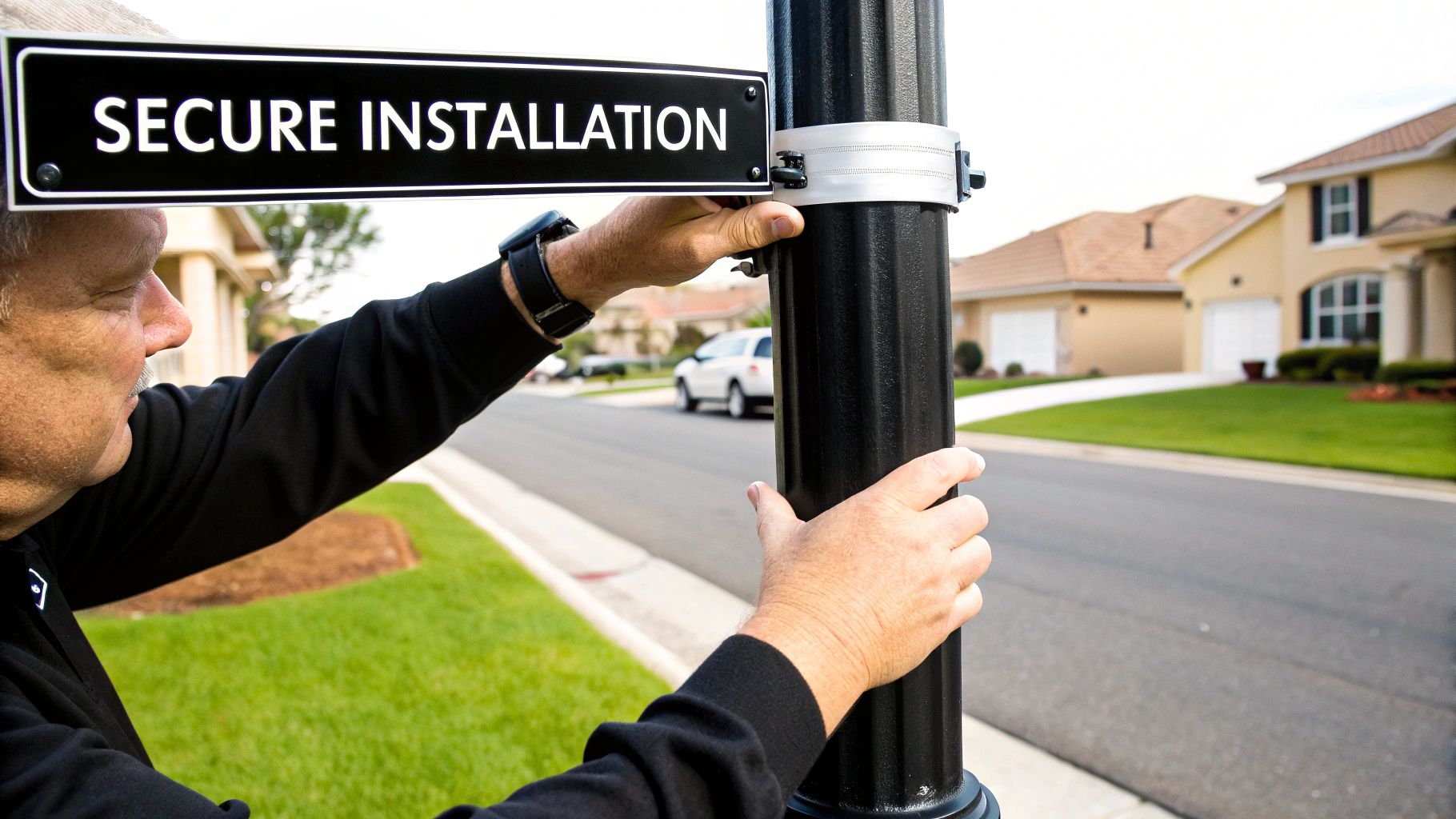
It's an effort that pays off, too. UK research shows a solid 10% drop in property crime in areas with active schemes. Digging deeper, it turns out 13% of offenders would give up on their plans if they saw a Neighbourhood Watch sign, while nearly 29% would simply move on to find an easier target.
Choosing the Right Mounting Hardware
The surface you're fixing the sign to dictates your entire approach. Using the wrong fixings is a recipe for disaster—a sign that works itself loose in high winds or becomes simple for someone to rip down.
Here’s a quick rundown of what hardware to use for common surfaces:
- Metal Lampposts or Poles: Stainless steel banding or universal channel clamps (UCCs) are your best bet here. They wrap securely around the post without needing to drill, which is often forbidden by local councils anyway.
- Wooden Posts or Fences: For any wooden surface, you'll want heavy-duty stainless steel screws complete with washers. If you're after a more secure, free-standing sign, you might need to install a dedicated post. Making sure that post is properly installed is key to its longevity, which includes understanding frost depth for secure post installation.
- Brick or Concrete Walls: This calls for masonry wall plugs paired with tamper-resistant screws. These specialised screws have unique heads that are difficult to remove with standard tools, offering a great defence against vandalism.
For ultimate durability, especially if you’re in a coastal or industrial area, always go for marine-grade stainless steel fixings to prevent rust and corrosion. This focus on robust materials also applies to the sign itself; for instance, a premium outdoor vinyl banner is weatherproof and UV-resistant, ensuring the message stays vibrant for years.
Practical Tips for a Secure Fit
Beyond the hardware, a few installation best practices can make all the difference in how long your sign lasts and how well it does its job.
Pro Tip: Always try to mount your signs at a height of at least 2.5 to 3 metres (8 to 10 feet) from the ground. This keeps them perfectly visible to drivers and pedestrians but makes them much harder for a casual vandal to reach without bringing a ladder.
Make sure the sign is perfectly level and tightened down so it doesn't rattle or spin in the wind. Once it's up, give it a firm tug to test its stability. A secure, professionally mounted sign doesn't just last longer—it reinforces the message that your community is organised, diligent, and serious about security.
Your Neighbourhood Watch Signage Questions Answered
Starting a new signage project always brings up a few questions, no matter how well-prepared you are. Getting those sorted is the key to moving forward with confidence and getting your scheme off to a flying start. Let's dig into the most common queries we hear, from figuring out numbers to sorting out the funding.
This is the practical stuff that helps you get the details right.
How Many Signs Do We Actually Need?
There’s no magic number here. The right quantity comes down entirely to the layout of your local area. The goal is to create a clear, visible boundary so that anyone entering your zone sees a sign. The best way to do that? Place one at every single entry and exit point.
For a simple cul-de-sac, two signs might be all you need. But if you’re covering a larger estate with lots of connecting roads, you could easily need a dozen or more to get that complete coverage.
- Walk the perimeter: This is the simplest way to get a real-world count. Walk or drive around the entire boundary of your watch area and note every entrance.
- Map it out: Pull up an online map and drop a pin on every road that leads into and out of your neighbourhood. This gives you a precise number to work with.
The aim is unavoidable visibility. You want everyone to know they're entering a protected area.
Who Is Responsible for Paying for the Signs?
More often than not, the funding for new neighbourhood watch signage comes directly from the residents themselves. While local police and councils are huge supporters of these schemes, their budgets rarely stretch to covering the cost of signs for every group.
This makes fundraising a crucial first step for most new schemes. The good news is that the cost is usually very manageable when it’s shared among all the households in the watch. For instance, if a sign costs £30 and you have 30 homes in your group, that’s just a £1 contribution from each household per sign.
Think of it as a small, one-off investment in your collective peace of mind. When the cost is shared, it becomes an incredibly affordable way to boost community security for years to come.
Some groups also have great success approaching local businesses for sponsorship. In return, you can offer a small, discreet acknowledgement on the sign. Just be sure to check with your local council if this is allowed before you make any promises!
Can We Create Our Own Custom Sign Design?
It’s great that you want to get creative, but we strongly recommend sticking with the official, nationally recognised Neighbourhood Watch branding. That familiar yellow and black logo is instantly understood across the country and carries a weight of authority that a custom design just can't replicate.
Using the official branding shows that your group is part of a larger, police-supported network. This consistency is precisely what makes the signage a credible deterrent. If you go your own way, you risk diluting the message and making your signs seem less official, which reduces their impact.
If you really want to add a local touch, consider adding a small line of text below the main logo, like "Proudly supported by the residents of [Your Street Name]". Just be sure to always prioritise that official look.
Ready to create high-impact, durable signage for your community? The team at Banner Printing Ltd specialises in weatherproof, professional-quality signs that will stand the test of time. Design and order your official neighbourhood watch signage at https://bannerprintingltd.co.uk today.


