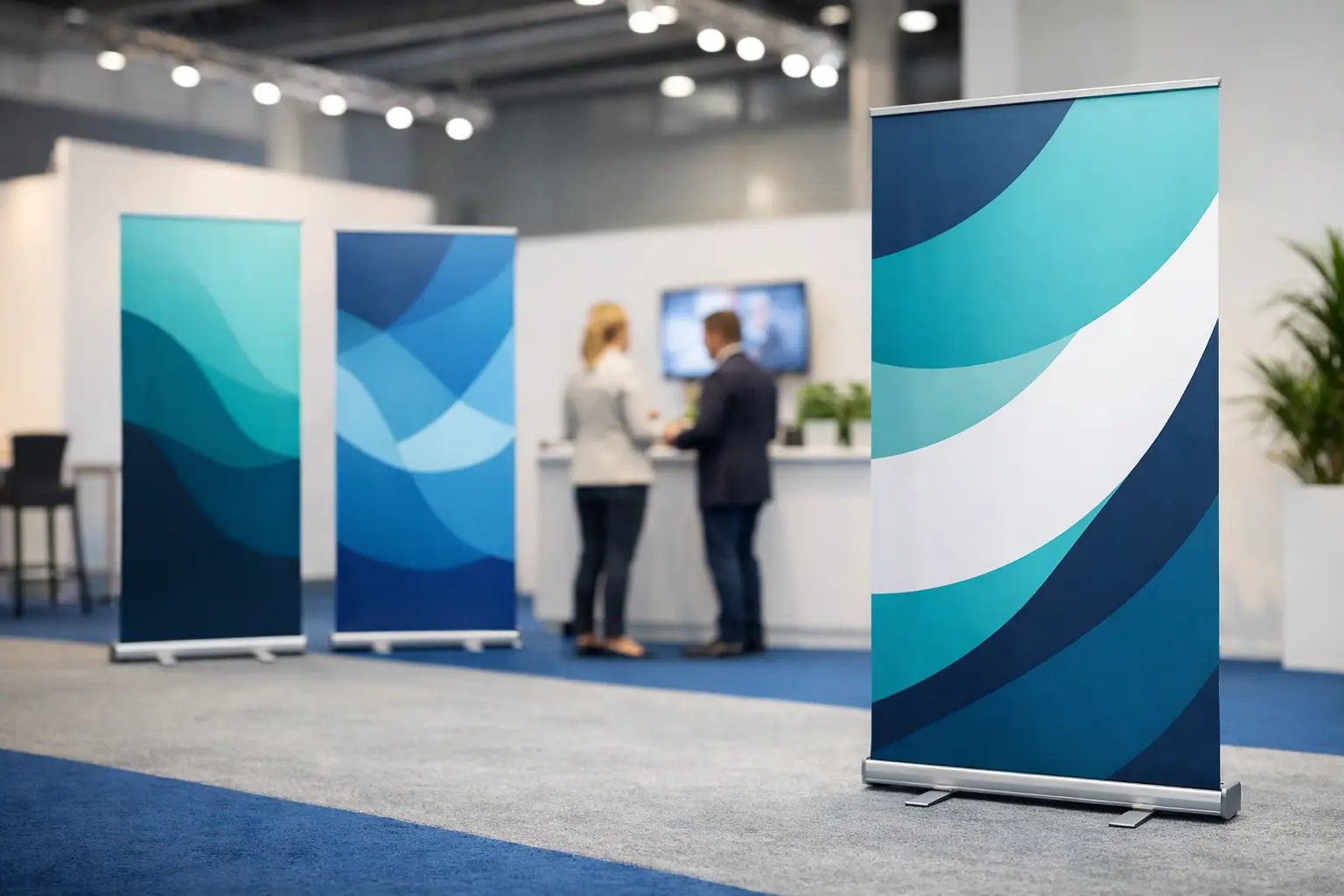
A busy exhibition aisle gives you only a few seconds to earn attention. Your stand may have great people, products and offers, but visitors need to understand what you do before they walk past. That is where exhibition roller banner printing earns its place. A well-produced pull-up banner puts your message at eye level, gives your space a professional finish and travels easily from one event to the next.
For UK businesses working to a tight event deadline, a roller banner is one of the most practical display investments available. It is compact in its carry case, quick to set up and large enough to make a clear statement without filling the whole stand. The difference between a banner that attracts enquiries and one that disappears into the background usually comes down to size, artwork and print quality.
What makes a roller banner effective at an exhibition?
A roller banner works because it handles the first job of exhibition marketing: it tells passing visitors who you are and why they should stop. It should not try to tell them everything. The most effective designs lead with one clear message, supported by a strong image or recognisable brand element, then give people a reason to start a conversation.
Think about the banner from several metres away. Your company name, main service or product category should be readable before a visitor reaches the stand. Details such as contact information, accreditations and a short supporting line can sit lower down, where they reward someone who has already stopped.
This is especially useful for businesses exhibiting in shared venues, hotel function rooms and trade halls where signage can be limited. A roller banner creates an instant branded backdrop for a shell-scheme stand, a reception desk, a product demonstration or a meeting area. It can also keep working after the show in a showroom, retail space or office entrance.
Choosing the right exhibition roller banner printing option
The standard roller banner size is popular for a reason. It offers a strong vertical display area while remaining easy for one person to carry and assemble. For many small stands, one banner beside a table or counter provides enough visual presence. If you have a larger pitch, a pair of matching banners can frame the space and make the stand feel more deliberate.
Size should follow the venue and the viewing distance. A compact banner can be right for a narrow space or indoor promotion where people will stand close by. A wider format gives more impact in an open hall, but only if the artwork has enough breathing room. Stretching a busy design across a wider banner rarely improves it.
The cassette and print material matter too. The cassette protects the graphic when it is rolled away and helps the banner stand securely throughout the day. For regular exhibitors, a dependable mechanism is worth prioritising. The printed panel should have a clean, opaque finish so colours stay solid and the display remains clear under exhibition lighting.
Roller banners are designed primarily for indoor use. If your promotion is outside, on a building site, around fencing or at a sports event, a weatherproof vinyl or mesh banner is generally the better choice. Choosing the right product for the setting avoids damage, wasted budget and last-minute display problems.
One banner or a full display?
A single roller banner is ideal when you need an uncomplicated, portable message. It is a good fit for networking events, recruitment days, pop-up promotions and smaller exhibition pitches. Two or three banners are better when you want to separate messages, such as your core service, a featured product and a customer benefit.
Avoid making every banner say the same thing. Use the first to establish your brand, the second to explain the offer, and the third, if needed, to support a campaign or call to action. They should look like one set through consistent colours, fonts and imagery, while each earns its floor space.
Build artwork for the way people actually read it
Exhibition artwork is not a brochure enlarged to banner size. Visitors scan from top to bottom and from a distance, often while moving. Give them a visual route that is simple to follow.
Start with a headline that explains the outcome you provide. “Fast, professional site signage” is more useful than a large block of corporate wording. Under that, use a short supporting statement, a product image or a relevant visual. Keep the main call to action direct: visit the stand, ask for a quote, book a demonstration or scan a QR code.
Text needs contrast. Pale lettering over a busy photograph may look acceptable on a laptop screen, then become hard to read under venue lights. Dark text on a light area, or light text over a solid dark panel, is a safer choice. If you use a QR code, make it large enough to scan and leave clear space around it. It should support the conversation, not replace the main message.
Keep key content away from the very bottom of the design. That area is less visible when people are standing nearby, and part of the graphic may sit inside the roller mechanism. Faces, logos, phone numbers and essential copy should sit comfortably within the safe area supplied for the chosen banner size.
For sharp HQ printing, supply artwork at the required dimensions and resolution. Vector logos are ideal because they retain crisp edges at large scale. High-resolution photographs also work well, provided they have not been pulled from a website or social media post. A small image may look fine on screen but print soft or pixelated when enlarged.
Common artwork mistakes to avoid
The most frequent issue is trying to fit too much onto one banner. Long service lists, multiple messages and tiny logos make visitors work too hard. Another is relying on a headline that only makes sense when someone already knows your business.
Be careful with margins, too. Artwork that runs important text right to the edge can look cramped, while a logo placed too low may be lost in the base. Before sending a file to print, check spelling, telephone numbers, dates, pricing and web addresses carefully. A fast turnaround is valuable, but it cannot rescue an approved typo after production.
Match the banner to the event objective
The best design depends on what success looks like for the event. A business launching a product needs a banner that creates intrigue and makes the product benefit obvious. A tradesperson attending a local show may get better results from clear service coverage, trust signals and examples of completed work. A retailer hosting an in-store promotion needs a concise offer that can be understood instantly.
For recruitment fairs, show what candidates gain from joining, rather than leading with a full list of vacancies. At hospitality and wedding events, high-quality photography can do more work than dense copy. For business-to-business exhibitions, a specific result, such as reduced lead times or easier procurement, can be stronger than generic claims about quality.
It also depends on where the banner will stand. If it is behind a staffed counter, the lower third matters less. If it will stand alone near an entrance, make the complete message work without explanation. Planning around the real location helps you choose a format and layout that performs rather than simply looks polished in a proof.
Plan print and delivery before the deadline becomes urgent
Exhibitions have fixed dates, which makes reliable production and delivery essential. Order as early as possible where you can, particularly if your artwork is still being developed or several people need to approve it. Early ordering gives room to refine the message, check the file and coordinate other materials such as flyers, business cards, posters or a branded backdrop.
That said, marketing opportunities do not always arrive with weeks of notice. UK-based production and fast turnaround can make a real difference when an event is confirmed late, a design changes or an existing banner has been damaged. Banner Printing UK supports straightforward artwork upload, practical display choices and fast dispatch for customers who need professional print without unnecessary delay.
When the banner arrives, set it up once before leaving for the event. Check that the graphic is clean, the base is stable and the support pole is fitted correctly. Pack the carry case with the rest of your stand equipment, rather than treating it as a separate item to remember on the morning.
A roller banner is a simple product, but it carries a big share of your exhibition presence. Give it one focused job, print it to a professional standard and place it where visitors can see it before they reach your table. That preparation gives your team a better starting point for every conversation that follows.