
When the worst happens, every second counts. Fire hydrant signs are the small but mighty markers that guide firefighters to their nearest water source, shaving precious time off their response. They aren't just a tick-box exercise for UK site safety; they provide critical information at a glance.
Why Fire Hydrant Signs Are a Site Safety Non-Negotiable
Picture the scene during a fire. It’s chaotic, urgent, and every moment is vital. A small, unassuming sign can make the difference between a swift, controlled response and a catastrophic delay. That’s the real job of a fire hydrant sign – it’s not just a bit of plastic, it's a vital tool in the UK's public safety infrastructure. For emergency services, these signs are simple, clear signposts that cut out the guesswork and get them straight to a life-saving water supply.
This instant access is absolutely crucial. When a fire engine arrives, the water it carries is limited and can run out in just a few minutes. Finding a hydrant isn't just convenient; it's an operational necessity. A clear, well-placed sign turns a frantic search into a rapid, decisive action.
The Bigger Picture of Public Safety
The sheer scale of this system highlights its importance. Across the United Kingdom, there are over 700,000 hydrants forming a massive public safety network. These assets are typically owned and maintained by local water companies working closely with Fire and Rescue Services, making them a cornerstone of nationwide emergency response. You can find more details on how smart technology is shaping this infrastructure and its future potential in the UK.
If you’re a construction manager, landlord, or business owner, understanding these signs is a core part of your responsibility. It's more than just following the rules; it's a practical step towards protecting property and, more importantly, lives. A sign that's missing, faded, or blocked by a hedge can create a dangerous blind spot for first responders.
Think of it like this: a fire hydrant without a sign is like a hospital without a road sign. The resource is there, but if nobody can find it when it’s desperately needed, its value plummets. These signs ensure a hydrant can always be used to its full, life-saving potential.
Ultimately, proper signage makes the entire community safer. It guarantees that our emergency services have the tools they need to do their jobs effectively, protecting your property and the surrounding area. Investing in clear, durable, and correctly placed fire hydrant signs is a direct investment in resilience. It just goes to show that sometimes, the smallest details have the biggest impact when it matters most.
How to Read Fire Hydrant Signs Like a Pro
At first glance, a UK fire hydrant sign can look like a secret code. But for firefighters, it’s a vital treasure map leading directly to a life-saving water supply. Once you know the simple logic behind the numbers and symbols, you'll be able to read these crucial markers in an instant.
This isn’t just trivia for emergency responders; it’s essential knowledge for site managers and property owners who need to ensure their signage is spot-on.
Think of that iconic black ‘H’ on a yellow background. It’s a universal nod to a fire hydrant’s location, but the real power is in the numbers surrounding it. With brilliant efficiency, these digits tell firefighters two critical pieces of information they need to know in a fraction of a second.
The Numbers Above and Below the H
The two numbers on a standard fire hydrant plate are its most important features. Each one has a distinct, crucial job: guiding firefighters to the exact spot and telling them about the water supply’s capacity.
The number above the 'H' tells you the diameter of the water main it’s connected to, measured in millimetres. Think of it like knowing the width of a motorway—a bigger pipe means more water can flow through it. A larger number, like 150 (mm), signals a wide main capable of delivering a powerful volume of water for tackling a major blaze. A smaller number, such as 75 (mm), points to a smaller main.
The number below the 'H' reveals the precise distance to the hydrant cover, measured in metres. So, a number like 3 means the hydrant itself is three metres away from the sign, usually in the direction the sign is pointing or directly in front. This simple direction saves crews from wasting precious time searching under snow, fallen leaves, or parked cars.
This clear-cut system removes all guesswork during an emergency. The importance of this clarity can't be overstated—it’s the foundation for a fast response, site safety, and legal compliance.
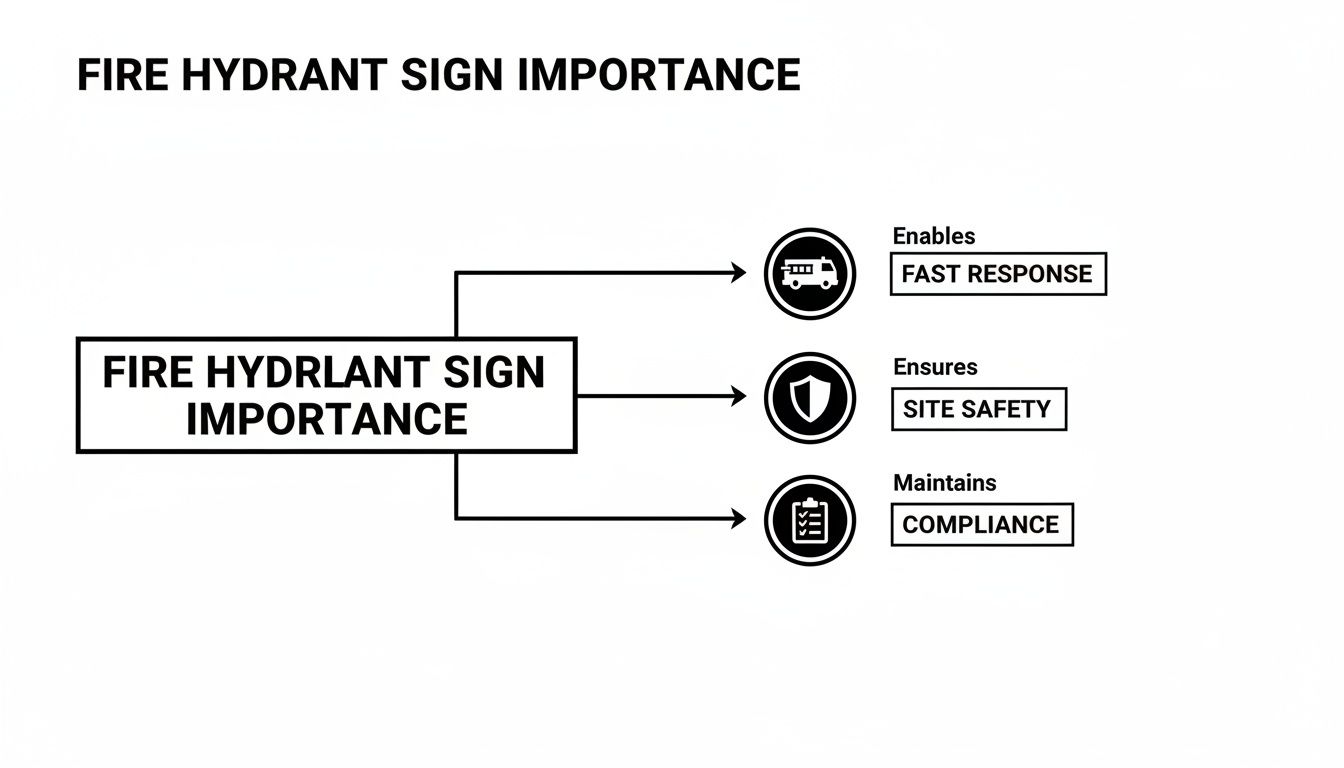
As the visual above reinforces, clear signage is the first step towards enabling a rapid emergency response, which is fundamental to overall site safety.
To break it down even further, here's a quick reference guide.
Decoding UK Fire Hydrant Sign Elements
| Element | What It Tells You | Typical Example |
|---|---|---|
| Top Number | The diameter of the water main in millimetres (mm). Bigger number = more water flow. | 100 |
| Central 'H' | The universal symbol indicating a Hydrant is nearby. | H |
| Bottom Number | The distance from the sign to the hydrant cover in metres (m). | 5 |
| Background Colour | The type of water source. Yellow for public mains, other colours for private sources. | Yellow |
With this simple breakdown, you can see how a sign instantly communicates everything a firefighter needs to know on arrival.
Understanding Colour Variations
While the yellow sign with a black 'H' is the most common sight on our streets, you might spot other variations. The colour scheme is a quick visual clue about the nature of the water supply.
- Yellow Background: This is the standard for signs indicating a public water main. The hydrant is connected to the mains network managed by the local water authority.
- Black Background: A sign with a white 'H' on a black background usually signals a private or non-mains water supply. This could be a static tank, a pond, or another dedicated water source located on private property.
This distinction is vital. Fire crews need to know if they're hooking up to a potentially limited private supply, while site managers carry the responsibility for maintaining these private systems to ensure they're ready when needed.
A fire hydrant sign is truly a masterpiece of functional design. It communicates location, power, and water source using just a few numbers and colours, ensuring that in the heat of the moment, information is crystal clear.
Whether you're a facility manager ensuring compliance or just a curious passer-by, you now have the knowledge to decode these life-saving instruments hidden in plain sight.
Navigating UK Regulations for Sign Compliance
Getting fire hydrant signs right isn't just about ticking a box to avoid a fine. It’s about making sure these vital markers can do their job in a real emergency, where every second counts. The key document here is BS 3251, which is essentially the official rulebook for their design, size, and placement across the UK.
Think of BS 3251 as the blueprint for instant clarity. It ensures that every sign, whether it's in Cornwall or the Highlands, speaks the same visual language. This standardisation is absolutely critical for firefighters, who need to read and understand a sign immediately without any guesswork.
The rules on sizing aren't arbitrary, either. They're there for a very practical reason: a sign has to be big enough and clear enough for a firefighter to spot from a moving fire engine, day or night. This single requirement dictates the size of the sign itself, the iconic 'H', and the numbers showing the pipe size and distance.
Core Principles of BS 3251
Compliance is more than just having a sign up. It’s about making sure that sign is effective around the clock, in any condition. The standard is built on a few non-negotiable principles designed to give firefighters the best possible information in a high-stress situation.
Key factors for compliance include:
- Standardised Dimensions: All signs must follow specific sizes. This removes any confusion and ensures instant legibility from a distance.
- Clear Colour Contrast: The familiar yellow and black (or white and black for private water supplies) isn't just for show. It provides the strongest possible contrast, helping the sign pop against any background.
- Reflective Materials: A sign is useless if you can't see it at night. Regulations demand that signs are made from retroreflective materials, which light up brightly when hit by a vehicle's headlights.
These elements combine to create a simple, tough, and universally understood system for every UK Fire and Rescue Service. That consistency is the backbone of an effective emergency response.
The legal framework is designed with one goal: to remove any barrier between a firefighter and the water they need. A non-compliant sign—whether it's too small, faded, or badly placed—is a barrier that costs precious time.
Conducting a Simple Visibility Audit
Keeping your signs compliant is an ongoing job. A sign that was perfect when installed can become completely hidden over time. It’s a good habit to regularly walk your property and do a quick visibility audit.
Just ask yourself a few simple questions:
- Can you see it clearly from the road? Find the most likely spot a fire engine would approach from and check the line of sight.
- Has anything grown over it? Overhanging branches, climbing ivy, or a fast-growing hedge can completely cover a sign in a single season.
- Are there any new obstructions? Think about things like newly installed fences, parked vans, or even large wheelie bins that might be blocking the view.
- Is the sign clean and bright? A layer of grime or sun-faded paint can dramatically reduce a sign's visibility and reflectivity, especially at night.
For property managers and landlords, these simple checks are a crucial part of your duty of care. Beyond these specific markers, remember that general UK landlord compliance covers a wide range of responsibilities. If you need a broader overview, there are excellent resources covering all types of site compliance signage to ensure your entire property is safe and up to standard. Being proactive doesn't just keep you on the right side of the law; it reinforces your role in keeping the community safe.
Choosing Materials That Withstand UK Weather
A fire hydrant sign that’s faded, cracked, or missing is no better than having no sign at all. With the UK’s notoriously unpredictable weather, your choice of material isn’t just a minor detail—it’s the backbone of long-term safety and compliance.
Investing in the right material ensures your signs stay clear and legible through years of driving rain, biting frost, and the occasional summer heatwave.

Imagine a sign that peels away after one harsh winter or bleaches into an unreadable mess after a single sunny spell. Not only does that render it useless in an emergency, but it also puts your site in breach of safety standards. To avoid this, you need to know the pros and cons of the most common sign materials on the market.
Core Material Options
When you’re looking at fire hydrant signs, you’ll usually come across three main contenders. Each one strikes a different balance between rigidity, longevity, and where it can be used, making them perfect for specific situations.
Here’s a quick rundown of the most popular choices:
- Dibond (Aluminium Composite): Think of this as the heavyweight champion of outdoor signage. It’s made of a tough polyethylene core sandwiched between two thin sheets of aluminium. This construction makes it incredibly rigid, completely weatherproof, and resistant to rust—a huge plus in the damp UK climate.
- Foamex (Rigid PVC): A versatile and popular option, Foamex is a lightweight yet sturdy compressed PVC sheet. It gives you a smooth, professional finish and is totally waterproof. While it's durable, it doesn’t have the same brute strength as Dibond, so it’s better suited for spots with a lower risk of getting knocked about.
- Self-Adhesive Vinyl: This isn't your average sticker. We’re talking about a professional-grade, flexible, and durable material with a powerful adhesive backing built for the great outdoors. It's the perfect solution for applying signs to tricky surfaces like lampposts or pillars where a rigid board just won’t work.
There’s no single "best" material—only the best material for the job.
The table below breaks down these choices to help you decide what’s right for your site.
Comparing Materials for Outdoor Fire Hydrant Signs
Choose the best material for your environment based on durability, application, and overall value.
| Material | Ideal Application | Key Benefit | Lifespan |
|---|---|---|---|
| Dibond (Aluminium Composite) | Permanent installations on flat surfaces like brick walls or posts in high-traffic areas. | Extreme rigidity and weather resistance; won't warp or corrode. | 10+ years |
| Foamex (Rigid PVC) | Sheltered walls, fences, or locations with less physical exposure. | Lightweight and cost-effective with a professional, smooth finish. | 5-7 years |
| Self-Adhesive Vinyl (High-Tack) | Curved or uneven surfaces like lampposts, pillars, and utility boxes. | Flexible and conformable; adheres strongly to difficult surfaces. | 5-7 years |
Ultimately, the right choice comes down to matching the material’s strengths with the demands of its future home.
Match the Material to the Environment
Think about exactly where your sign will be mounted. A sign attached to a windswept fence on a coastal construction site faces a much bigger challenge than one fixed to a sheltered brick wall in a quiet courtyard. Context is everything.
Your sign's material is its first line of defence against the elements. Choosing a material that can’t handle its environment is like sending a soldier into battle without armour—it’s destined to fail when it's needed most.
Consider these common scenarios:
- For a permanent, flat surface like a brick wall: Dibond is your best bet. Its supreme rigidity means it won't warp or bend over time, and its durability gives you the longest possible lifespan with minimal fuss.
- For a smooth, sheltered wall or fence: Foamex offers a fantastic balance of durability and value. It’s perfect for standard installations where it won't be taking a lot of physical punishment.
- For a curved surface like a lamppost or pillar: High-tack self-adhesive vinyl is really the only practical choice. It moulds perfectly to the shape of the surface, ensuring a secure and professional look where a rigid sign simply can't.
By thinking through these factors, you can be confident your investment in safety signage is one that will last. If you’re looking at options for other needs around your site, our guide to choosing the right plastic for signs offers more in-depth advice to ensure every sign is built to withstand the elements.
Correctly Placing and Mounting Your Signs
A perfectly designed, compliant fire hydrant sign is pretty much useless if firefighters can't see it. Where you place your sign is just as crucial as the information it displays. Getting the mounting right isn’t just about ticking boxes; it’s about making sure your sign can do its job when lives are on the line.
The process is surprisingly straightforward once you grasp the logic. The entire goal is to make the sign instantly visible to a fire crew arriving on site—often in a hurry, under pressure, and looking out from a vehicle. Every decision you make should serve this one simple purpose.

The trick is to think like a firefighter. They need a clear, unobstructed view from the road or access point. That means you need to consider height, angle, and any potential blockages before you even think about drilling holes.
Finding the Optimal Mounting Height
Height is your first and most important consideration. A sign that’s too low can easily be hidden by a parked car, a hedge, or even a heavy snowfall. Mount it too high, and it might be out of a driver's natural line of sight. The sweet spot is all about aligning it with where a firefighter will be looking from their cab.
While official UK standards focus more on the design of fire hydrant signs, general best practice for safety signage gives us a solid principle: mount signs so they are readily accessible and visible. This means putting them at a height that avoids obstruction while being easy to spot in an emergency.
A good rule of thumb is to place the sign so the carrying handle of a portable fire extinguisher would sit somewhere between 3.5 and 5 feet (roughly 1 to 1.5 metres) from the ground. This range is widely recognised for great visibility in safety contexts, making it a reliable guide for your hydrant signs.
Positioning for Maximum Visibility
Once you’ve sorted the height, the next job is orientation. The sign needs to be dead easy to read from the most likely direction an emergency vehicle will approach from. This simple thought dictates everything else about where and how you fix it.
For the best results, follow these key placement rules:
- Position Perpendicular to the Road: The sign needs to face outwards, at a right angle to the nearest road or access route. This ensures the full face of the sign is visible to an approaching vehicle, not just its thin edge.
- Ensure a Clear Line of Sight: Before you fix it in place, stand back on the road and look. Are there any trees, lamp posts, other signs, or building corners that could block the view? These are the common culprits.
- Place It Near the Hydrant: The sign should be located right in the immediate area of the hydrant it points to. The number on the bottom of the sign will then guide the crew those final few metres to the exact spot.
By following these simple steps, you're directly connecting the information on the sign to its real-world location. The top number gives the water main size, while the bottom number and the sign's position work together like a simple, effective navigation tool. It’s a practical approach that guarantees your investment in safety and compliance really pays off when it counts.
How to Order Custom and Compliant Signage
Ordering the right fire hydrant signs shouldn’t be a puzzle. It’s a simple, straightforward process, but getting a few key details right from the start makes all the difference. This ensures your signage is fully compliant and, most importantly, effective in an emergency.
Think of it as putting together a small information toolkit before you place your order. With these specifics, the process is smooth, fast, and guarantees the final sign can do its life-saving job correctly.
Your Pre-Order Checklist
To get a custom, compliant sign made, you’ll need three crucial pieces of information. These details translate directly into the numbers and colours on the finished product, so it's vital to get them right.
- Water Main Diameter: This is the size of the underground pipe, measured in millimetres. It will be the top number on your sign.
- Distance to the Hydrant: Measure the distance from where the sign will be mounted to the hydrant cover itself. This figure, in metres, will be the bottom number.
- Type of Water Supply: Is the hydrant connected to the public mains or a private source? This dictates the sign’s background colour – typically yellow for public mains and often black for private supplies.
Gathering this information first ensures you're ordering a sign that is not just visually correct but functionally accurate for the fire service. To see what's out there, you can explore a wide range of available fire hydrant signs from reputable suppliers.
This standardised system is part of a trusted, life-saving tradition. The details you provide aren't arbitrary; they are a direct communication link to first responders, built on decades of proven safety protocol.
This clear, metric-based system has been the standard in the UK for a long time. During the major metric conversion programme of the 1970s and 1980s, nearly all hydrant signs were systematically updated from Imperial to metric units, solidifying the clear system we rely on today.
Supplying Your Artwork Correctly
If you're designing your own artwork, a couple of basic print terms will help you get a professional, high-quality result. Don't worry, they're much simpler than they sound.
Think of 300dpi (dots per inch) as a measure of sharpness. For a sign to be crisp and easily readable from a distance, your image file needs to have this minimum resolution. A low-resolution file will look blurry or pixelated when printed.
CMYK refers to the four ink colours used in professional printing: Cyan, Magenta, Yellow, and Key (Black). Your artwork must be set up in this colour mode, not RGB (Red, Green, Blue), which is for screens. This guarantees the colours on your finished sign will look exactly as you expect them to.
For a more detailed walkthrough, our comprehensive artwork help section covers everything you need to know to get it right.
Your Fire Hydrant Sign Questions Answered
Even after covering the basics, a few practical questions always seem to pop up. Site managers, property owners, and even just observant passers-by often have specific queries that need a clear, straightforward answer. This section is here to clear up any lingering confusion.
Think of it as the final piece of the puzzle. We’ve gathered the most common questions to give you simple, practical answers about these vital safety markers.
Can I Install a Fire Hydrant Sign Myself?
Yes, in most cases, you can. There’s no law stopping you from installing a fire hydrant sign yourself, so long as you follow the proper placement and mounting guidelines. The most important thing is making sure it’s securely fixed, easy to see from the road, and positioned at the right height – usually somewhere between 1 to 1.5 metres off the ground.
That said, if you’re at all unsure about the best spot or how to fix it to a tricky surface, getting a professional handyman or signage installer in is a smart move. Their experience guarantees the sign is not only compliant but also fitted to last.
How Often Should I Check and Clean My Signs?
Regular checks are essential to keep your fire hydrant signs doing their job. A good rule of thumb is to give them a visual inspection at least twice a year. Scheduling it for spring and autumn is ideal, as it lets you sort out any issues caused by the winter frost or summer growth.
Your quick inspection should cover three things:
- A good clean: Use a soft cloth and some mild detergent to wipe off any dirt, grime, or green algae that might be hiding the text or dulling its reflective shine.
- A visibility check: Make sure nothing new is blocking the view from the road. Overgrown hedges, parked vehicles, or new fencing can all cause problems.
- A damage assessment: Look closely for any fading, peeling, cracks, or signs of vandalism. Remember, a damaged sign is a non-compliant sign, and it needs replacing fast.
This simple routine takes just a few minutes but ensures your signs are ready and reliable for the emergency services, whatever the season.
What Do I Do If a Sign Is Missing or Damaged?
If you spot a missing or damaged fire hydrant sign on your property, you need to get it replaced immediately. It’s not just a compliance issue; a faulty sign creates a genuine safety blind spot that could have serious consequences in an emergency.
If the sign is on public land, like a pavement or roadside verge, then it's a job for the local council or the water authority. Report it to them as soon as you can. They're responsible for maintaining public hydrants and signs, and a quick phone call from you ensures everyone in the community stays safe.
A missing sign is a broken link in a critical safety chain. Whether it's your responsibility or the local authority's, reporting it is a vital public service that could one day help save property and lives.
Are the Signs Different for Hydrants on Walls?
Yes, they can be slightly different. The core information—the big 'H', the pipe diameter, and the distance—all stays the same, but the sign might have an extra clue. For hydrants located directly on a building wall, you’ll often see an arrow or another directional marker pointing to the exact location of the inlet.
This is especially common for buildings with dry or wet risers. The sign on the outside wall is there to show firefighters exactly where to connect their hoses. At the end of the day, the principle is identical: give clear, immediate directions, no matter where the hydrant is.
At Banner Printing Ltd, we provide high-quality, durable, and fully compliant fire hydrant signs to keep your property safe and up to standard. Whether you need a standard design or custom specifications, we deliver fast across the UK. Explore our range of safety signage solutions at https://bannerprintingltd.co.uk.


