

So, you've got a killer design and you're ready to print. The big question is, where do you go? Broadly, you have two paths: hopping online for ultimate convenience or popping down to your local print shop for a more hands-on experience. The right choice really hinges on what you need most—speed, budget, or a bit of expert advice.
Your Guide to UK Poster Printing Options
Figuring out whether to go with an online service or a local shop is the first real decision you'll make in bringing your poster to life. It’s not just a simple transaction; it’s about finding a partner whose strengths align perfectly with what you’re trying to achieve. Whether it’s a one-off art print for your wall, a hundred posters for an upcoming gig, or a full-scale marketing campaign, knowing the lay of the land is key.
Making an Informed Choice
The UK’s commercial printing industry is a beast, valued at a whopping $18.6 billion in 2024. That means you’re spoilt for choice. From household names on the high street to specialised online hubs, the options can feel a bit much. But the good news is that modern digital printing has made professional quality more accessible and affordable than ever, even for small batches or custom sizes.
As you weigh your options, think bigger picture. How does this poster fit into your marketing? A big part of this comes down to understanding the principles of visual merchandising in retail. Your poster isn’t just ink on paper; it’s a powerful tool meant to grab attention and get people to act.
So, let's break it down. Ask yourself these three things:
- Urgency: Do you need this poster in your hands tomorrow, or can you wait a few days?
- Expertise: Are you a design pro, confident your files are print-perfect? Or could you use a second pair of eyes?
- Tangibility: Is it important for you to physically see and feel the paper stocks before you commit?
Online Printers vs Local Shops At a Glance
To help you decide at a glance, here’s a quick rundown of what each option typically offers. This table should make it easier to see which route aligns best with your project's immediate needs.
| Factor | Online Printing Services | Local Print Shops |
|---|---|---|
| Cost | Often more competitive, especially for bulk orders. | Can be higher due to overheads, but great for small, quick jobs. |
| Speed | Varies widely. Express options available, but standard delivery takes days. | Often unbeatable for same-day or next-day turnaround. |
| Convenience | Excellent. Order anytime from anywhere, 24/7. | Requires a physical visit during business hours. |
| Support | Usually limited to email, chat, or phone support. | In-person, hands-on advice and proofing. A massive plus. |
| Choice | Huge range of paper stocks, finishes, and custom options. | Limited to the stocks and equipment they have on-site. |
| Proofing | Digital proofs (PDFs) are standard. Physical proofs can be slow and costly. | You can see a physical proof, often while you wait. |
Ultimately, neither option is "better" than the other—it's all about what's right for you and your project. An online printer might be perfect for a big, planned-out campaign, while your local shop could be a lifesaver for a last-minute event.
Your final choice will balance the convenience and vast selection of online printers against the personalised advice and immediacy of a local expert. The right answer is the one that best serves your project's unique demands.
Choosing Your Path: Online Service vs Local Shop
So, where should you get your poster printed? It’s the classic trade-off: the speed and scale of an online service versus the hands-on expertise of a local print shop. There’s no single right answer, just the one that’s best for your project.
Let's look at where each one shines.
Online printers are built for volume, and that brings two huge benefits: choice and price. You get access to a massive catalogue of paper stocks, weights, and fancy finishes like matt lamination or spot UV that a small local shop just can't keep on hand. If you're printing a big run—say, 200 A2 posters for a UK-wide campaign—the cost per poster is almost always lower online thanks to their streamlined process.
But that digital convenience isn't without its downsides. If you hit a snag with your artwork, you're dealing with customer service via email or a chat window, which can feel slow and disconnected. And then there's shipping. Even with express options, standard delivery takes a few days, which is no good when you’re in a real hurry.
When to Go Local
This is where your neighbourhood print shop saves the day.
Picture this: it’s Tuesday afternoon, and you’ve just been told you need 50 A1 posters for a conference that starts Thursday morning. An online order simply isn't going to make it. A local printer’s ability to offer same-day or next-day turnarounds is an absolute lifesaver.
The other huge win is the hands-on experience. You can actually hold the paper samples, feeling the difference between a 170gsm silk and a heavier 250gsm gloss. That tactile confirmation takes all the guesswork out of it. Plus, you get instant, expert advice. If there’s a resolution problem with your file, they’ll spot it and help you fix it right there, preventing a disappointing and costly print run. That kind of personalised service might cost a bit more for small orders, but the peace of mind is often worth every penny.
When your deadline is tight, getting the colour just right is critical, or you simply need some face-to-face guidance, a local print shop offers a level of service that online platforms just can't match.
Making the Final Call
Ultimately, it all comes down to balancing your priorities: time, budget, and quality. The thought process is very similar to what you'd go through for any specialised print job. You can find out more by exploring what to look for when selecting a banner printing service in the UK.
Here's a quick guide to help you decide:
- Go online if: Your deadline is flexible, budget is your main driver (especially for larger quantities), and you’re 100% confident your design files are print-perfect.
- Go local if: You’re racing against the clock, you want to see and feel the materials first, or you'd value an expert eye on your project to guarantee a flawless result.
Weigh these points against what your project needs, and you'll be able to confidently choose the right path to bring your poster design to life.
How to Prepare Your File for a Perfect Print
Getting your digital file right is the secret to a flawless poster. It's the difference between a crisp, vibrant print and a costly, disappointing reprint. Honestly, a poorly prepared file is the number one reason print jobs go wrong, but a few simple checks will ensure your design looks as amazing on paper as it does on your screen.
Think of it as a pre-flight checklist. Before you even decide where to get your poster printed, you need to make sure your artwork is ready for take-off. The most common pitfalls—blurry images, weird colours, and crucial details being trimmed off—are all easily avoidable.
This simple guide helps you decide whether to prioritise speed or price when choosing a printing service.
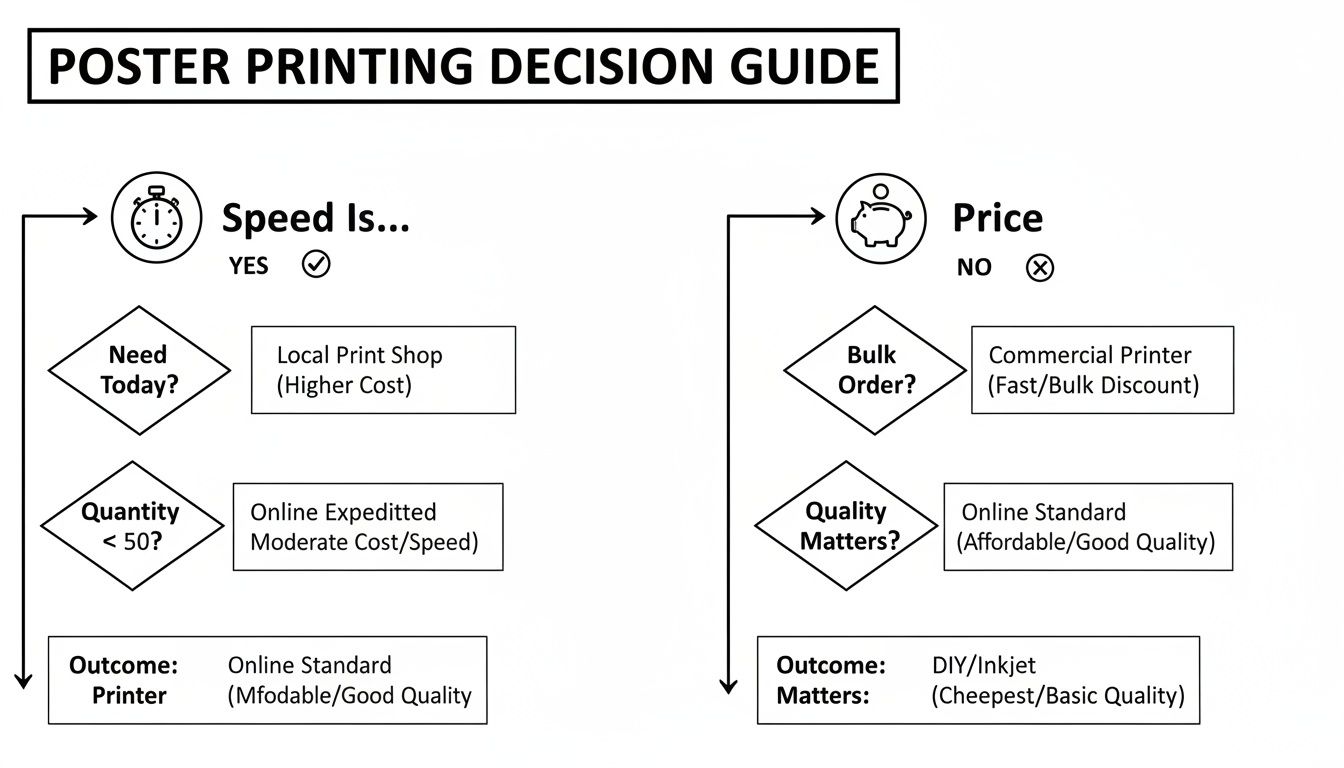
As you can see, your priorities will quickly point you toward an online service for budget-friendly options or a local shop for those urgent, last-minute turnarounds.
Your Essential Pre-Print Checklist
To avoid any headaches, run through these key specs before you send anything off. They might sound a bit technical, but nailing them is crucial for a professional result.
- Resolution is King: Your file absolutely must be 300 DPI (dots per inch) at its final print size. If you use a low-resolution image, it’s going to look blurry and pixelated when blown up, no matter how fancy the printer is.
- Colour Mode Matters: Set your design file to CMYK (Cyan, Magenta, Yellow, Black). This is the colour model for ink. Files left in RGB (Red, Green, Blue)—the model for screens—will often print with dull, disappointing colours.
- Add Bleed: A 3mm bleed is non-negotiable. This just means extending your background design 3mm beyond the final trim edge on all sides. It’s a small safety buffer that prevents ugly white slivers from appearing if the trimming is off by even a fraction of a millimetre.
A print-ready PDF is the gold standard in our industry. Unlike a JPG or PNG, a PDF embeds all your fonts and images, ensuring nothing gets lost, shifted, or substituted when the printer opens your file on their system.
Choosing the Right File Format
A print-ready PDF is always your safest bet. For really large poster files, you might need to shrink the file size a bit to make uploading easier; this is a great guide that shows you how to compress your PDF without losing quality.
The UK's custom printing market is absolutely booming right now, with digital printing leading the charge. This growth, expected to hit USD 4,243.6 million by 2030, means high-quality, professional services are more accessible than ever before.
Of course, knowing your poster printing size options is another vital step in this prep phase. Getting these technical details right from the start saves you time, money, and guarantees a perfect print every time.
Selecting the Right Paper and Finish
Once your design file is print-ready, it’s time for the fun part: choosing the materials. The paper and finish you pick can elevate your poster from something functional to something truly memorable. This isn't just about what looks good; it’s about what works for your poster's specific job, affecting everything from colour vibrancy to durability.
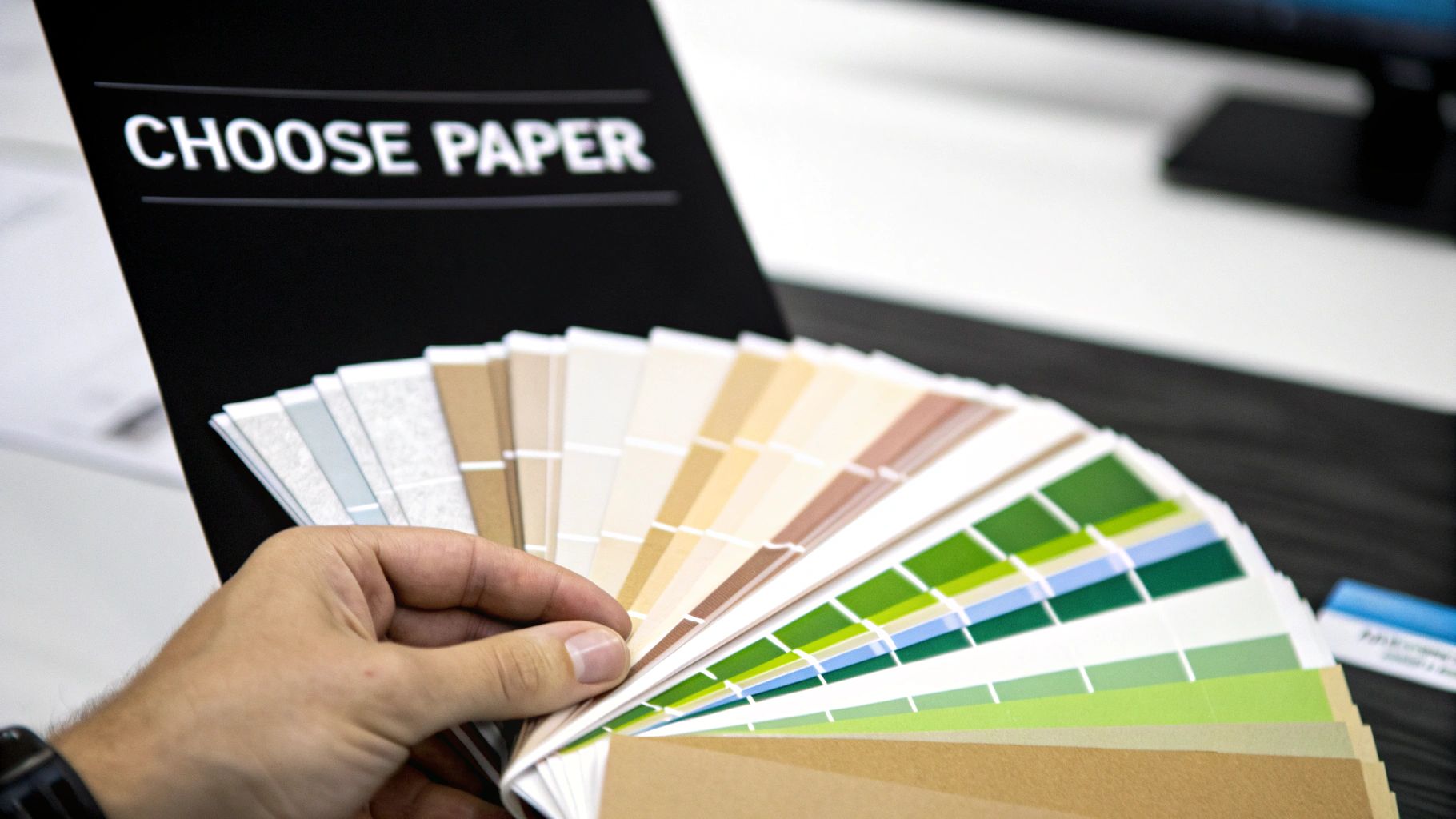
It’s easy to get bogged down in print jargon, but getting a grip on the basics of paper weight and finish gives you full creative control over the end result.
Decoding Paper Weight
Paper weight, measured in gsm (grams per square metre), is your go-to guide for a poster's thickness and sturdiness. A higher gsm number simply means a heavier, more substantial paper. It’s not about finding the "best" weight, but the right one for the task at hand.
Here are the common weights you’ll come across:
- 150-170gsm Silk: A brilliant all-rounder. This stock has a subtle sheen, feels professional, and is durable enough for most indoor applications like event promos or shop window displays. It’s often the most budget-friendly option for bulk orders.
- 250gsm+ Gloss: Now we’re in heavyweight territory. This paper feels more premium and robust, and the high-gloss finish makes colours absolutely sing. It’s perfect for photographic prints or any design that needs to grab attention instantly.
- 300gsm+ Matt/Uncoated: This is your top-tier choice for art prints or high-end displays. It’s thick, almost like card, lending a real sense of quality and permanence. An uncoated or matt finish adds an artistic, sophisticated feel.
Knowing where to get a poster printed often comes down to which supplier offers the right range of paper stocks to bring your vision to life.
Don’t automatically go for the heaviest paper. A lighter 170gsm stock is perfect for short-term promotional posters, saving you a packet on bulk runs without sacrificing the quality needed for its purpose.
Choosing the Perfect Finish
The finish is the final flourish. It dictates how your poster plays with light and how people perceive its colours, and it can completely change the mood of your design.
Your main choices are Gloss, Silk, and Matt. Each has its own personality and is suited to different jobs.
Gloss Finish
Think of a gloss finish like a coat of fresh varnish. It's highly reflective, making colours look incredibly deep, rich, and saturated. This makes it a fantastic choice for photo-heavy designs where you want maximum visual punch. The downside? Glare. Under direct shop lights or in a bright gallery, it can be tough to see the details.
Silk Finish
Silk is the perfect middle ground. It has a lovely, low-sheen coating that gives colours a boost without the mirror-like reflection of gloss. This makes it incredibly versatile and a safe bet for almost anything, from corporate event posters to festival advertising. The colours stay crisp, and the poster is easy to read from any angle.
Matt Finish
A matt finish has no sheen at all, giving your poster a modern, sophisticated, and often artistic feel. Because it’s completely non-reflective, it’s the best option for posters displayed under bright lights or for text-heavy designs. It has a smooth, tactile quality that works beautifully for illustrations and minimalist art prints.
Understanding Costs and Turnaround Times
Alright, let's talk about the practical bits: money and time. Figuring out where to print your poster is one thing, but knowing the cost and when it'll land on your doorstep is what really matters for project planning. The final price tag boils down to four things: poster size, paper choice, how many you're ordering, and how fast you need them.
To give you a rough idea, a single A2 poster on a standard 170gsm silk paper might set you back about £10-£15. If you go for something a bit more premium, like an A1 print on a hefty 250gsm gloss stock, you’re looking at something closer to £20-£25.
But here's where it gets interesting. The real savings are in the numbers. Ordering 50 of those same A2 posters could slash the cost to just £2-£3 per poster. It’s a game-changer for promotional campaigns where volume makes all the difference.
Balancing Speed and Budget
The biggest factor influencing both your cost and delivery date is the turnaround time. This is the window between you signing off the proof and the printer shipping your order. Most printers will give you a few options to play with.
- Standard Turnaround (3-5 Business Days): This is your wallet's best friend. It gives the print team breathing room and works perfectly if you’ve planned ahead.
- Express Service (1-2 Business Days): In a hurry? Express service bumps you to the front of the queue for a premium, usually adding 25-50% to the total cost.
- Same-Day Service: The absolute fastest option, usually only offered by local print shops. It’s a lifesaver for those "I need it yesterday" moments, but it comes with the highest price tag.
Once they're printed, you've got to account for delivery time as well. You can find all the details on what to expect in our complete shipping information and delivery timelines.
Pro-Tip: The easiest way to save money on poster printing is simply to plan ahead. By choosing a standard turnaround and delivery, you automatically get the best price, which might free up some budget for a nicer paper stock or a larger print run.
The rise of digital printing in the UK has been huge for making these flexible timelines possible. The industry has seen solid growth because it can churn out brilliant, high-quality posters quickly, which is exactly what businesses and event organisers need. You can dig into the numbers in this comprehensive industry report.
Ultimately, it comes down to being honest about how urgent your job really is. If your event is two weeks away, there’s no need to shell out for express service. A little bit of forward planning does wonders for your printing budget.
Your Poster Printing Questions Answered
Getting the final details of a print job sorted can feel a bit overwhelming. When you're figuring out where to get a poster printed, the same few questions always seem to come up. Here are some straightforward, no-nonsense answers to get your project across the finish line.
These are the things that make the difference between a smooth print run and a stressful one – from budget and quantity to making sure the final product looks as good in your hands as it did on screen.
What Is the Cheapest Way to Get a Poster Printed in the UK
If value is your top priority, planning ahead and using an online printing service is nearly always your best bet. Because they operate at a huge scale, they can offer much lower prices, especially for common jobs like an A3 poster on a standard 170gsm silk paper.
The single biggest money-saver? Choose a standard turnaround time of 3-5 working days. Express or same-day printing comes at a serious premium. Ordering in bulk also brings the cost per poster right down. A local shop might seem cheaper for a one-off print by saving on delivery, but for any order of two or more, online services almost always win on price.
It's easy to chase the absolute rock-bottom price, but remember that true value is a mix of cost, quality, and reliability. A cheap poster that looks washed out or turns up late isn't a bargain – it's a headache.
Can I Get Just One Single Poster Printed
Absolutely. Thanks to modern digital printing, getting just one poster printed is easy and affordable. It’s perfect for a personal gift, a piece of art for your wall, or even a single prototype to check your design before committing to a big order.
Both online printers and your local print shop can handle one-off jobs without any trouble. Most local shops will even let you pop in with a USB stick for on-the-spot printing. Just be prepared for the price to feel a bit steep for a single print. That’s because the setup costs are the same whether you’re printing one poster or a hundred.
How Do I Ensure My Poster's Colours Match My Screen
Ah, the classic printing problem. Screens create colour using an RGB (Red, Green, Blue) light-based model, while printers use an ink-based CMYK (Cyan, Magenta, Yellow, Black) model. Because of this fundamental difference, a perfect 1:1 match is technically impossible.
But you can get incredibly close. The trick is to set up your design file in CMYK mode right from the start. If you design in RGB, the printer’s software has to convert it, and that’s when you get those disappointing dull or shifted colours. For projects where colour accuracy is non-negotiable – like matching a specific brand colour – ask your printer for a 'hard proof'. It’s a single printed sample you approve before they run the full job. It costs a little extra, but it's the only way to guarantee the colour you see is the colour you get.
What Is the Right Resolution for a Large Poster
For a crisp, professional-looking poster, your image file needs to be 300 DPI (dots per inch) at its final print size. So, if you're printing an A2 poster, your digital artwork should measure 300 DPI when it's scaled to 420 x 594 mm.
If you try to enlarge a low-resolution image, like a 72 DPI picture you saved from a website, the final print will look blurry and pixelated. Always, always start with the highest quality image you can get your hands on. Most good online printing platforms have a built-in quality check that will flag a low-resolution file, giving you a chance to fix it before you waste any money.
Ready to bring your vision to life with vibrant, high-quality prints? At Banner Printing Ltd, we specialise in fast, reliable poster and banner printing for UK businesses and events. Upload your artwork today and let us handle the rest!


One Comment
[…] Choosing the right material and finish is a crucial step. To ensure you get a professional result every time, it helps to know your options. For more guidance, check out our guide on where to get a poster printed. […]